








SC questions why panel for appointing Election Commissioners should include Cabinet minister
The third member of the selection committee should be a neutral person, Justice Dipankar Datta verbally observed.
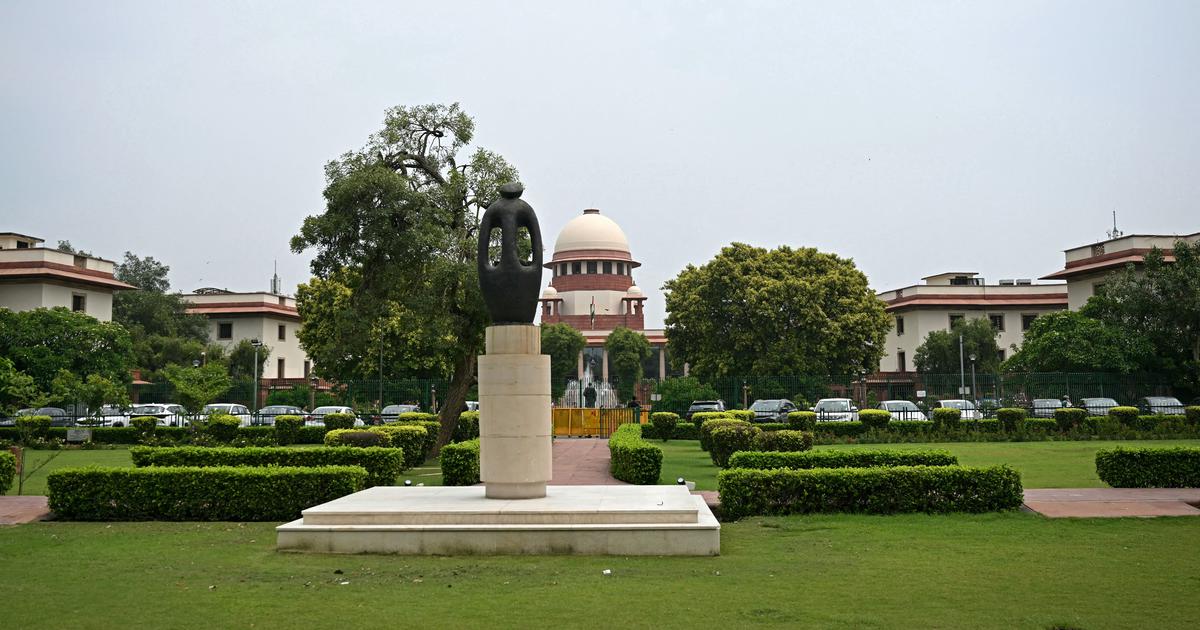
The Supreme Court on Thursday questioned why a Union Cabinet minister should be part of the selection committee that appoints the chief election commissioner and the two other members of the poll panel, Live Law reported.
A bench comprising Justices Dipankar Datta and Satish Chandra Sharma made the observations while hearing six petitions challenging the constitutional validity of a 2023 law that governs the appointment of the Election Commission members.
The Chief Election Commissioner and Other Election Commissioners Appointment, Conditions of Service and Term of Office Act states that the head of the poll panel and the two other members are to be appointed based on the recommendations of a selection committee comprising the prime minister, a Union Cabinet minister and the leader of Opposition in the Lok Sabha.
The composition of the panel means that the government enjoys a 2:1 majority over the leader of the Opposition, if there is a difference of opinion.
The law that was passed by Parliament in December 2023 replaced an arrangement created by a Supreme Court judgement in March 2023 that had formed a selection committee consisting of the prime minister, the leader of Opposition and the chief justice.
On Thursday, Datta remarked that it was not enough for the Election Commission to be independent, and that it also had to be seen as independent.
“The third member should be somebody who is a neutral person,” he verbally observed, according to Live Law. “He should select. Why should it be a minister from the Cabinet?”
He further questioned whether the Opposition leader was merely “ornamental”, Bar and Bench reported.
“It will always be 2:1,” Datta said. “Why do you put up this show of independence in the body? Will a member of Cabinet go against the prime minister?”
Attorney General R Venkataramani, representing the Centre, argued that the court should not strike down a law on account of hypothetical bias.
“We have to eat the pudding to know if it is bad,” PTI quoted him as saying. “Unless the ECs [election commissioners] demonstrate a lack of independence in their actual functioning, the law cannot be held invalid.”
The attorney general argued that Parliament had the absolute right to enact the law, and that it is not bound by the “stop-gap” arrangement suggested in the March 2023 Supreme Court judgement.
He said the earlier ruling was issued under Article 142 of the Constitution, which allows the Supreme Court to pass orders to ensure complete justice, and did not amount to a binding law under Article 141, PTI reported.
Article 142 pertains to the Supreme Court’s discretionary power to pass orders to ensure complete justice. Article 141 states that the law laid down by the Supreme Court will be binding on all courts in India.
Datta observed that the independence of the Election Commission was a constitutional feature because free and fair elections depended on it.
Retired Indian Administrative Service officer SN Shukla, appearing on behalf of petitioner Lok Prahari, argued that the 2023 law did not ensure the independence of the poll panel, Live Law reported.
He described the legislation as “a fraud on the Constitution”, and alleged that a provision replacing the Cabinet secretary with a Union minister in the selection committee was added at the last moment, without a justification being put forward before Parliament.
Referring to the current Election Commission, Shukla said neither Chief Election Commissioner Gyanesh Kumar nor Election Commissioner Sukhbir Singh Sandhu had served as a chief electoral officer in a state, Live Law reported.
Sharma however, noted that IAS officer regularly work as returning officers and election observers.
“They do have the experience in management and conduct of elections,” the judge told Shukla. “They are IAS officers. You were also one. They have worked as returning officers and observers.”
Edited by Sara Varghese.
Also read: Explainer: How Modi government’s new bill aims to wrest control of Election Commission appointments
