









Under UCC, only those with one marriage will have the right to live in Madhya Pradesh: CM
‘If Ram will marry once, why should Rahim marry twice or four times,’ Chief Minister Mohan Yadav said.
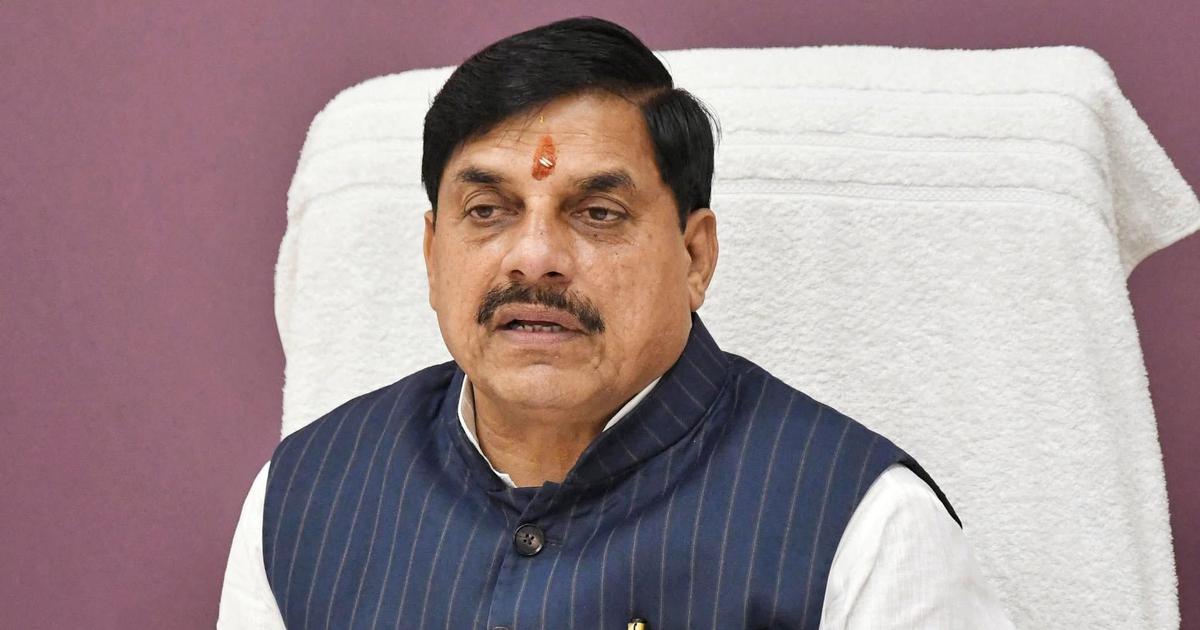
Madhya Pradesh Chief Minister Mohan Yadav on Friday said the state’s proposed Uniform Civil Code would legally recognise only one marriage and that only those with one legal spouse would have the right to live in the state, ANI reported.
The Uniform Civil Code aims to introduce a common set of laws governing marriage, divorce, succession and adoption for all citizens. Currently, such personal affairs of different religions are based on community-specific laws, largely derived from religious scripture.
A government-appointed committee headed by retired Supreme Court judge Ranjana Prakash Desai submitted its draft Uniform Civil Code report to Yadav on Monday, recommending that Adivasis be excluded from the proposed law.
#WATCH | Katni: Madhya Pradesh CM Mohan Yadav says, "...Why should there be separate laws for Hindus and Muslims? There should be one law for everyone. If Ram will marry once, why should Rahim marry twice or four times? Muslim sisters are also our sisters. Under the proposed… pic.twitter.com/rz8nwRNCsQ
— ANI MP/CG/Rajasthan (@ANI_MP_CG_RJ) July 17, 2026
On Friday, the chief minister said that the draft bill would be approved at the next Cabinet meeting. It will be introduced in the Assembly during the Monsoon Session which begins on July 20.
“Why should there be separate laws for Hindus and Muslims?” ANI quoted him as saying. “There should be one law for everyone. If Ram will marry once, why should Rahim marry twice or four times? Muslim sisters are also our sisters.”
Referring to the abolition of instant triple talaq, Yadav said that anyone who said “talaq” three times would be sent to jail, adding that the “era of triple talaq is over”.
Triple talaq allows a Muslim man to instantly divorce his wife by pronouncing “talaq” three times.
The Muslim Women Protection of Rights on Marriage Act criminalises instant triple talaq, or Talaq-e-Biddah, and provides for imprisonment of up to three years for any man who seeks to divorce his wife in this manner.
The Act was notified on July 31, 2019, and came into force with retrospective effect on September 19, 2018. The law was implemented over a year after instant triple talaq was declared unconstitutional by the Supreme Court on August 22, 2017.
BJP and UCC
It has long been on the ruling Bharatiya Janata Party’s agenda to implement a common personal law and several states ruled by the party have made progress towards achieving the goal.
In January 2025, BJP-ruled Uttarakhand became the first state to implement the Uniform Civil Code after independence. The Gujarat Assembly cleared a similar legislation in March amid protests by the Opposition.
The Assam Assembly on May 27 passed the Uniform Civil Code bill seeking to ban polygamy and make the registration of live-in relationships compulsory. The Opposition had demanded that the bill be sent to a select committee for scrutiny.
A common civil code has been in place in Goa since the Portuguese Civil Code was adopted in 1867.
Edited by Tanya Shrivastava.
