









At the Bombay Natural History Society in Mumbai’s Fort district, a jaunty black-and-white hornbill named William sits in profile against a bright yellow disc. The great hornbill is not the only bird to nest on the Society’s premises. There is a comb duck, a sandgrouse and a mallard, among several other species. Happily for intrepid birdwatchers, this flock is unlikely to take flight or swim away.
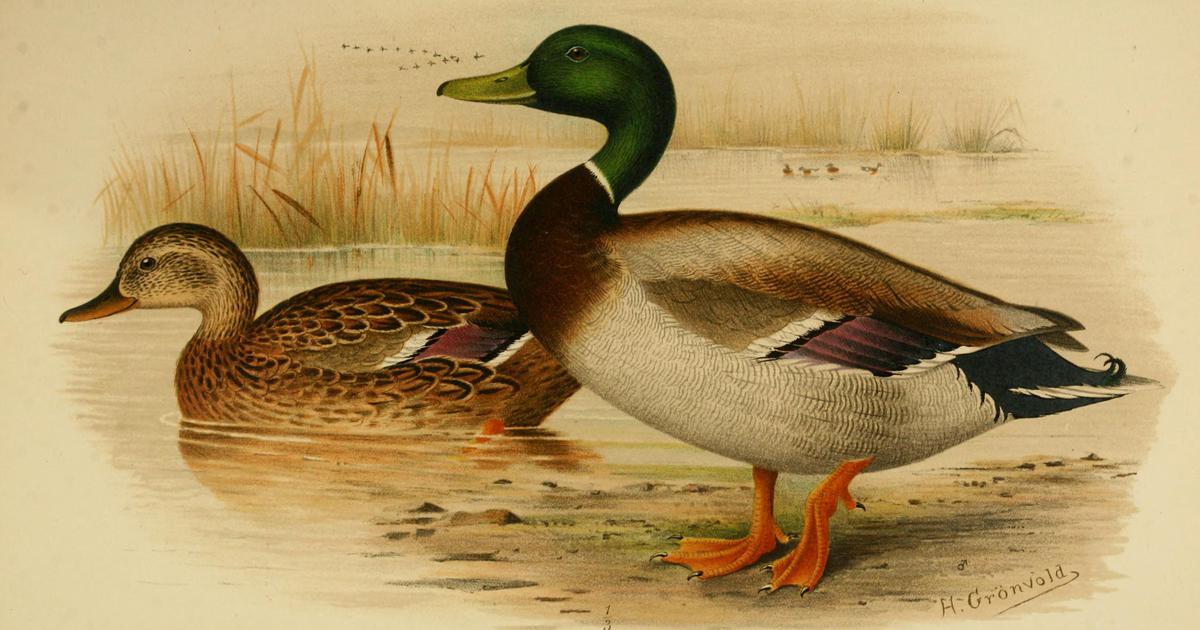
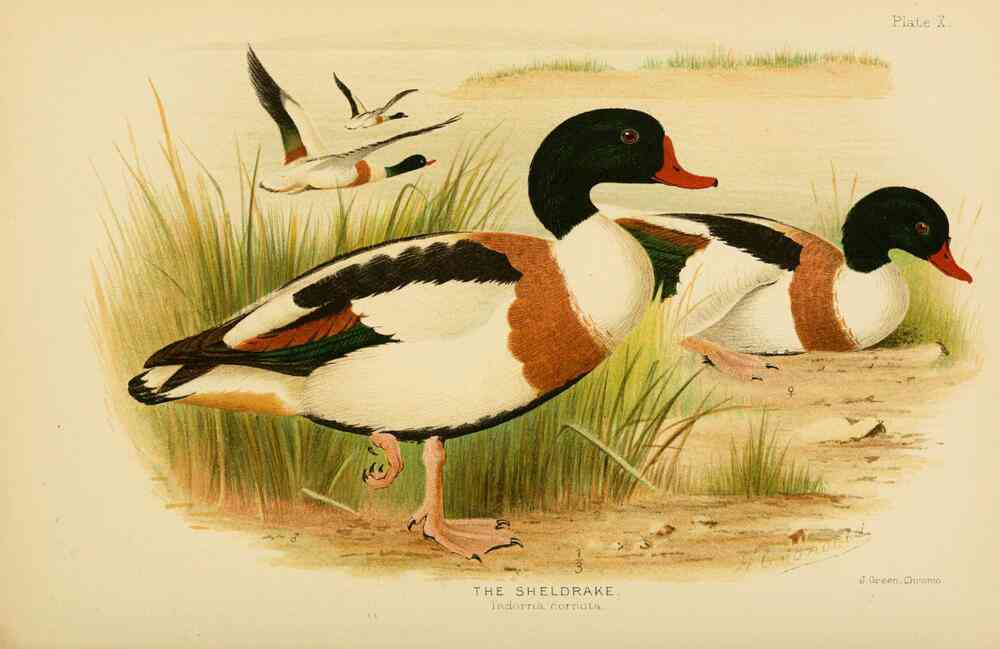
William perches on the facade of the Society’s building, of which he is the logo, while the others wade and waddle only on paper. They are the subjects of rare ornithological chromolithographs from the turn of the 20th century held in the organisation’s library. Slid from large white envelopes and spread across a table, the prints constitute a virtual aviary of vibrant waterfowl, mostly in profile: floating on waters, resting in marshy terrain, gliding low along the horizon. A close quint at the bottom right corner of the prints reveals that all but one are signed “H. Grönvold”, with the remaining plate signed “J.G.K.”.
Commissioned by the Society for its specialist journal, founded in 1886, the lithographs formed part of a series published between 1897 and 1905 under the title The Indian Ducks and their Allies. Compiled by ornithologist and police officer ECS Baker, the series proved successful enough to be issued in 1908 as the Society’s first book, featuring 30 colour plates. The edition was limited to 1,200 copies – “after which the Lithographs will be erased” – a stipulation that made the images particularly valuable at the time.
The signatures on the unbound lithographs belong to two illustrators of this series, among the most celebrated bird artists in 19th-century Britain: the Dutch artist John Gerrard Keulemans and the Danish artist Henrik Grønvold. The collection at the Society holds 18 prints, featuring seven of the 30 lithographs in the book: two sets of six copies signed by Grønvold, a third set of five copies by him, and a stray Keulemans print. A third contributor, the English artist George Edward Lodge, is absent from the Society’s collection. None of these Britain-based illustrators ever set foot in India, and yet their avian subjects appear in natural settings, exhibiting characteristic behaviours as though observed on site.
How were Indian ducks rendered with such fidelity by artists who had never encountered them alive? One possibility is that they relied on field sketches supplied by Baker, who had illustrated early instalments of the series in the Journal of the Bombay Natural History Society himself. Like the 18th-century writer-artist James Forbes, whose drawings of Indian birds were delineated by another artist, then lithographically reproduced, and finally hand-coloured by others., Baker may have provided the basis for Grønvold, Keulemans and Lodge to develop finished plates. Yet given the refinement of the published images, this seems unlikely.
More plausibly, the artists worked from taxidermied specimens dispatched to Britain’s natural history institutions from the early 19th century onward. Consider the book A Century of Birds from the Himalaya Mountains published around 1830 after John Gould, renowned taxidermist and Superintendent of the Ornithological Collection of Britain’s Zoological Society, acquired a sample of skins of the titular mountain fowl. The accompanying lithographs were delineated by his wife, the artist Elizabeth Gould. According to writer Melissa Ashley in her book The Birdman’s Wife about Elizabeth’s life, she prepared the patterns plates and selected the pigments and brush sizes the colourists would use to create hand-painted copies.
The case for stuffed specimens as models for The Indian Ducks artists is strong: Grønvold worked as a taxidermist at the Natural History Museum; Lodge freelanced as one; and Keulemans – who illustrated major ornithological works of the 19th century – “probably never saw the birds alive in the romantic settings he so diligently illustrated”, reports Maureen Lambourne in her book The Art of Bird Illustration. They would have painted in watercolour, a medium praised for its tonal and stylistic versatility.

Keulemans’s practice illuminates the likely production process of the Society lithographs. The Society plates bear the imprint “J. Green Chromo”, identifying the press that produced them. Lithography was especially suited to bird art – as science historian Jonathan R Topham notes in an essay, it offered a distinctive pencil-like tone ideal for rendering plumage and field marks. By the time of the Society’s series, chromolithography had replaced hand-colouring, enabling printers to reproduce watercolour originals with remarkable fidelity.
Colonial menagerie
To interpret the lithographs at the Bombay Natural History Society, they must be situated within a longer history of Indian bird depiction – from the murals of the Ajanta Caves to Mughal atelier paintings and the sketchbook of Raja Serfoji I. After the consolidation of East India Company rule, Indian birds entered the colonial menagerie, both literal and representational. They were documented by British amateurs such as Lady Elizabeth Gwillim and James Forbes as well as by professional Indian artists.
From the mid-18th to the mid-19th century thrived a style of painting known as Company style or kampani qalam. In Indian Painting for the British 1770-1880, Mildred and WG Archer describe it succinctly: although commissioned by the British, it was executed by Indian artists from the disbanding Mughal and provincial ateliers who adapted to European technical and aesthetic norms, such as watercolours, linear perspective and shading. These Indian artists were commissioned by the employees and associates of the East India Company to record the natural and cultural exotica of the colony. Among the prominent European patrons of bird paintings in the late 18th century were Claude Martin, a major-general in the Company’s Bengal Army, and Lady Mary Impey, wife of Sir Elijah Impey, the chief justice of the Supreme Court in Bengal.

In The Lucknow Menagerie: Natural History Drawings from the Collection of Claude Martin (1735-1800), historian Rosie Llewellyn-Jones notes that Martin imported premium drawing paper from Europe and China for local artists to paint birds – pigeons, parrots, cuckoos, partridges, a bulbul and a robin – “probably housed in bamboo cages” at his Najafgarh estate. By contrast, the Impeys’ album of over 100 folios depicting the birds in Mary’s famed Calcutta menagerie was painted by three artists associated with the Murshidabad court: Shaykh Zain al-Din, Bhawani Das and Ram Das.
In Birds of India: Company Paintings 1800 to 1835, curator and art historian Giles Tillotson compared the mises en scène of the two near-contemporary series: “Typically, they [the Impeys’ artists] portrayed each bird perched on a branch of a flowering shrub or fruit tree, or standing against a blank ground, by contrast with artists in Lucknow who frequently included a strip of idealised distant landscape.” The Martin album occasionally seems to tilt towards the Mughal influence on its Lucknow artists, placing fauna in its environment, the stylised courtly idiom tempered by European natural history art’s preference for mimesis. The Impey album, on the other hand, took as its starting point what art historians Toby Falk and Gael Hayter describe in Birds in an Indian Garden: Nineteen Illustrations from the Impey Collection, as the “‘bird on a stump’ convention perpetrated by European illustrators of the day”, yet it drew on the Mughal tradition of perceptive portraiture to vivify its subjects.
Falk and Hayter note that several practitioners referenced the Impey series in their research, including the ornithologist and artist John Latham for his landmark publication A General Synopsis of Birds (1783). This suggests that the images may also have been known to specialist bird artists such as Grønvold, Keulemans and Lodge.

By the late 19th century, a prevailing orthodoxy held that scientific illustrators should represent animals in profile, a convention apparent in the collection of the Bombay Natural History Society. Yet alongside this tenet was an attempt to paint life into the still specimen, echoing the late Victorian ideal of “continual sympathy” with the living being espoused by John Ruskin. The addition of landscape backgrounds, attention to avian behaviour and evocation of movement may reflect older Company-era compositions but they also suggest a deliberate effort to animate taxidermied models. The Society lithographs express an attitude to nature “imbued with a sense of the autonomy and dynamism that truly characterised animals’ lives in the wild,” as Diana Donald writes in Science and Visual Culture in Great Britain in the Long Nineteenth Century.
It is possible to read a humane perspective in these avian tableaux vivants. Yet, the fact that the latter were based on exported taxidermied specimens also points to the late empire’s capacity to observe and report from afar. In an article for Scroll, Jamil Urfi, professor of environmental studies at the University of Delhi, observes that “detailed works on Indian birds by British authors are almost all dated after the revolt of 1857… It may be safe to assume that when control of Indian colonies was transferred from the EIC to the British Crown, it was a relatively settled period for British colonists, often with domestic values coming to the fore.”
The global infrastructure of imperialism enabled not only the export of taxidermied specimens from colonial fields to artists in the metropole, but also the mass production and circulation of images within Victorian Britain’s emergent scientific public sphere.

Promoting science
The 19th century witnessed the beginning of institutionalisation and rationalisation of scientific endeavour in Europe and North America, including disciplines such as ornithology. In her article Science and Society: Scientific Societies in Victorian England, sociologist Eszter Pál says that British science modernised radically in the mid-century, developing structures, rules and criteria while actively cultivating public interest and promoting the idea that science served society at large.
Alongside museums and research organisations, scientific societies for amateurs proliferated, as did richly illustrated periodicals aimed at both specialist and general readers. The Bombay Natural History Society and its journal, for which The Indian Ducks and their Allies lithographs were commissioned, exemplify this moment. In his essay Illustrating Natural History: Images, Periodicals, and the Making of Nineteenth-Century Scientific Communities, historian of science, photography and visual culture Geoffrey Belknap contends that not only were these periodicals a “premier and primary site for the construction of science”, they also played a role “in imagining a British, scientific nation”.
That nation, of course, was a colonial one. The shift in visual production from Company to Crown strengthened an already well-oiled apparatus of extraction through documentation. Historians Pradip Chakrabarti and Michael Worboys observe in their essay Science and Imperialism since 1870 that “European imperial governments saw science as a means to discover and then develop the natural resources of their new colonies. The amateur explorer, driven by curiosity and adventure, was to be replaced by the professional scientist and engineer with the expertise to survey, assess, and advise on the exploitation of natural resources”. As part of the structures of the colonial state, Baker’s documentation, and the lithographs that accompanied it, cannot therefore be regarded as entirely benign.

The Bombay Natural History Society plates were institutionally commissioned and designed for reproduction. They were made possible by the expeditions of colonial administrators and security officials in India, by the export of taxidermied specimens to metropolitan museums and by the reanimation of those specimens into vivid lithographs by artists working at a geographical remove from the birds they depicted. From there, the images circulated within a global community of scientific enthusiasts.
Viewed as a whole, the Society’s popular early 20th-century series on Indian avifauna exemplifies the entwinement of science and art during the Raj, signalling both the institutionalisation of natural history and its popularisation through illustrated periodicals. Where Company paintings were singular commissions produced for elite patrons, these lithographs were conceived for multiplication: printed in journals, bound into volumes and disseminated across an expanding scientific public sphere. The naturalistic representation of the birds does not indicate proximity to life – rather, it reflects imperial science’s capacity to capture, literally as specimen and symbolically as likeness.
At the same time, the consummate quality of the art deserves recognition, and the names of the artists must be retrieved from the shadows of institutional history. Grønvold, Keulemans and Lodge were skilled practitioners whose ability to restore vitality to preserved specimens required both adroitness and imagination. Scientific illustrators have long been relegated to the margins, their signatures often tucked out of sight, their labour subsumed by the institutions and publications they served. The lithographs held at the Bombay Natural History Society – whether encountered in its library or accessed online – invite us to look again, not only at the birds but at the hands that made them come alive. Perhaps, like the natural world they sought to record and preserve, the artists themselves deserve to be taxonomized, their legacy named and remembered.
Kamayani Sharma is an independent writer, researcher and podcaster based in New Delhi. This project was made possible under the Scroll x MMF Arts Writer Grant.
