





Marathi filmmaker Hemant Dhome kicks off 2026 by ringing in Maharashtra Day as well as Teachers Day early. The Jhimma and Fussclass Dabhade director’s latest movie is set in Nagaon in Alibaug, where the Marathi-medium Krantijyoti Vidyalay is under threat.
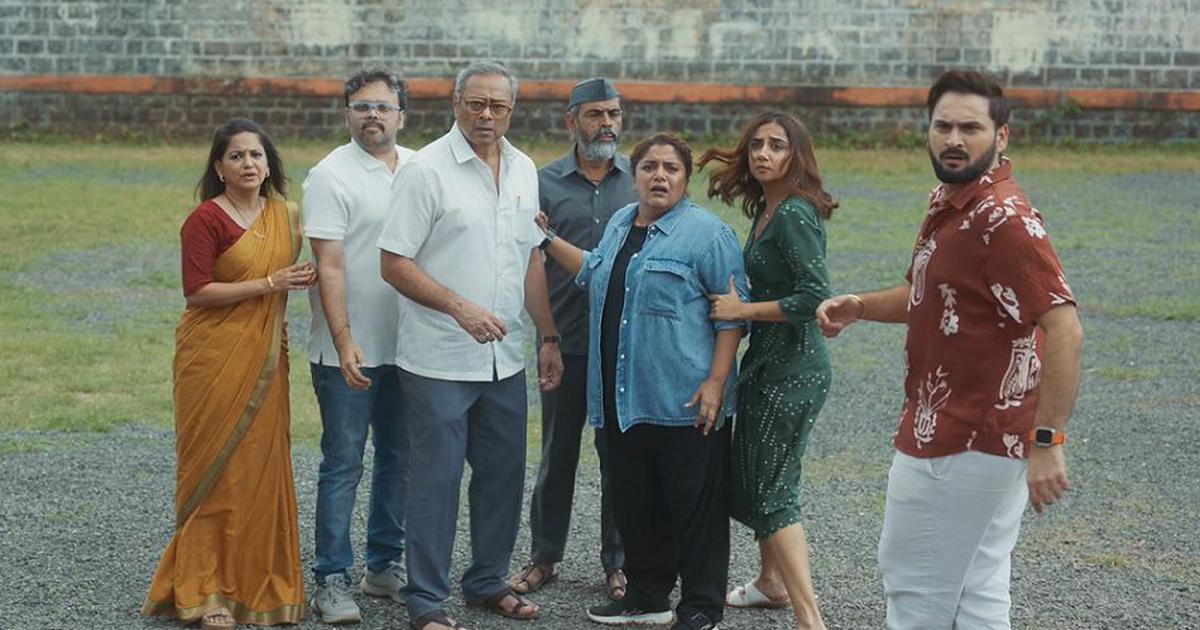
The school run by Dinkar Shirke’s family for generations has been declared a dilapidated structure, to be replaced by an English-medium, swankier structure. Shirke (Sachin Khedekar) rallies his favourite students to save the school. Every one of them has migrated except for Baban (Amey Wagh). Conveniently, all of them are from the same batch, giving their return to Nagaon the flavour of a reunion.
Deep (Siddharth Chandekar), Anjali (Prajakta Koli), Salma (Kshitee Jog), Rakesh (Harish Dudhade), Vishal (Pushkaraj Chirputkar) and Suman (Kadambari Kadam) revisit old pleasures and lasting grouses. The flame between Deep and Anjali still burns, as does resentment. Rakesh and Vishal look up the man who used to sell bhajis outside the school. Salma recalls her time in the classroom as being less pleasant than the others. Baban scampers about like a puppy happy to be reunited with his litter.
For half of its runtime, Krantijyoti Vidyalay affectionately observes adults becoming children again. The episodic-nature of Dhome’s screenplay best suits these portions, in which the pupils remember Shirke’s highly effective teaching methods, gleefully consume orange candies and revel in nostalgia.
But as the teacher Narkevar (Nirrmitee Sawant) reminds the group, they aren’t there on a picnic. They are there to help Shirke outfox the callous developer Jagtap (Anant Jog). They are also there to save Marathi itself.
The film’s agenda, which has been hinted at here and there, soon emerges in full view. Hemant Dhome launches nothing less than a battle cry to save Marathi-medium schools, and thereby the language itself, from erasure.
Some of the scenes feel like television debates about the preference for English-medium schools, the dwindling Marathi reading habit, and the overall lack of pride in Marathiness. Shirke even directly addresses the camera, like a politician in an election campaign commercial.
Dhome is never shrill. He isn’t on an anti-English trip – how can he be, when characters like Anjali and the couple Vishal and Suman live abroad? Nor does he advocate anti-Hindi bashing. Rather, Dhome wants his film’s viewers to embrace Marathi at the school level itself.
By this point, the film is a political tract, rather than a film. Despite picking a worthy subject, Krantijyoti Vidyalay is too simplistic and facile to address the actual problems that affect Marathi-medium schools, or the larger existential crisis that has engulfed Marathi culture.
The movie makes Marathi-saving appear easy-peasy. Jagtap is too foolish to be a serious adversary. While Jitendra Joshi has a cameo as Maharashtra’s education minister, the film never quite confronts the lack of political will in preserving the language.
The Alibaug setting, with its beaches, greenery and pretty coastal architecture, is deceptive too. Some of the biggest hurdles faced by Marathi-medium schools is actually in Mumbai, where a shocking collusion of ministers, bureaucrats and builders is leading an assault on municipal institutions.
A few of Dhome’s progressive ideas survive the messiness. His film offers nothing short of a manifesto for a renewed Maharashtra in which all faiths will be united under the banner of a single language.
The 149-minute movie takes too long to spell out its intent and then keeps wandering off after it has done so. The lack of tight, focused and coherent writing render an enjoyable film about a bunch of affable characters into a slog.
There are fine performances throughout. Sachin Khedekar is perfectly cast as the charismatic, dedicated principal who has set his flock on the right path. Amey Wagh is hilarious as the sweet-natured, shambolic Baban. Prajakta Koli, in her first Marathi-speaking role, is impressive as Anjali, even though Anjali’s ardour for Deep feels as contrived as Salma’s manufactured angst.
