









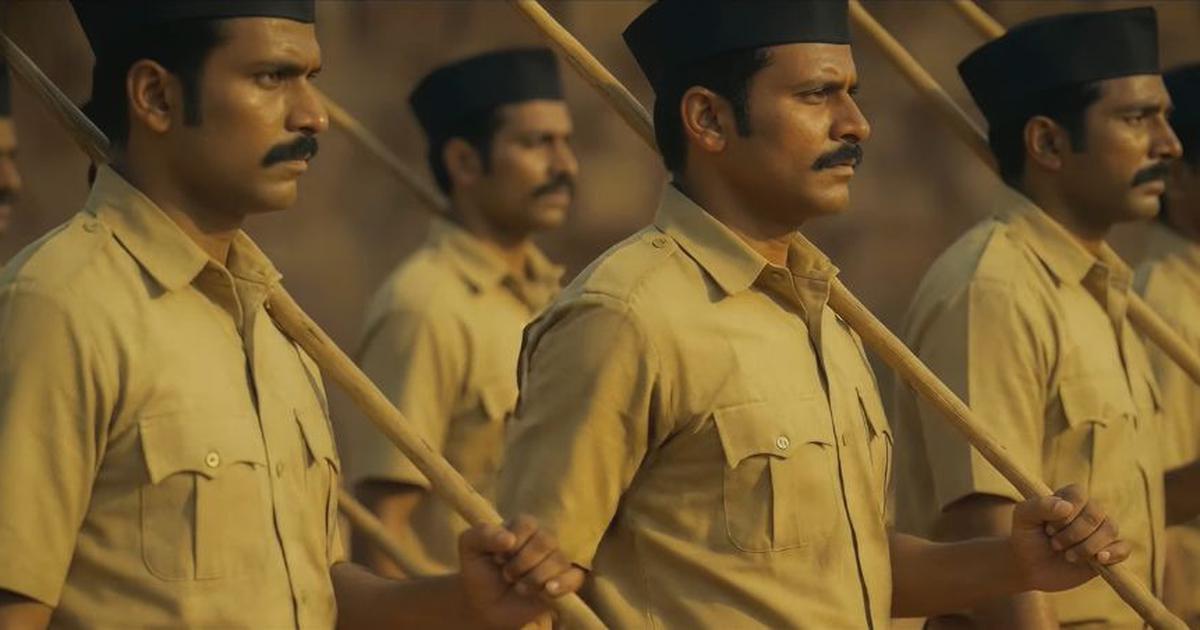
Shatak is recruitment video, tutorial and pat on the back rolled into one. Released in cinemas to mark the Rashtriya Swayamsevak Sangh’s centenary, the propaganda project is well suited to play on a loop in the lobbies of the Sangh’s ever-sprouting branch offices.
Creator Anil Agarwal, director Aashish Mall, a trio of writers, AI and visual effects join forces to give the parent organisation of the ruling Bharatiya Janata Party the perfect Happy 100 gift: a saffron-washed version of pre- and post-Independence history.
Initially revolving around founder Keshav Baliram Hedgewar (whose full name is mentioned several times to aid memory and pronunciation), Shatak presents the RSS as the unacknowledged, deeply misunderstood force behind key events before and after freedom from colonial rule.
This is the history that you weren’t told about, the 112-minute movie repeatedly tells non card-carrying viewers. Under Hedgewar and later his protege MS Golwalkar, RSS members throw themselves into nation-building and nation-saving, with the noble and necessary goal of creating a majoritarian Hindu society, the film contends.
Hedgewar is introduced as the other revolutionary who was thrown out of a first class compartment by racist British officers. This competition with Mohandas Gandhi, as well as a subtle but insistent undermining of the Mahatma’s secular politics, is one of the film’s major themes.
In his early years, the Zelig-like Hedgewar is involved with several anti-British agitations. Bhagat Singh, Lokmanya Tilak and Gandhi rolled into one, Hedgewar works tirelessly to unite Hindus against British oppressors and the community’s historical enemy, the Muslims. From a pro-British teacher at Hedgewar’s school to various dangerous-looking, sword-wielding types, Shatak identifies the Muslim community as an old and permanent adversary.
Golwalkar, first seen as a dashing proto-Dhurandhar type on a cricket field, is an equally avid leader. My home is a train compartment, Golwalkar says as he travels across the country, with an unacknowledged hand in everything between the Indo-China War of 1962 and the Goa Liberation struggle, Shatak claims.
Even Mahatma Gandhi sheds his initial scepticism, warming to the Sangh’s nobility. Endorsements come from other sources too – Tilak, Bhagat Singh, Vallabhbhai Patel, Lata Mangeshkar, an Indian Army officer battling the Chinese in ’62. The parade of alt-history pauses to consider the assassination of Gandhi. “Kisine Gandhiji ki hatya kar di,” it is said. Some random bloke gunned down the icon of non-violence.
The RSS gets a clean chit for the assassination. But the perfidious Congress party, whose own role in the freedom struggle is barely noted, uses Gandhi’s death to ban the RSS. The Congress is far too mired in the muck of politics to be taken seriously, Hedgewar observes. The victimisation of the Sangh all the way until the Emergency foxes its leadership, given how selfless, incorruptible and patriotic the followers are.
Shatak tries to cover all bases. There are asides on why the RSS is represented by the colour saffron, and why some of its leaders opted for celibacy. There are scenes about Bengal and Kerala.
Shatak is dipped in shades of saffron. Even the rubbery faces of the AI-enhanced, video game-like characters who uncannily resemble the actual individuals have saffron highlights.
The film, if it can be called that, states its goals plainly: to clear the RSS’s name and position it as the only way forward if India is to thrive.
The Sangh is shown to be a talent magnet for educated individuals who want to serve their country with a “jhanda and a danda”, a saffron flag and a loudly thumping stick. Other faiths are shown to be charmed by the Sangh’s stellar service – except Muslims.
