

Above the fold: Top stories for the day
1. Nitish Kumar returns as chief minister of Bihar as the Grand Alliance scores a massive victory over the Bharatiya Janata Party and wins a two thirds majority in the legislative assembly.
2. Delhi Chief Minister Arvind Kejriwal called the Bihar results a referendum on the Narendra Modi government at the Centre, proving "that hate politics doesn't work".
3. The Bihar assembly elections saw the highest number of NOTA (None Of The Above) votes polled till date.
The Big Story: Now for the Grand Promise
The Mahagatbandhan has won and decisively, securing 178 out of 243 seats in the Bihar assembly, reducing the National Democratic Alliance to a mere 58. It is being called a victory for plurality, an affirmation of the idea of India and a defeat of the BJP's communal politics. But when this miraculous moment's euphoria disperses, there will still be a very poor and very populous state to govern. The Grand Alliance will have to be greater than the sum of its parts.
This was an alliance forged in defeat, essentially between two charismatic leaders who have represented two faces of Bihar over the last couple of decades. Although both Nitish Kumar and Lalu Prasad started out in the Janata Dal, with similar impulses towards social justice and anti-Congressism, they drifted apart in the 1990s to pursue separate political destinies and become bitter adversaries. Kumar came to power in Bihar in 2005 as the promised antidote to Prasad's "jungle raj", a decade and a half of corruption, poor governance and crime. But the decimation of both the Rashtriya Janata Dal and the Janata Dal (United) in the 2014 Lok Sabha polls convinced Prasad and Kumar to join forces in the state. The Congress, already a ghostly presence in Bihar, decided to throw in its lot with the alliance as well. The volatility of the Mahagatbandhan and the tensions within became apparent when the Samajwadi Party's Mulayam Singh Yadav walked out of the coalition after a spat over seat sharing.
As commentators have pointed out, the alliance scripted a victory out of Kumar's governance record and Prasad's social base. In days to come, this record will have to be maintained in spite of Prasad's suspicion of "development". And as the Grand Alliance casts its eye on the national stage, with hopes of reviving the Third Front, knotty issues of leadership will have to be untangled. Prasad's initial remarks suggest he will lead the charge on Delhi while Kumar manages the state. However it plays out, the partners in the Grand Alliance must show political judgement in sharing power while ensuring stability in Bihar.
The Big Scroll: Scroll.in on the day's biggest story
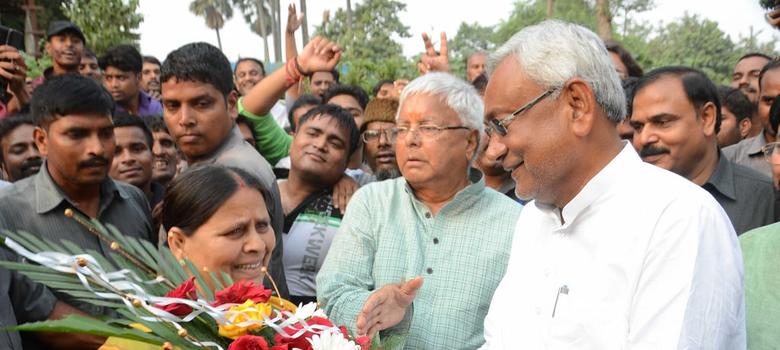
Supriya Sharma witnesses Lalu Prasad and Nitish Kumar's first meeting post victory.
Ajaz Ashraf predicts the Bihar elections will intensify the Hindutva versus liberalism battle.
Anjali Mody on why Prime Minister Narendra Modi is not "sab ke saath".
Sankarshan Thakur looks back on the rupture between Nitish Kumar and Narendra Modi.
Rohan Venkataramakrishnan on how pollsters and TV channels got it wrong and on the implications of the election results, for Bihar, for the BJP and for national politics.
Politicking and policying
1. Soul searching in the BJP after the electoral defeat in Bihar: there was too much pressure on Brand Modi.
2. BJP MPs blame the defeat on Rashtriya Swayamsevak Sangh chief Mohan Bhagwat's remarks on reservations.
3. Sartaj Akhlaq, son of Mohammad Akhlaq, who was killed in the Dadri lynching, calls the Bihar results a "tribute to my father".
4. Government may go the executive route to push through policy reforms.
Punditry
1. In the Indian Express, Prataph Bhanu Mehta calls the victory of the Mahagatbandhan a "regenerative moment" in Indian politics and a blow for hubris.
2. In the Hindu, Sanjay Kumar reads the Bihar verdict as a vote for development, Nitish style.
3. Mukul Kesavan in the Telegraph calls the verdict a victory for the "much-thrashed idea of India".
Don't Miss...
Vipin Pubby on the predicament of the Badals in Punjab:
We welcome your comments at
letters@scroll.in.
1. Nitish Kumar returns as chief minister of Bihar as the Grand Alliance scores a massive victory over the Bharatiya Janata Party and wins a two thirds majority in the legislative assembly.
2. Delhi Chief Minister Arvind Kejriwal called the Bihar results a referendum on the Narendra Modi government at the Centre, proving "that hate politics doesn't work".
3. The Bihar assembly elections saw the highest number of NOTA (None Of The Above) votes polled till date.
The Big Story: Now for the Grand Promise
The Mahagatbandhan has won and decisively, securing 178 out of 243 seats in the Bihar assembly, reducing the National Democratic Alliance to a mere 58. It is being called a victory for plurality, an affirmation of the idea of India and a defeat of the BJP's communal politics. But when this miraculous moment's euphoria disperses, there will still be a very poor and very populous state to govern. The Grand Alliance will have to be greater than the sum of its parts.
This was an alliance forged in defeat, essentially between two charismatic leaders who have represented two faces of Bihar over the last couple of decades. Although both Nitish Kumar and Lalu Prasad started out in the Janata Dal, with similar impulses towards social justice and anti-Congressism, they drifted apart in the 1990s to pursue separate political destinies and become bitter adversaries. Kumar came to power in Bihar in 2005 as the promised antidote to Prasad's "jungle raj", a decade and a half of corruption, poor governance and crime. But the decimation of both the Rashtriya Janata Dal and the Janata Dal (United) in the 2014 Lok Sabha polls convinced Prasad and Kumar to join forces in the state. The Congress, already a ghostly presence in Bihar, decided to throw in its lot with the alliance as well. The volatility of the Mahagatbandhan and the tensions within became apparent when the Samajwadi Party's Mulayam Singh Yadav walked out of the coalition after a spat over seat sharing.
As commentators have pointed out, the alliance scripted a victory out of Kumar's governance record and Prasad's social base. In days to come, this record will have to be maintained in spite of Prasad's suspicion of "development". And as the Grand Alliance casts its eye on the national stage, with hopes of reviving the Third Front, knotty issues of leadership will have to be untangled. Prasad's initial remarks suggest he will lead the charge on Delhi while Kumar manages the state. However it plays out, the partners in the Grand Alliance must show political judgement in sharing power while ensuring stability in Bihar.
The Big Scroll: Scroll.in on the day's biggest story
Supriya Sharma witnesses Lalu Prasad and Nitish Kumar's first meeting post victory.
Ajaz Ashraf predicts the Bihar elections will intensify the Hindutva versus liberalism battle.
Anjali Mody on why Prime Minister Narendra Modi is not "sab ke saath".
Sankarshan Thakur looks back on the rupture between Nitish Kumar and Narendra Modi.
Rohan Venkataramakrishnan on how pollsters and TV channels got it wrong and on the implications of the election results, for Bihar, for the BJP and for national politics.
Politicking and policying
1. Soul searching in the BJP after the electoral defeat in Bihar: there was too much pressure on Brand Modi.
2. BJP MPs blame the defeat on Rashtriya Swayamsevak Sangh chief Mohan Bhagwat's remarks on reservations.
3. Sartaj Akhlaq, son of Mohammad Akhlaq, who was killed in the Dadri lynching, calls the Bihar results a "tribute to my father".
4. Government may go the executive route to push through policy reforms.
Punditry
1. In the Indian Express, Prataph Bhanu Mehta calls the victory of the Mahagatbandhan a "regenerative moment" in Indian politics and a blow for hubris.
2. In the Hindu, Sanjay Kumar reads the Bihar verdict as a vote for development, Nitish style.
3. Mukul Kesavan in the Telegraph calls the verdict a victory for the "much-thrashed idea of India".
Don't Miss...
Vipin Pubby on the predicament of the Badals in Punjab:
"The roots of the agitation lie in the sudden and secretive pardon granted by the Sikh clergy on September 24 to the Dera Sacha Sauda chief Gurmeet Ram Rahim Singh, who had been accused of blasphemy in 2007 for imitating the clothes and gestures of Guru Gobind Singh, the last of the Sikh gurus.
This had led to violence and tension in the state and the Sikh clergy had then issued a Hukamnama or edict calling for social boycott of the Dera chief, who had sought to clarify that he did not intend to show disrespect to the Sikh guru. His "regrets'' were suddenly, after eight years, accepted in September, leading to charges of it being a politically motivated decision.
While the pardon seemed to be the immediate cause, the pent-up anger against the Akali Dal, discredited by years of non-performance and corruption, was further stoked by regular motivated incidents of sacrilege, which is what led to it spilling out on the streets."
