




Transnational male friendship, in RG Salvi’s Whom Enemies Sheltered, locates itself within a wartime memoir-writing tradition of romance and unexpected relationships in the Italian countryside. Eleanor Bass highlights how, following Italy’s Armistice with the Allies in September 1943, hundreds of British PoWs fled their camps, rescued by the goodwill of local Italians who “welcomed prisoners into their communities and secreted them amongst their homes and haylofts”. This resulted in a romanticised literature of Allied evasion in the Italian mountain passes and farmlands, exemplified by Eric Newby’s memoir Love and War in the Apennines (1971), which achieved notable prominence in Britain during the early 1970s. In Salvi’s memoir, anti-colonial feeling is nowhere evident. Instead, his privileged Anglicised upbringing is emphasised, and his love for sport and adventure indicated in his preferences: “Gunn and Moore’s Autograph, or Slazenger’s Queen, attracted me more than did Shakespeare’s Othello or Shelley’s ‘Skylark’.”
Born in Satara in western India, Salvi was studying for a bachelor’s degree at Wadia College in Poona when war broke out. His grandfather had been Chief of the Baroda Army, and in tracing such a military lineage he romanticises his own participation in war: “As a youngster, I had always imagined myself in the uniform of an army officer. Tales of adventure and acts of bravery had always attracted me”. Selected to enlist as a Second Lieutenant in the Maratha Light Infantry, it seems as though Salvi’s route to elite military participation in the Indian Army is secured. Yet even in representations of Salvi’s army life before his PoW years, the memoir anticipates a commonality of feeling in those moments where it pauses for reflection.
En route from Bombay to an unknown wartime destination in 1942, Salvi recalls “many a poignant scene” at the train station, where people from different social classes enact a ritual of leave-taking. To Salvi, the platform itself seems to “surge with emotion”, becoming the site where shared feelings arising from an impending separation from loved ones are expressed:
With malice towards none and love to all they waved to us, cheering, shouting and praying for our safe return. Never before was I so moved. Never did I know that common grief brings us all so close, making us forget our worldly differences, and confirming that below our skins we are all the same.
That differences can be but skin deep continues to form the thematic arc of the memoir. While stationed at Mina Camp in Egypt in April 1942, Salvi receives a letter from home informing him of his father’s death. His initial response is to reach out to fellow officer Maharaja Vikram Sinh [sic] for emotional guidance. Vikram Sinh, or Vikramsinhrao Puar, king of the Maratha princely state of Dewas, had trained with Salvi at the same elite officers’ camp in India, and Salvi feels his empathy keenly at this time of unexpected sorrow:
The next moment Vikram Sinh was by my side. He consoled me as one would a younger brother. The tears, which I had controlled till now, flowed freely now. I sat down and wept. Never before had I known such sorrow. How I wished I had never left the shores of my country! For I felt that our separation was partly responsible for my father’s fatal heart attack.
These emotions of guilt and grief are partially mitigated by Vikram Sinh’s solicitous fraternal nurturing, making him a “true friend”. Sinh is willing to give up his own leave and accompany the battalion to the front, so that he, Salvi, could go home to India for a period of bereavement. Even though Salvi decides against this course of action, he feels “a sense of gratitude towards this noble-hearted man. He was not merely a king but was endowed with kingly qualities too”. Throughout his interactions with Sinh, then, Salvi remains keenly aware of rank and royalty, providing us with an idealised portrait of a gracious Indian gentleman and ruler. Nonetheless, the textures of this relationship also reveal shared moments of fragility and tenderness between Sinh and Salvi, and it is such encounters that transform Mina Camp itself into an intimate male space across the divides of privilege.
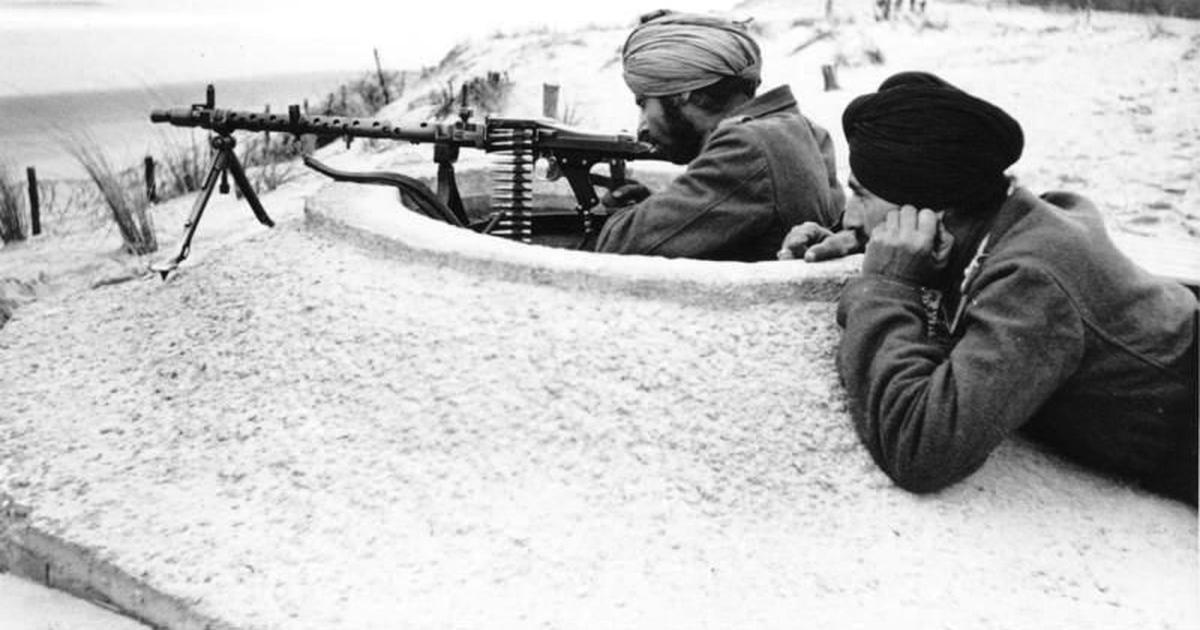
When Salvi finally finds himself on the battlefront at Tobruk in modern-day Libya, he is stationed with Indian Sikh, Gurkha and Muslim soldiers as well as the Scottish Cameron Highlanders.
Rather than religious or racial difference, he emphasises the “feeling of oneness” of military life, along with the strong homosocial bonds he feels for British and Indian servicemen, drawing upon the “shared codes of martial masculinity” analysed by Rosalind O’Hanlon in pre-colonial north India, discussed previously in this chapter. He writes:
A Sikh would greet you with ‘Sat, Siri, Akal’, while a Gurkha would salaam with a ‘Jai Ramji Ki’, and the Marathas responded with a ‘Ram Ram Saheb’. To the Camerons ‘Oich Ayah’. Occasionally a Muslim would pass you with his ‘Salaam-a-lekum’. Quite often the jawans would greet a comrade in the other’s language. While we were there, the thought of language, religion, country or colour never entered our minds, nor did it affect in any way our admiration for one another.
This may seem a romanticised depiction of colonial military life, a nostalgic evocation of the past in the forty-odd years that separated Salvi’s lived experience of war from memoir writing, particularly since his memories are being filtered through a post-Partition, communal lens. Nonetheless, he creates a democratic space within the narrative through the use of words such as “comrade”. The battle cry of the Maratha Light Infantry – “Bolo Shri Chhatrapati Shivaji Maharaj Ki Jai” (“All hail King Shivaji!”) – also becomes a collective shout, and Salvi observes: “Strange as it might seem today, even our British officers never hesitated to join in this battle-cry before launching an offensive”.
It appears to be colonial military service itself, experienced as an Indian officer, that makes Salvi recognise the existence of a larger male fraternity, across racial, linguistic and religious separations.
At the Battle of Gazala during the Western Desert Campaign led by Rommel’s Panzerarmee Afrika in June 1942, Tobruk transforms for Salvi into a desert battlefield where violence and intimacy rub uncomfortably, and sometimes exhilaratingly, against each other. Taken as a PoW by a German officer, Salvi finds a revolver on himself that he had forgotten to declare. In the midst of “the dead and the dying”, he shoots his captor from behind with it: “I pulled out the revolver, and mercilessly emptied the chamber into the back of that fine young officer”. Salvi’s memory lingers admiringly on this German officer, on his youth and physical form even as he recalls this act of killing. Is there a trace of regret in the comment that follows soon after: “How elusive was victory for him!”? Or, instead, is this evidence of the “thrill of destruction”, as Joanna Bourke terms it?
A little while later, Salvi is woken up from the trench in which he had taken shelter by the groans of a wounded British sergeant. He tells us: “Unmindful of my own injury, I took him close to me and bandaged him. Then I took out his flask [of brandy] and helped him to have a swig”. Nursing the sergeant overnight in his arms, Salvi is recaptured by enemy forces in the morning, by which time the sergeant has died. While analysing the emotional lives of British soldiers on the Western Front during the First World War, Michael Roper has compellingly demonstrated the importance of soldiers’ relationships with their mothers, and the emotional sustenance generated by those men who themselves took up a mothering role on the frontlines.
For Salvi too, the act of nurturing becomes a crucial aspect of forging relationships with other men. In the same “unforgettable” night, he crosses racial boundaries twice, first by becoming a killer but then also a carer, offering physical tenderness and drink to the dying British sergeant. These moments of heightened emotion and male intimacy culminate in an extraordinary interaction, this time across enemy lines, with a German officer and captor, who drives him in the morning to the aerodrome at Tobruk from where all PoWs were being transported to their camps. Depression engulfs Salvi on seeing so many PoWs under German control: “A look of defeat and despair was seen stamped on every prisoner’s face. It was indeed a dismal sight and made me feel sick and miserable”.
Perhaps this German officer, whom Salvi calls a “kindly soul”, realises some of Salvi’s unspoken emotions. He gifts Salvi a blanket from his own belongings, shakes his hand and wishes him well. Salvi notes with a mixture of surprise and pleasure: “I was an Indian officer from the Allied army and as such his enemy. Despite this he had treated me with dignity […] War is not a mere slaughterhouse after all – it has its soft and tender moments too!”. “Soft” and “tender”, much like Crasta’s “simple” and “kind”, then become part of Salvi’s vocabulary in representing male bonds on the battlefield in the memoir, despite their transient nature. This German officer’s unexpected gesture of friendship forges a lasting moment of affinity between two men sharing military rank but separated by political and racial allegiances. There is even a forlornness in Salvi’s tone, an undercurrent of the sorrow of separation, as he writes of being left at the aerodrome, blanket in hand, after the German officer’s departure: “His jeep drove off leaving clouds of dust and smoke behind. I stood there watching it silently till it disappeared into the distant desert land”.
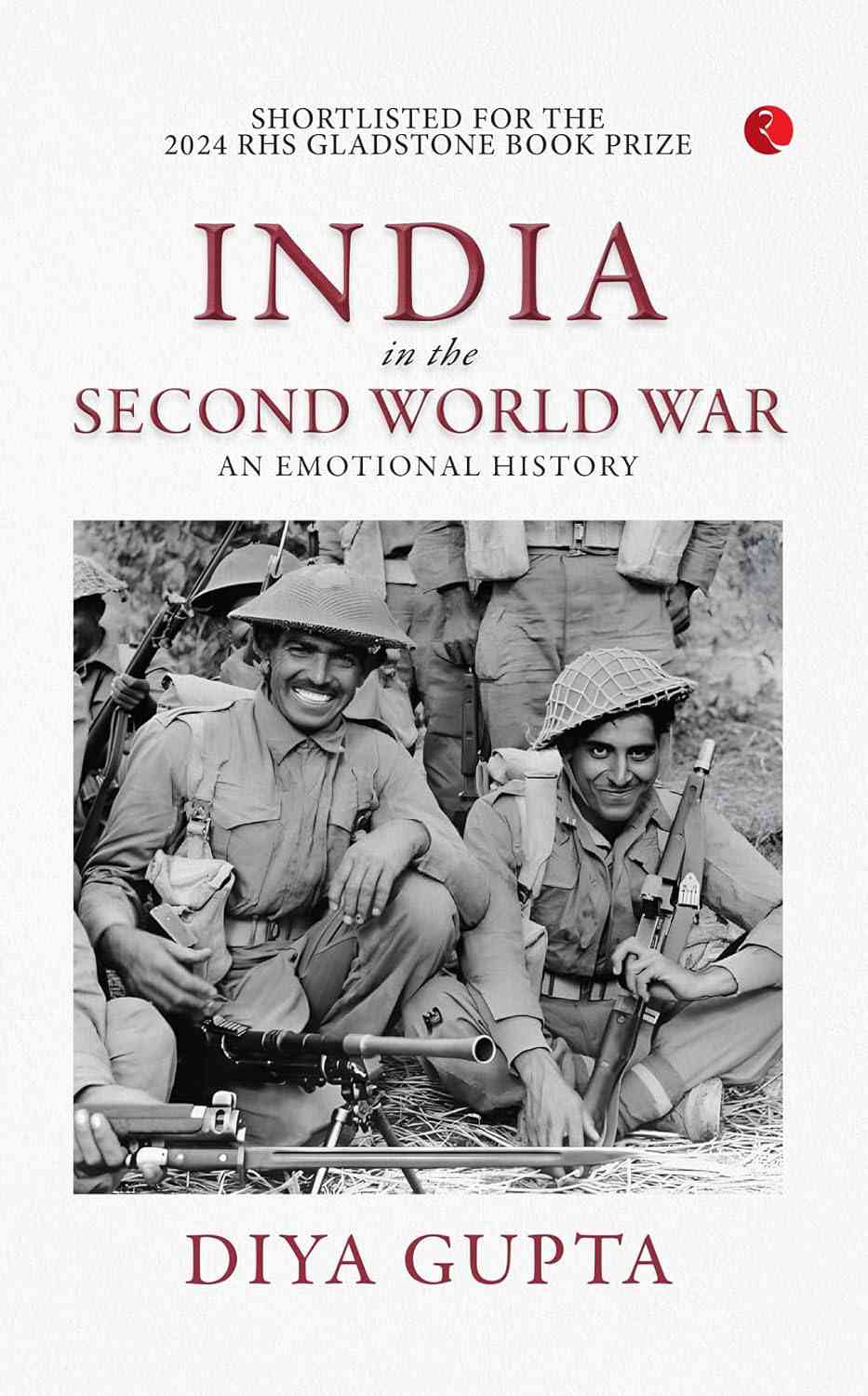
Excerpted with permission from India in the Second World War: An Emotional History, Diya Gupta, Rupa Publications.
