


There is nothing more shameful in our house than waking up before dawn.
Snuggling up under the blanket cosily, waking up now and then, and going back to sleep again curled up against each other, even after the sun is out white and bright – this majaa, the joy of sleeping in, I’m pretty sure no one knows better than us.
Sometimes when my mother tried to rouse us early for school, the God that our father is, the most merciful and the most compassionate, he’d say, “Mey! Are my children going to rule kingdoms or what, waking up so early?! Let them sleep for a while,” and hugging my younger brother close to his chest, wouldn’t wake us up until we got up on our own.
At the time when my father was handing down to me and my elder brother this carefully guarded treasure of oversleeping, my sister too turned up, saying, “Are you the sole heirs? Why not me?” and laid claim to the inheritance. Truth be told, when it comes to sleeping, our younger sister stands head and shoulders above us – if we are ser, she’s sava ser! If we are sleep, she’s stupor!
“This Ammi is sleeping like a log even at this young age, when she grows up she’s definitely going to get her mother-in-law to do all the donkey work,” my grandmother would say, amazed at my sister’s ability to sleep.
Besides my grandma, my mother too got up early in the morning, and just for the heck of it, came by and jabbed words in our ears now and then: “The whole town is up, yet these father and children won’t wake up!”
We never let that disturb our sleep though.
Because of our habit of sleeping in late, we did suffer a few petty losses here and there, but nothing so serious as to take into account, really.
My father had no problem working into the wee hours of the night – one o’clock, two o’clock – puffing on cigarettes and drinking tea, he’d work on with eyes wide open like empty boxes. But ask him to work before daybreak and he wouldn’t budge, not if you showered crores at his feet.
Whenever one or the other Reddy chased my father down early in the morning, “Babbabu! Naayana! My dear fellow! My good man!” trying to cajole him into fixing pipes in the slab or a motor in the well, my father would get up bleary-eyed, give them jhoota bharosa (just stretching the truth a little!) – “Don’t worry, bhai! You carry on, I’ll be right there in five minutes” – and then go back into the house to sleep, not tossing off the blanket even after ten. And for this reason alone, sometimes work that was to come my father’s way fell to someone else’s share.
Coming to me, my one sweet loss was permanently bunking early morning parvet! Since I joined every tutorial only after laying down the condition that I wouldn’t attend morning classes, I got punished at home only if I didn’t go in the evening. Mornings were excused.
All through my study life I hung on to this habit with the panache of a Sheikh Chhote Nawab. Though classes in our Jawahar Bharati college began at seven-thirty in the morning, thanks to my late-rising habit, I never had to commit the sin of attending the first period. Only once though, in senior Inter, I was forced to eat crow because of this habit. Our Prasad aivoru, as if he bore me a grudge, began taking Maths tuitions at six in the morning. There are no words to describe the pain I felt at that time. Unable to wake up so early, for a while I attended a class here, a class there and finally chickened out completely. The result? My goose nearly got cooked – I barely made it out alive in the final exams, somehow scoring the exact passing marks and missing an F by the skin of my teeth. Because of the body blow dealt by this one subject, I ended up with a second class in Intermediate.
Fine, whatever. Forget all that. Come, let me tell you how we make hot-hot tea soon after we wake up in the morning.
Whenever my father got a quarter kilo or 100-gram packet of tea, guzzling four cups a day, we’d polish it off in a wink, so tea in our house meant a new Bismillah every day, a fresh new start every morning!
Only after my mother went to old Setty’s shop and returned with five ten-paise or two quarter-rupee Superdust packets hanging on the string, did our tea get made. If she got four quarter-rupee ones, it meant we were going to have strong tea that day. (We used to tear the quarter-paise and ten-paise pictures on these packets and use them as cash in our games.)
After she’d brought the tea packets, we’d all wait patiently until the tea was made, but the instant she strained it into the round chembu – Attack! We pounced on her. Ah! What a divine feeling it was…Drinking piping hot tea with slimy teeth and slobbering mouths! (All you brush-teeth-and-drink-tea wallahs are simply missing out on this taste, abba!)
Sometimes when we woke up late, all the milk would’ve been sold by then, right? But no worry – we’d still get our tea. My mother would hand me a rupee coin and a washed steel chembu and say, “Rey abbaya! Go to Krishna Otel and get him to pour five strong teas in this.”
Once the Tamilian in Krishna Otel was done pouring the tea, covering the chembu with a vistaraaku leaf, I’d dash home so fast, the tea would still be steaming hot when I got there. (But whenever tea was brought from the hotel, a quarrel followed at home for equal portions. All of us would hold out our glasses and crowd around my mother for “some more, ma, some more,” and my mother would pretend to tip the chembu just a little and act as if she was pouring out tea.)
While we were leading our lives like this, fighting over tea and waking up to broad daylight instead of dawn, there came a day when all of us woke up in the wee hours of the morning.
It was the day of “Aakhree Chahar Shumba”, The Last Wednesday! The day we went to bathe in the sea.
That day, Shammi’s father brought an empty lorry covered with a tarpaulin sheet, and at first light, everyone in our street climbed into it. As we made our way to the sea at Tummalapenta, we could not help but stare open-mouthed in amazement at every little thing on the way – the cold breeze, the ash-coloured clouds, the sparrows that had already woken up, the empty streets. Because from the time I was born and became aware of my surroundings, I had never seen these things at this time of the day.
When we reached the sea, instead of going straight into the water, all of us slumped down in the sand, to see the sun who was about to wake up too.
Before long, on the other side of the sea, floating on the water, who should come up but the pink candy-coloured sun!
We were thrilled to bits. “Hoy! Sooreej!” we screamed, waving our hands to welcome him. Along with us children, even the adults gazed at the sun with their eyes peeled, as if they were seeing him for the first time.
My mother who was sitting with my younger brother in her lap made him wave his hands too. It was then that my father, sitting next to my mother, rather than keep his mouth shut, yawned and said, “Looks like getting up early is not such a bad idea after all, mey!”
My mother stopped waving my brother’s hands and gave my father a scorching look.
This man, who forgot home when at work and work when at home and the world itself when asleep, this jewel of a man, my father, who no matter what was happening in the world, thought “why bother?” and carried on with his own life, to this man my mother shot a frosty glare and replied, “You don’t need to wake up early, my Lord. It’s enough if you just wake up,” before turning around to look at the sun again.
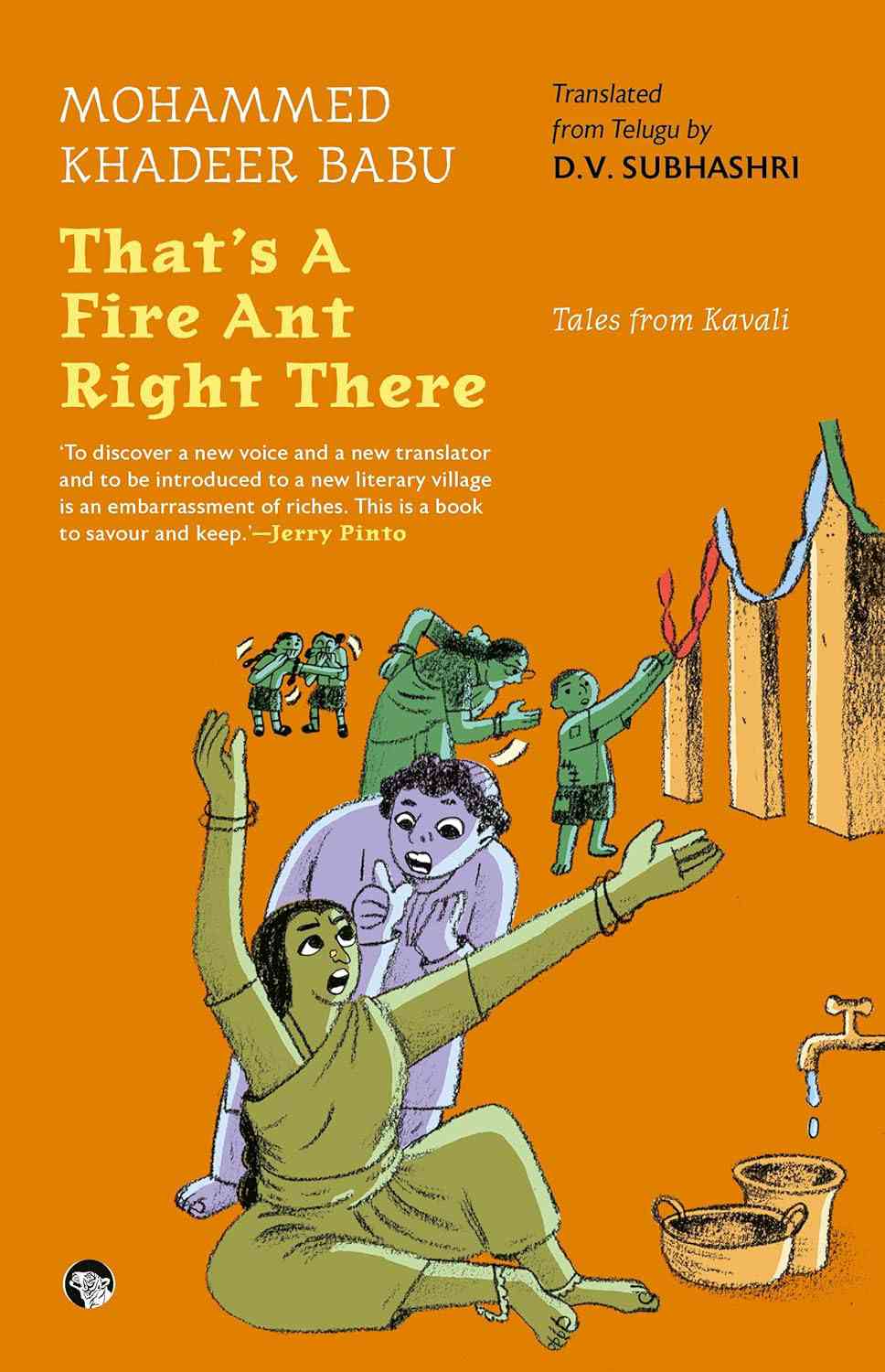
Excerpted with permission from ‘The Fortune Our Father Left Us’ in That’s A Fire Ant Right There!: Tales From Kavali, Mohammed Khadeer Babu, translated from the Telugu by DV Subhashri, Speaking Tiger Books.
