



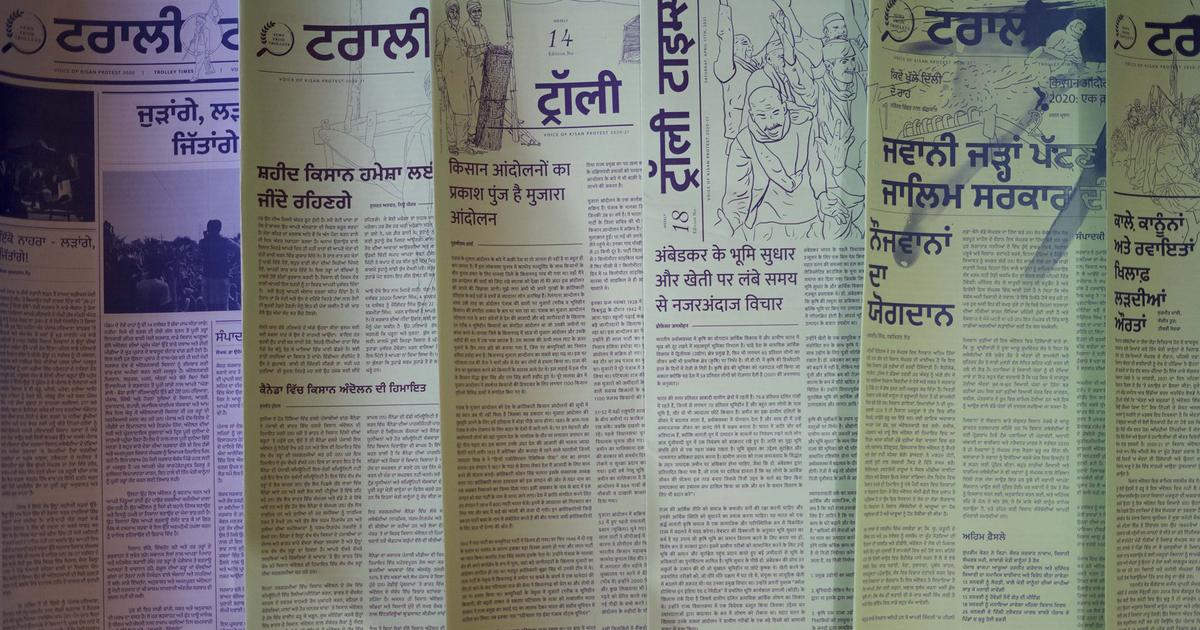
The most potent response to Godi Media, during the farmers’ protest, however, was the establishment of the campaigners’ own media – initially in the form of daily broadcasts from the main stages on YouTube or Facebook, then with print and social-media platforms. Organised and inspired by a group of cultural activists and organisers, the news sheet Trolley Times was first published on December 18, 2020, only a few weeks after the march to Delhi. In Punjabi and Hindi, with a healthy use of line-drawn imagery and photography, the news sheet was meant to keep “people warm in the cold” while negotiations proceeded, as Surmeet Marvi, a Punjabi screenwriter and one of the founding team, said in an interview: “I was sitting with Gurdeep Dhaliwal, a photographer from Punjab, and in Narinder Pinder’s trolley when the idea of a voice for the protest was conceived. Not only to provide sustenance for the movement but also to reach the outer limits of the occupation where farmers were sat without any means of getting to the main stages.”
The impetus from these activists was for the voices of those sitting on the roadsides to be articulated and circulated amongst themselves, which is why the initial issues were only in Punjabi and Hindi. Over its 22 issues, the newsletter took on a life of its own in aesthetic terms, as the internationally acclaimed, Delhi-based fine-arts team of Thukral & Tagra provided line drawings illustrating various aspects of the campsites. Organisational praxis came from the Kirti Kisan Union and, in particular, Navkiran Natt and Mukesh Kulriya. Ideologically, the newspaper stressed the efforts of women and daily workers in driving and sustaining the struggle, mixed with poetry, prose, and biographies. Trolley Times offered a lens on the breadth of the movement, but with an emphasis on its most progressive elements.
The transnational attention the newsletter ultimately garnered demonstrates how something completely organic to the campsite – created by a series of artists, writers, and cultural activists with a physical circulation of a few thousand – captured a global audience. As shown in the previous chapter, the stages were controlled by the farm unions and their agenda, whereas Trolley Times offered an independent voice that reflected those elements marginalised by the male, dominant-caste voices loudest on the stages. Diasporic contributions took the form of translating articles into English and circulating the publication online. In the UK, a team of comrades transliterated the text into Persian script to make it legible to those in Pakistan, and articles were circulated in progressive magazines there. This transnational response ultimately led to an English-language mini-book, Trolley Times: Voice of Kisan Protest 2020. Back in the land of tractor-trolleys, the farmers’ unions themselves then started to produce imitation newsletters, which briefly circulated but did not carry the same impact as Trolley Times. Largely, this was due to the media-savvy team behind the newspaper, but also because its presentation tapped into progressive international circuits that were looking to support the farmers yet were not linked to the farmers’ unions or organisational structures. Ultimately, social media played a huge role in catapulting Trolley Times onto the international stage – and it was this arena that became the site of an intense virtual conflict between the demonstrators and the regime.
The digital space was employed directly by the SKM and the other farmers’ unions. Misreading these “simple” farmers – and misnaming them – was a constant mistake by the Modi regime. Whilst the farmers’ leadership was of a generation that deployed a daily press conference to convey their messaging, in the background, a digital ecosphere that consisted of young, educated farmers – often students in higher education was operating. Initially, individuals set up supportive accounts such as Tractor2Twitter, which also became the title of a popular song in the style of the folk tune Jaggo (“wake up”). The song’s refrain pithily sums up the intergenerational shift: “young people rising, and those who drove tractor-trolleys are now driving Twitter!”’ By mid-December, a group of supporters – some of whom were IT professionals – consulted with the farmers’ unions and set up the Kisan Ekta Morcha tag on multiple social-media platforms. The purpose of these sites was to generate counternarratives to the state, as one of the members reported:
So, let’s say a news channel is doing some propaganda against the farmers…Because we cannot keep an eye on everything, people would send us links to that page, the website, or the Facebook post. We would just pick up the information and then decide and discuss how we needed to answer [the propaganda]. We will just tweet the answers, and those guys [from Twitter groups] would further share our tweets…(Ally Participant).
Social media was enthusiastically deployed by the farmer-digital activists in two main ways. Firstly, by responding to online state propaganda, in which hashtags would rapidly delegitimise the farmers’ demands. Hashtag mimicking would create a stalemate. For example, when the hashtag #FarmersTogether was used, the counter would be #IndiaTogether, or #AgainstModiPropaganda would be challenged by the BJP IT cell with #IndiaAgainstPropaganda. A more pointed and direct set of social-media attacks was coordinated by the state through the #RealSikh hashtag, which basically accused anyone who posted about the farmers’ plight of being a Khalistani.
These assaults on Twitter, Facebook, and Instagram were organised, as such networks usually are, through a series of fake accounts that repeated the same content with identical personas. These manually operated accounts used pictures of celebrities and common names to generate multiple accounts and then spew propaganda. They were deployed to spread misinformation, doctor photographs, and offer false stories which, in turn, would be circulated by the mainstream Godi media as “facts from the ground”. Counter-narration by the protesters relies on being able to tell the “truth”. However, in the instantaneous, mediated world of imagery, soundbites, and rapid response, presenting a ground reality is often complex and open to debate. Creating confusion is a strategy that benefits the state and is difficult to respond to. For example, exaggerating the number of demonstrators in a crowd would normally be considered positive for the farmers, as it would evidence large-scale support. However, these images could be created by the state with an accompanying narrative of the nation under attack, thus extenuating the use of excessive force. Promoting images of police violence, deceased farmers, and women beaten to the ground was circulated to deter people from coming to the border.
Finally, playing to their usual audience, accusations that Muslims were disguising themselves as Sikhs and infiltrating the camps would circulate with doctored images of Sikh men doing namaz and women in burqas in the crowd. Again, this belied the actual presence of Muslim farmers in solidarity and common alliance, rendering them only in religious garb to stir communal animosity. Social-media platforms enable counter-publics or counter-narratives to dominant discourse within the overall algorithmic logic of increasing activity (the basis for profit generation). However, it is the controversial or sensational that gains traction, and this is fertile ground for state-sponsored trolls.
The second role for the media platforms was mobilisation and education of the public. Hashtags for boycotting Ambani’s and Adani’s companies were circulated, as were notifications about, and subsequent reporting on, specific actions. Feedback on the negotiation rounds, activities taking place at the encampments, and merely tracking the expanse of the multiple sites were all roles taken by these digital activists. Their success can be gauged by the fact that the Kisan Ekta Morcha Facebook page had garnered 9.4 million followers by the end of December 2020, when the Indian authorities asked for it to be closed down. Understanding that the state could always shut down social-media sites, organisational practice took place with a group-texting infrastructure. This was as multi-layered as the organisation at the encampments themselves, which was networked and consisted of volunteer hierarchies. Messages passed through the structure of the union hierarchy: from the state, to the district, to the block, to the village, and then to farmers via chains of WhatsApp messages. Other messenger systems, while available, were not prevalent amongst the community and were avoided. However, decisions were always made through face-to-face deliberation, thus eluding misinformation circulating – a known limitation of messaging platforms. Each technological innovation developed through capitalist logic contains inherent contradictions that can be utilised by liberatory movements, within a recognition that the structure is biased towards those in power. Physical presence at the encampment, living in close quarters, emerged as a key base from which the many fissures that social media opens (through disinformation, trolling, and gaslighting) could be congealed. As a site of contestation, the digital sphere spanned the length and breadth of the struggle.
Excerpted with permission from Hope for Everyone: The Indian Farmers’ Protest, Virinder Singh, Speaking Tiger Books.
