





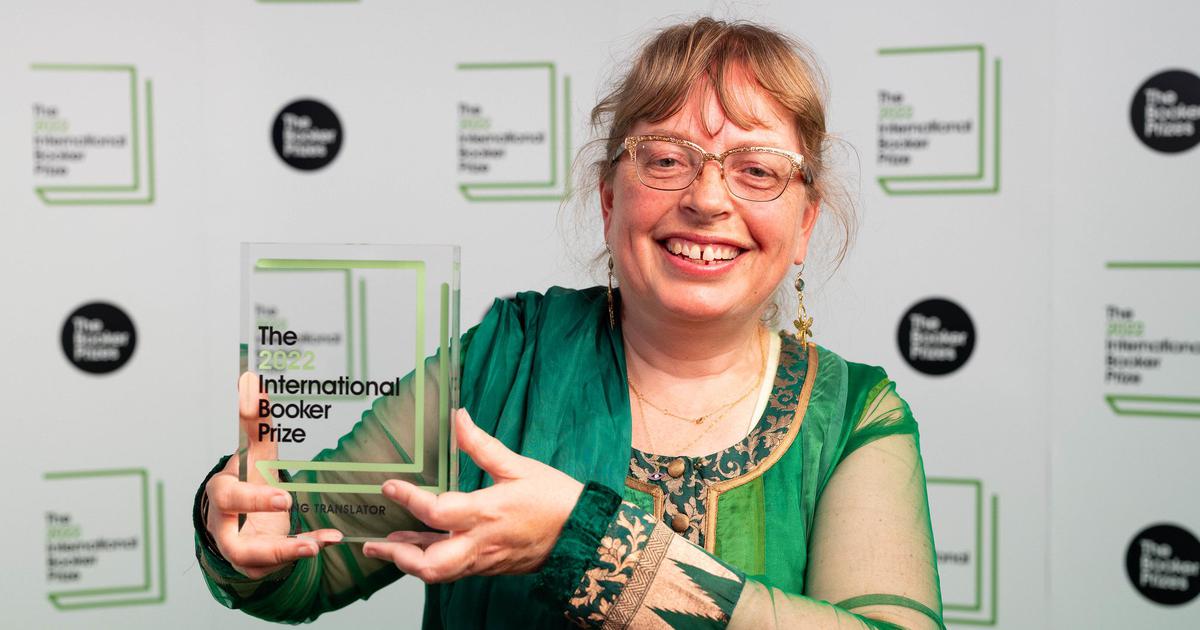
Look closely at International Booker Prize winner Daisy Rockwell’s work, and you will see a pattern emerging across the books that she has translated from Hindi and Urdu into English.
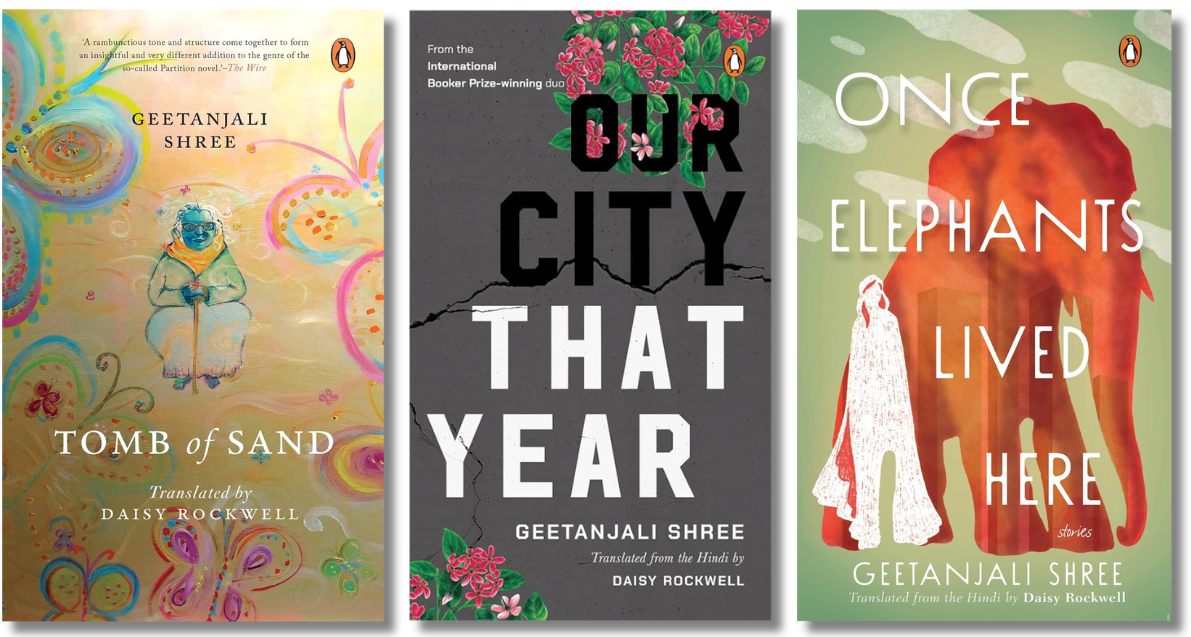
Religious extremism and sectarian violence are recurring themes in Once Elephants Lived Here, her translation of Geetanjali Shree’s short story collection Yahan Hathi Rahte The, and in the novels Tomb of Sand and Our City That Year, which Rockwell translated from Shree’s Ret Samadhi and Hamara Shahar Us Baras, respectively. The former has an 80-year-old woman “confronting the unresolved trauma” of Partition by travelling from India to Pakistan, and the latter is based on riots that followed the demolition of the Babri Masjid “along fault lines of faith and ideology”.
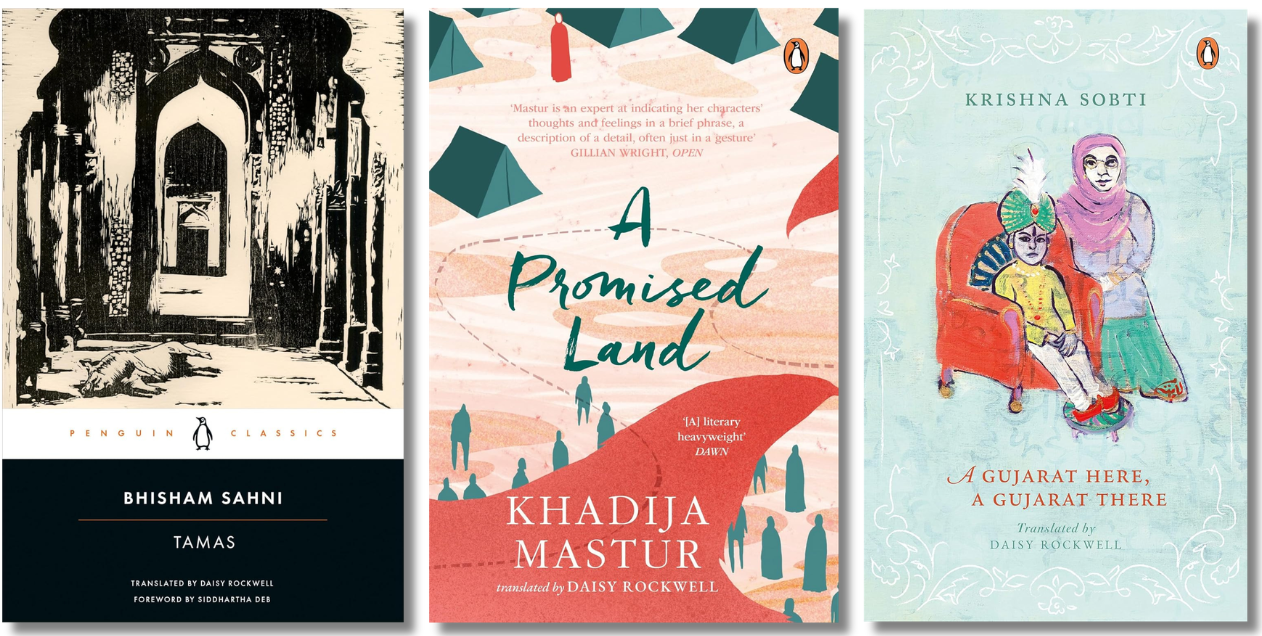
Previously, Rockwell translated Bhisham Sahni’s novel Tamas, which bears witness to “an orgy of bloodlust” in undivided Punjab, and Krishna Sobti’s Gujarat Pakistan se Gujarat Hindustan (A Gujarat Here, A Gujarat There), grieving the “loss and dislocation” after the Partition of the Indian subcontinent. The same themes appear in The Women’s Courtyard, Rockwell’s translation of Khadija Mastur’s Aangan, dealing with “the claustrophobic lives of women” in the 1940s with “Partition looming on the horizon”, and The Promised Land, a translation of Mastur’s Zameen examining the lives of Partition refugees “swept up in a welter of chaos and deprivation”.
Her pet themes also find their way into in The Little Book of Terror, which fights war propaganda with Rockwell’s paintings and essays critiquing the Global War on Terror led by the United States.
In a conversation with Scroll, the translator opened up about translating Once Elephants Lived Here and writing Mixed Metaphors: The Art of Translation. She also reflected on the political affinities and humanitarian solidarities shaping her professional journey, particularly in the context of the genocide in Palestine and institutional responses in the United States. Excerpts from the interview:
Religious extremism and sectarian violence are recurring themes in your books. Is this a coincidence, or are you building a body of work that holds a mirror to our times? Why?
Thank you for noticing! The first Hindi novel I ever read was Yashpal’s Jhutha Sach (translated by his son, Anand, as This Is Not That Dawn, published by Penguin Classics). It is a lengthy and incredibly detailed novel about the 1947 Partition, set in Lahore and Delhi. Because I was not used to reading whole books in Hindi, reading it slowly had a profound impact on me intellectually. Since then, I have always focused on translations that have something to do with the Partition itself, or the ongoing partitions that continue to happen in South Asia and elsewhere.
As the era of extractive colonialism came to an end, the retreating British and European powers left debilitating power structures in their wake. The India-Pakistan partition was not the only devastating line the British drew on a map. Palestine was partitioned the same year, into Israel and Palestine, kicking off the escalating cycles of violence that have existed in that region ever since. These partitions and the end of foreign rule displaced millions of people and uprooted communities that had been settled for centuries. With that kind of churn, we see an endless upending of traditions and fates and that makes for incredible literature. I am drawn to such literature because it shines a spotlight on injustice and forces us to think about what ethnic cleansing does to individuals and societies.
When you read Geetanjali Shree’s short story “Yahan Hathi Rahte The” (translated as “Once Elephants Lived Here”) for the first time, how did you respond to it? What associations did you make with other fiction that you have read?
I love that story because it is so enigmatic but at the same time, it clearly lays out the violence of segregation and ethnic cleansing. It contains echoes of her novel Our City That Year, and also the story “These Days,” which is in the same volume. She is able to talk about violence with a kind of irony that is fascinating to me.
The narrator in “Once Elephants Lived Here” works for an Israeli insurance company. I thought about the genocide in Palestine while reading your translation: “And why would there be any memory, when all the villagers and the fields and the elephants and the elephant keepers are gone?” It was first published in Hindi in 2012. As someone who is vocal about her solidarity with the people of Palestine, how do you read this?
Yes, I think Geetanjali is very committed to readings of her work that go far beyond India. She tends to stick to allegorical or non-specific language to allow our minds to wander to Palestine and all the other places and peoples who have been displaced by communalism or sectarian violence. Tomb of Sand is the exception to this rule because it is so specific to the India-Pakistan split.
In the same story, buildings have been “purchased by the government for a pittance and turned into guest houses or tourist offices” Others have been “bought up for dirt cheap by private companies and turned into five-star hotels.” This sounds like the plans that President Donald Trump and US Special Envoy for Peace Jared Kushner have drawn up for the reconstruction of post-war Gaza. How do you feel when reality turns out to be more unbelievable than fiction?
Fiction isn’t so much about telling stories that are fantastical or exaggerated. Often, it helps us organise the implausibility of reality in a way that we can process it. This is why fiction is essential to the survival of humanity, and AI robots will never be able to write fiction because they are not trying to make sense of anything at all but simply churning out words and filling pages. It is only thanks to fabulists such as Bram Stoker that we can make sense of a real-life character such as Jared Kushner, whom I am sure no one has ever seen in sunlight.
In the past, you have been critical of PEN America’s decision to prioritise wealthy donors over at-risk writers. Apart from taking a principled stand against the genocide, how can cultural institutions in the US provide material and moral support to Palestinian writers and translators?
Well, they can publish them, and after they publish them they can publicise those books. Attitudes in the US towards Palestine are in a state of radical transformation, and the established order has not caught up. Publishers, grant-giving agencies, political parties, universities, all kinds of venerable institutions are in the process of getting caught flat-footed in a mind-blowing and historical shift in sentiment towards the plight of the Palestinian people.
PEN America President Dinaw Mengestu resigned in response to Lisa Tolin, Geraldine Baum and Malka Margolies’ article “A Silent Moratorium” published on the organisation’s website. This article is about the “hostility, discrimination, and hate” being faced by some Jewish and Israeli authors who have been asked by literary agents to remove Jewish characters and Israeli references from their novels because Jewish and Israeli identity “won’t sell”. What do you think about the resignation, and the Palestinian Campaign Against the Cultural and Academic Boycott of Israel (part of the broader Boycott, Divestment, Sanctions movement)? Are you open to having your fiction and nonfiction translated into Hebrew?
One way you can tell that BDS is an effective tool for protesting against the Israeli government is that an enormous amount of money has been thrown at suppressing the movement, at least in the US. I have close friends in Israel who strongly advocate for participation in BDS because they see it as one of the only methods available for fighting injustice against Palestinians. One of these friends had to leave Israel because of his open support for the boycott. I actively participate in BDS myself, as do the other members of my family. Does that mean I am against having my work translated into Hebrew? No, because no language is the exclusive property of any nation state. If there was some situation in which something I had written could be translated into Hebrew and not published in Israel, I would welcome it. Of course it is unlikely, because most Hebrew publishing takes place in Israel, but still Sally Rooney was apparently able to make this happen, so the option exists. In the case of PEN America, I absolutely endorse Dinaw Mengestu’s statement and his resignation. As he has put it, the time for boycotting PEN America is over, and now it’s time to walk away and build something new. The organisation has long positioned itself firmly on the side of Israel and actively worked to silence Palestinian voices. This is obviously the exact opposite of what PEN chapters are supposed to be doing.
Your solidarity with Palestinians goes back a long way. It did not start in response to the genocide unleashed by Israel after the Nova Festival Massacre executed by Hamas on October 7, 2023. In 2002, when Yigal Bronner, your former colleague at the University of Chicago, refused to go for mandatory military reserve duty in the Occupied Territories, the Israel Defense Forces sentenced him to 28 days in confinement. You, along with Wendy Doniger and Sheldon Pollock, helped generate global attention and advocated for his release. How do you look back at that time?
My solidarity with the Palestinian cause even predates Yigal’s 2002 imprisonment. Yigal and I attended graduate school together in Chicago and carpooled to campus on an almost daily basis for a couple of years. He taught me many things, both about the Middle East conflict and Sanskrit poetics, and I still make use of all that knowledge to this day. Starting in 1997, I taught at Loyola University Chicago for several years. I had many students whose families had immigrated from South Asia and parts of the Middle East. Those students were very concerned about the injustices experienced by Palestinians in Gaza and the Occupied Territories. They asked me to help them bring speakers to campus to talk about the issues and we were able to invite the famous Palestinian historian Rashid Khalidi who inspired us all. Those days in the ‘90s and early 2000’s radicalised me deeply on this topic, and I am sorry to say that none of the warnings one heard then turned out to be hyperbolic because things are so much worse now.
In Geetanjali Shree’s short story “These Days”, which you mentioned earlier in this interview, the narrator says, “But fear isn’t a straightforward thing; it doesn’t always pop up for clearly discernible reasons. It blows about madly in the breeze, and wherever it goes, it’s apt to invade anyone who accidentally inhales it.” Can this be said of publishers as well, who might engage in self-censorship to protect themselves? Does their fear invade authors, too, who feel discouraged from writing what they want to?
Definitely! It is often the impulse behind “obeying in advance” under authoritarian regimes.
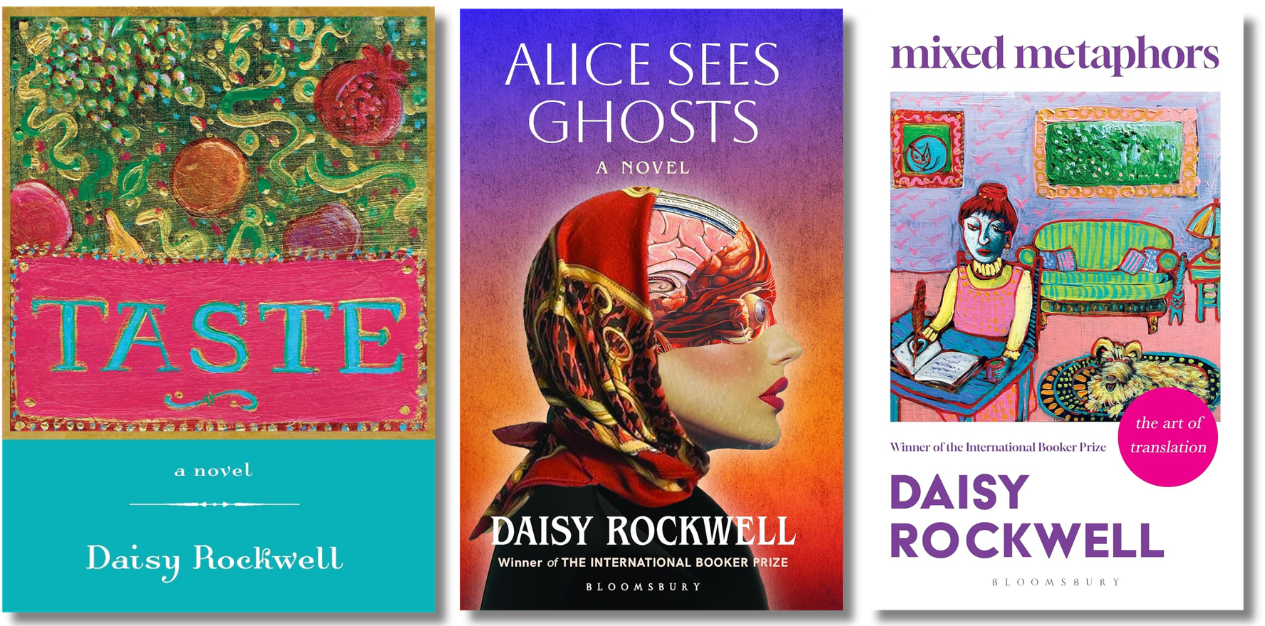
You have another new book out. Mixed Metaphors is a humorous and insightful contemplation on the art of translation. How does your practice as a translator draw on what you learnt from AK Ramanujan, who was your professor at the University of Chicago?
Yes, my understanding of what it means to translate really began with a seminar I took with Professor Ramanujan in 1992, but since he was taken from us so soon after, I have had to build my philosophy on my own ever since. What I loved was how pragmatic he was about translation. Nowadays, people often speak of the art of translation in very abstract and sometimes misleading ways, but I never heard him do that. I have repeated this many times, but his pronouncement on the use of footnotes in translation was “every footnote is a confession of failure.” That one line is my bible.
Fifteen years after he died, some students and teachers found his essay “Three Hundred Ramayanas: Five Examples and Three Thoughts on Translation” blasphemous and said that it hurt their religious sentiments. There were protests and counter-protests. The matter went to court. A few years later, Delhi University’s history department dropped it from its syllabus. What did this episode teach you about translation, scholarship, publishing, and Indian politics?
It taught me that people are cowards and that there are those who have an inexplicable desire to make polytheism more like monotheism. Why would you want that? Polytheism and polyphony should be and have always been a source of incredible strength.
Most of your books were out in India before you signed contracts in the US. What does this say about the American publishing industry and the appetite for translations from Hindi and Urdu? If someone with your publishing history and family name found it so hard to get her books out, what are the chances for Indian writers who aspire to get a book deal in the US?
It says that the American publishing industry has no interest in South Asian literature in translation. Many of my books will never make it to my country because there is no appetite on the part of the super-white publishing industry. SALT (South Asian Literature in Translation, a project at the University of Chicago that funds translations of South Asian literature) is helping to make some headway but the whole thing is pretty discouraging, and any translator will be able to hand you a great list of all the publishers that have rejected their work in the US and UK.
What do you think of Penguin India’s decision not to distribute your fellow writer and artist Joe Sacco’s graphic novel The Once and Future Riot? Like many of your books, it talks about weaponising religious identity to spread hatred and commit acts of violence. Are the risks and pressures different while publishing fiction and non-fiction? Or do you think this might have more to do with the fact that he is the creator of Palestine, Footnotes in Gaza and War on Gaza?
Joe Sacco is an exemplary graphic novelist who has always spoken truth to power. That quality is not a good fit in societies that are rushing to embrace authoritarianism by “obeying in advance.” We see a lot of people and institutions obeying authoritarian diktats in advance, i.e., before they are even issued, in the US these days, and sadly, that behaviour is nothing new across South Asia either. I am very much looking forward to reading the book myself. I am a huge fan of Sacco’s work on Palestine and Bosnia.
Chintan Girish Modi is a writer with a background in peacebuilding. He has worked with Insaaniyat, the Kabir Project, the UNESCO Mahatma Gandhi Institute of Education for Peace and Sustainable Development, the Prajnya Trust, the HRI Institute for South Asian Research and Exchange, and Women in Security, Conflict Management, and Peace.
