





One day in February 2019, when we were just over seven months in our NPA [Non-Performing Asset] journey, the two of us found ourselves in the small, tight bylanes of Kurla, in the fringes of the almost-slums neighbouring Mumbai’s tony Bandra–Kurla Complex.
We were looking for a “solid” investor. But we were completely perplexed and almost lost.
The two brokers, Vishnu and Rao, who had got us to this “pucca-your-work-will-be-done-here” meeting place looked befuddled and uneasy in these surroundings.
“You said you knew these guys would deliver on our requirement … don’t you know them? Haven’t you been here earlier?” asked Dhimant.
As soon as these words were out of his mouth, we realised it was too late in the day to be asking this basic question. This was the first time we were trying to meet investors who were not white-collar professionals, and we were completely at sea in this new landscape of individual investors.
The 1% Hope principle inspired us to continue till we crossed this phase. It was a philosophy that became our guiding light for many decisions as we looked for an investor or a buyer. There was no right or wrong here, no prejudices – we just kept moving ahead on hope. We took to it because this philosophy reminded us of what the character of Andy Dufresne says in one of our favourite movies, The Shawshank Redemption: “Hope is a good thing, maybe the best of things, and no good thing ever dies.”
Hope was all we had, and being hopeful was what we decided to be. Our choices make us what we are at the end of the day. This is how we got into never-give-up mode!
With these thoughts in mind, we had started widening our sphere of investors. In fact, we got another nudge in this direction when we started receiving forwards on WhatsApp from acquaintances about Imagicaa. People (brokers or wannabe investment bankers) we didn’t know had created detailed documents on WhatsApp describing our company data, loan amount and potential settlement value. These documents were being sent without any restrictions across WhatsApp. Some enterprising people even had the gall to put a footer with their name to show that it was their document. We were becoming famous for all the wrong reasons!
Since we were becoming famous, or infamous, we decided to listen to whoever turned up with a solution and give them a fair and patient hearing. It was interesting to see the perspectives people came with because they could go either way – some made us look at the same thing in an interesting new light, while some made us laugh out loud. Either way, it broke the monotony of the day. That’s the simple reason of why we were lost in the bylanes of Kurla.
The reality was a little more complex.
Our so-called problem-solving brokers, Vishnu and Ra,o were also apparently newbies to broking. One of them, Vishnu, was a former tabela (dairy cattle shed) owner! Vishnu’s tabela had become a prime property during one of Mumbai’s expansion periods, when the city loosened its belt to provide for overflowing demand. He had monetised his real estate for an astounding amount. Now that he had lots of money and ample time to spend, he had decided to become a broker and get more deals with his newly acquired skill. He and Rao had been vetted over a few rounds of discussion by Amarnath, a member of our accounts team. They had a fair idea of the amount we were looking for because Amarnath had repeatedly told them that we needed at least Rs 700 crore to tide over the debt.
“Don’t worry, I know that this investor has much more than the required funds,” Vishnu had said after eliminating other investors from his “list”. Despite the assurances and the weeks of discussions with Amarnath, we were bemused when Vishnu said that this was also the first time he was meeting with this wealthy investor, the solution to all our problems!
Mayuresh had earlier gone with Rao and Vishnu to meet one of the gatekeepers of the investor, called Guru Rajput, to check the investor himself first, before they met Dhimant.
As he entered the chosen conference room, a group of men stood up. Then the sea of men parted, and a giant of a man walked towards him, holding out his hand. His confident steps and arrogant walk were reminiscent of Spot Anna from the film Pratibandh.
Tall, muscular and bearded with long oily hair, this was Guru, the proposed investor. He was clad in a white kurta pyjama, and three thick golden chains dangled around his neck. A few gold bracelets and chains were on his wrists and multiple rings on his fingers. Guru was everything you would picture a Bollywood bhai to be.
Guru began the conversation by saying, “I have a bungalow in Kharghar, but I have come all the way here because you are a good party.” Was this said to flatter Mayuresh or give himself an air of importance?
While talking to new investors, Mayuresh always looks for points that can help him tick them off as being credible. In Guru’s case, he quickly said that the deal would be done through a very premier law firm in Mumbai because they were his “seth’s” lawyers. Hearing the name of this particular law firm gave his credentials a green tick – a reputed Parsi firm like this one would only have credible clients. Then Guru said that they could give much more than Rs 700 crore. “We can give around Rs 1000 crore.” This again sounded like music to Mayuresh’s ears.
After that successful meeting, Mayuresh also checked up on the company details of Guru’s “seth”. Quick research on ZaubaCorp about Guru’s company showed a registered company with a car fleet business. All these tick marks – the premier lawyer, the reaction to Rs 700 crore and the legitimate nature of the owner’s company made us feel that we were possibly heading somewhere relevant and interesting.
A few days later, we were asked to assemble at a certain address in BKC. When we were halfway there, we received an updated address in Kurla East. It was a congested area and, as we had never quite been to that part of Mumbai, we relied on Google Maps to take us there. At one point, it became evident that going ahead in a car would be impossible because the lanes were too narrow. We left our car behind and went ahead on foot. Turning another bend, we saw another alley of narrow crisscrossing lanes and that’s when Mayuresh made a quick decision on a gut feeling – he quickly shared our location on Google Maps with an office colleague saying, “Last seen at X”. We were definitely concerned for our safety, so this was a backup measure.
The two of us soon found ourselves walking through lanes that were no wider than the full stretch of our arms, with narrower pathways crisscrossing in between. Finally, Google Maps informed us that we had reached our destination. Looking around, we found a huge compound with several cars parked on our right that opened to an old, dilapidated building with peeling paint and rusted shutters. By this time, we were ready to imagine the worst because it seemed like we had just survived a Bollywood movie chase scene.
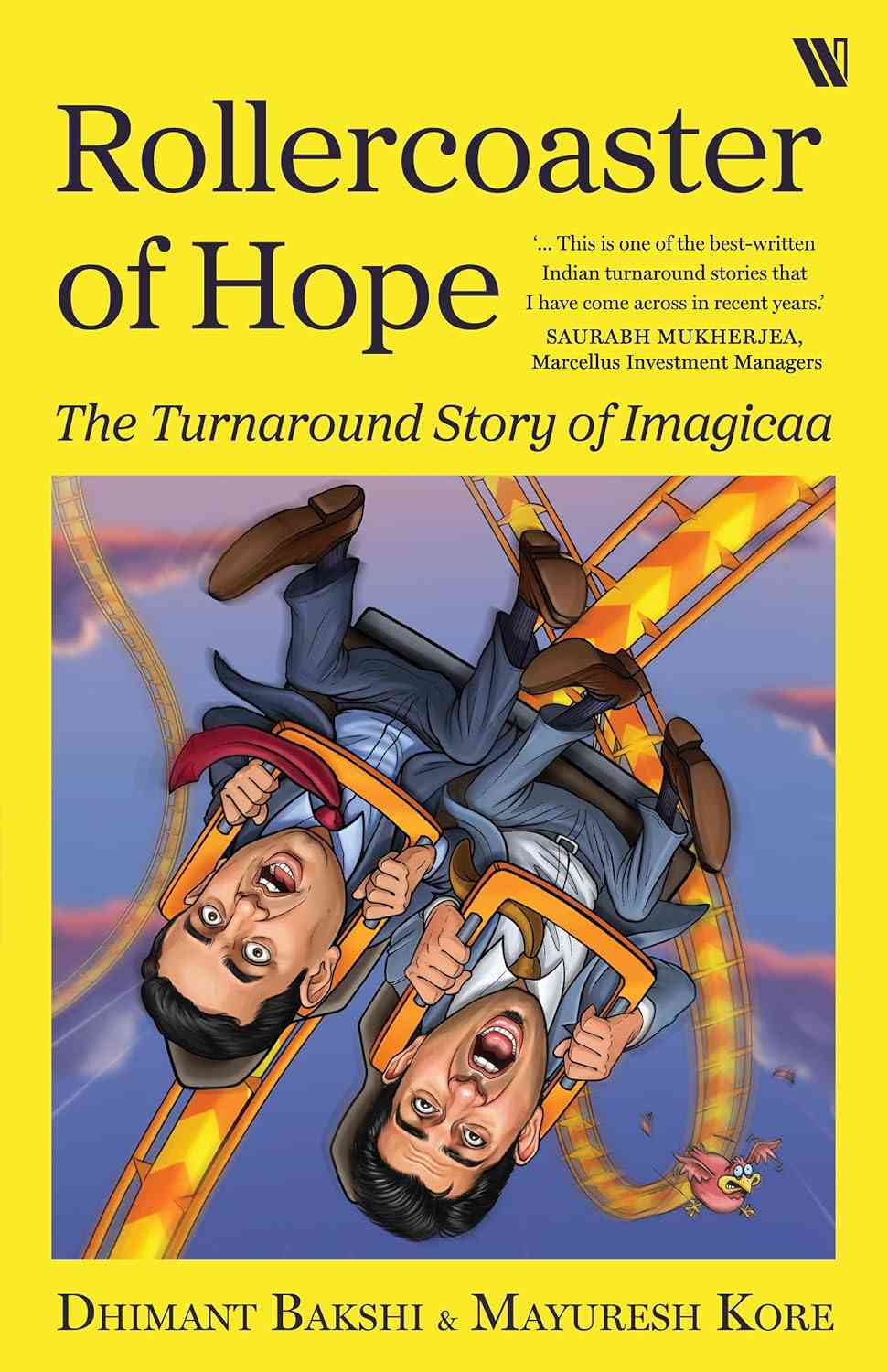
Excerpted with permission from Rollercoaster of Hope: The Turnaround Story of Imagicaa, Dhimant Bakshi and Mayuresh Kore, Westland.
