










The summer before he turned forty, he lived in New Haven, on its High Street, in an old apartment building. Its exposed brickwork, when he saw it the first time, reminded him of the gas chimneys in Dachau. In the spring of that year, he had been offered a fellowship at Yale. When he received the email in Delhi, he realised that there was a chance to live in solitude after a long, long time; that, at last, he could find space to think without disruption.
The apartment was close to the repertory theatre. It was on the sixth floor and comprised a large living room, bedroom, kitchen and bathroom. He checked into it well past midnight, after being helped with his two suitcases by the driver who had picked him up from JFK and who, en route, finished eating a big bag of oranges. An administrative staffer of the fellowship programme had kept bread and milk and tea bags on the kitchen slab in anticipation of his arrival. If he looked out of the kitchen window, by whose sill he later kept a pot of African violets, he could see, on the street below, a bicycle locked to a pole. He didn’t spot anyone take it for a ride; he did not ask the building manager, but he assumed that some student had left it there and had gone back to his life elsewhere.
The bedroom came with a closet that had extra linen and a giant vacuum cleaner. He used the vacuum cleaner once a week after he had done his washing. There was a big brown couch in the living room, with a TV in front of it. The deluge of pharmaceutical advertisements depressed him, so he never switched it on.
On the other side of his bedroom wall lived a young scholar who suffered from incessant bouts of coughing, over which he continuously played “Nessun Dorma”. Sometimes, they’d pass each other in the corridor, where the scholar would smile without making eye contact.
Five days a week, after working briefly at his office in Horchow Hall, he’d walk past the repertory theatre, crossing the homeless man sitting on his chair, who always looked straight ahead. At that moment, he’d remember an old picture of Meryl Streep, who had performed at the repertory as a student of the school of drama. In it, she was kneeling in front of her partner, John Cazale, in a Shakespearean drama, Measure for Measure, which played at the Delacorte Theatre in New York’s Central Park in 1976.
Two years after that performance, Cazale died of lung cancer.
He’d enter the Book Trader Café, past its racks of used books, and order a coffee, taking the corner table outside, his back towards the small wrought-iron gate. And he would wait for Annie. At exactly fifteen minutes past one, she would walk in, put her arms around his neck and kiss him. The kiss was the reason why he always sat with his back towards the gate; he wanted it to surprise him, as if he were not expecting it at all, as if it were not supposed to happen.
Annie smiling, her eyes half closing in the process – he would take her hand in his and caress it, gazing at her hair that was a million hues of gold.
She was a PhD scholar working on the Holocaust; her parents knew Philip Roth well.
Annie drank coffee from his mug, and they shared a tuna sandwich – her favourite.
Most evenings, they walked around, hand in hand, past the red emergency buttons installed all over the Yale campus. Sometimes, Annie took him to her department, where a Fellini film was always on, and someone passed around slices of pizza. On weekends, they went for dinner to a small Italian restaurant near Papa John’s. It was run by two sisters who knew Annie and with whom she spoke in Italian. After the elder sister brought in fresh bread, she’d look at him and say, “Hey, Neel, go easy on the bread. It will make you fat like me.” Then she’d wink at Annie, making her laugh. It was her ritual, a way of accepting him in her circle.
Sometimes they just stayed in his apartment. While he cooked an Indian meal, Annie hovered around with a bottle of Laphroaig, taking a gulp and passing it to his mouth. Later, he’d lift her in his arms from the couch and take her to bed, over the strains of “Nessun Dorma”. Afterwards, she’d hold him tightly and say, “We are one now; we are one!” When Annie got high, she spoke in Yiddish and pretended to be her grandmother – who, when she was Annie’s age, had fought the Nazis as a partisan – and that he was her lover and there was a cuckold named “Fascism” beside them in the room.
“Fuck me, fuck me hard,” she would say, looking sideways at “Fascism”. He would watch her getting off the bed the morning after, rushing for her classes, her body so warm that he often suspected she had a fever. As she put on her jeans and then her tan boots, he would look at her and say, “Leave something behind, I am dying.” She would smile seductively (at this moment, her eyes not quite half closing) and say, “Die!” From the door, she’d then throw him something of hers – her bra, or her hairband, or a napkin with her lipstick mark. After she was gone, he would keep lying in bed, collecting strands of her hair from the white fitted bedsheet, which he then kept in a muslin cloth.
Most mornings, he wrote for some time and then ran up to the East Rock hill. On his way back, he stopped at the Grove Street Cemetery, next to Hezekiah Augur’s grave, and thought of how fast the days were passing. His fellowship was to last only for six months, after which he’d have to leave New Haven (Augur never did!). The thought that he may never be able to see Annie again made him sad. Like that unknown student who had left his bicycle locked to the pole, his life, too, was elsewhere. But Annie – what would he do without Annie?
The German mystic Jakob Böhme had provided him with a word for something he always felt deep inside him. The word was “Ungrund”. It meant non-ground or an absence of ground, the ontological nothingness of being. For forty years, he had struggled to discover a ground, to come out of the void, to find a home. In Annie, he had found it, though he knew it would soon slip away from him.
Annie, too, he thought, was aware of their impermanency. But they never brought up his impending departure. They talked about their lives, their families. And the more important things, they expressed through raw, physical love. Neel wanted to be like that bicycle, not leaving High Street ever. He imagined getting buried next to Augur, and Annie would visit him, bringing cigarettes and coffee and Laphroaig, and bread from her Italian friends.
Later, a moment came when things with Annie could become permanent. But he lost that with the display of what he could only describe as a kind of paralysis, a benumbing. It occurred at times when a small gesture from his side could salvage everything. And so, the moment of action would pass, and for him, it never came back.
In New Haven, that year, the paralysis left his entire universe with Annie asunder.
In December, six months after he had met Annie, Neel was gone, walking past the menacing dogs at JFK, who reminded him of Abu Ghraib. He knew then that it was unlikely that he would find a permanent ground; a place somewhere – anywhere – he could call home.
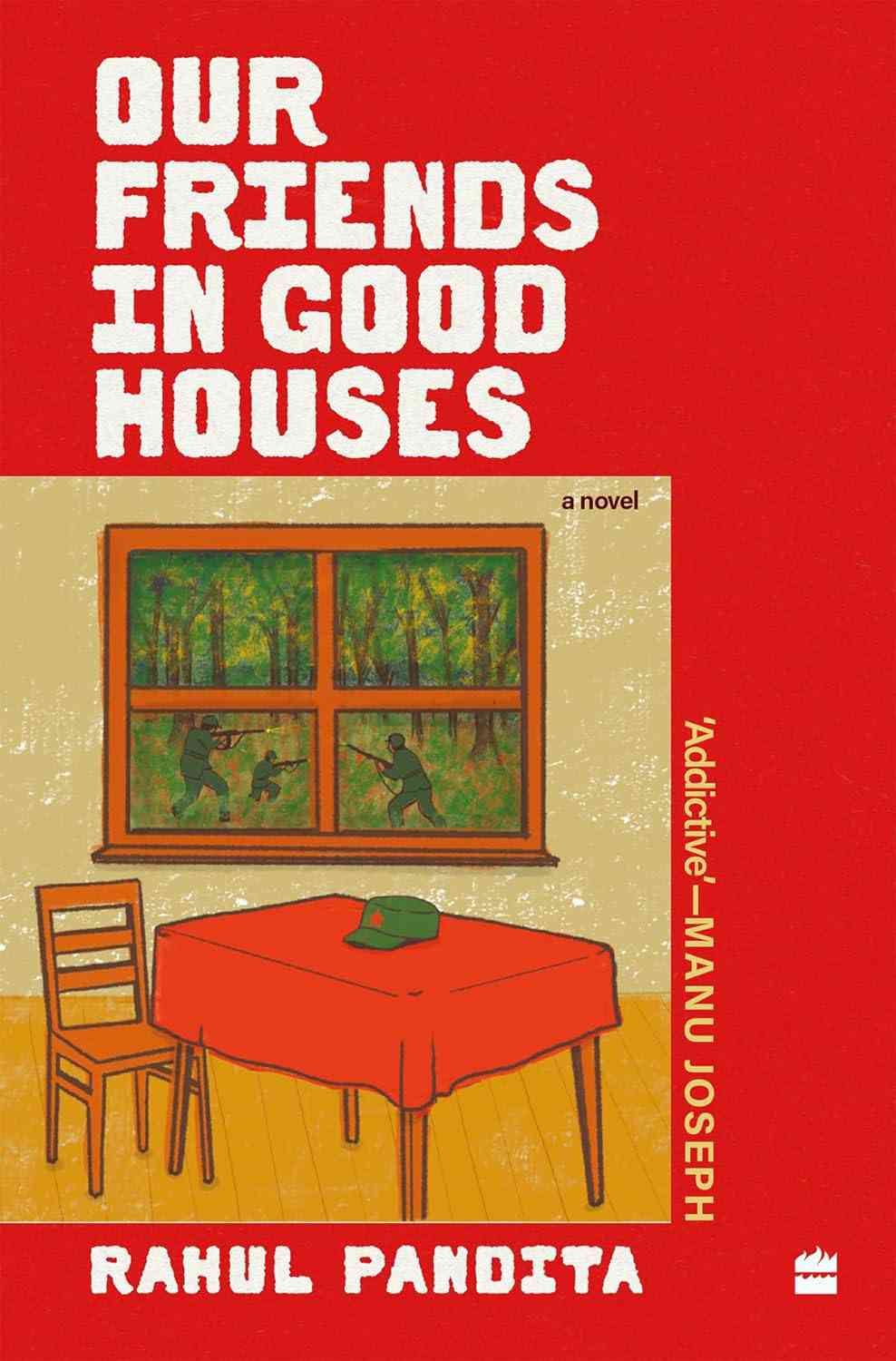
Excerpted with permission from Our Friends in Good Houses, Rahul Pandita, HarperCollins India.
