










A crackling debut is a tough act to follow. Megha Majumdar’s A Burning (2020) was an immediate, critical success. It won literary awards and was on bestseller lists and generated a significant buzz for its sharp social and political commentary. Five years later, A Guardian and a Thief, defying the jinx of the middling, or worse, trying-too-hard second novel, delivers a powerful punch, packed in just over two hundred pages. Set in a Kolkata of the future, the novel is a story of struggle and survival.
Two-year-old Mishti lives with her Ma and her grandfather, Dadu. Her father, Baba, is a researcher/scientist in Ann Arbor, Michigan. Situated within their relationships to the child, Majumdar’s characters remain Ma, Dadu, and Baba through the text. Their Kolkata is poised on the brink of an apocalypse – temperatures are rising and resources have become scarce. The city has survived a period of submergence, of flooding and destruction. Baba has secured his family “climate visas”, and they are to leave the deprivations of India for the promise of plenty that America still holds. It is this period of seven days between the grant of visas for the family and their proposed date of departure that the story plays out within.
A cautionary note
Writing about science fiction and all things fantasy in her In Other Worlds (2011), Margaret Atwood insists that texts can no longer be located within inviolable boundaries: “When it comes to genres, the borders are increasingly undefended, and things slip back and forth across them with insouciance.” Majumdar’s novel is at once several genres. It is both climate fiction and speculative fiction, genres that are typically adjacent to each other, and despite its firm anchoring within the familial space, it has scenes that have the nerve-wracking energy of a thriller.
She writes of a climate crisis, entirely too believable at a time when major Indian cities are choking on unbreathable air and are routinely either running out of water or drowning in downpours. Swiftly, she pulls the reader into a dystopic landscape where crops have failed, farmers have collapsed from unrelenting heat, and pests have taken over agricultural land: “In the west a drought had cleaved riverbeds and in the east salt water had tainted the paddy fields.” Refusing to acknowledge a famine, the government continues to downplay the situation, calling it a “shortage”. The media does one better and insists it is a hoax.
Majumdar connects the shortage in the city to the history of famines in India, particularly in Bengal, reminding the reader of the horrors of 1770 and 1943. Food scarcity in Ma’s Kolkata has finally breached the class divide, dragging the formerly complacent middle-class into the same states of anxiety as the permanently poor. Concerned citizens march on overheated streets, asking for the right to shade and shelter, even as fights break out for the most meagre of resources. The climate crisis is uncontainable and will dismantle all our carefully insulated borders, the novel tells us, delivering a much-needed cautionary note.
Speculative fiction, while anticipating a future based on the crises and the peculiarities of the present, always asks, “What if?”, excavating a range of ethical and moral issues. In this book, the primary ethical question is, when human life is on the brink of disaster, who gets to live and at what cost? On the day the novel opens, Ma is home, packing up their lives of several decades into three suitcases, pulling together a meal for her child, thankful for their relative comfort of a house that offers safety. She has recently resigned from her role as manager of a shelter for adults with children, sponsored by the city’s only remaining billionaire, a woman who has constructed a haven for herself on an artificial island in the river, with access to pure, unadulterated air, and fresh, unlimited produce, some of which, as largesse, makes its way to the destitute population of the city.
In her role as manager, Ma would often pilfer small amounts of food – eggs, grains, dry fruits – for her child, to tide her family over the worst of this crisis. Boomba, a young man taking refuge at the shelter, hounded by ill luck, tragedy, and dogged poverty, spots her stealing eggs and sets in motion a series of events that bind their destinies together. He steals into her house, searching for food, and steals, inadvertently, her family’s passports and visas, their ticket to a life away from hunger and starvation.
Turned into adversaries in a situation that is hostile towards all of them, Ma and Boomba navigate not just the city but fear, helplessness, and rage. If Ma has Dadu and Mishti to protect, Boomba has his family – an incapacitated father, an out-of-work mother, and a much younger, ailing brother – that he intends to bring to the city and care for. In their roles as guardians, both Ma and Boomba must let go of ideals that belong to an age that has passed. Conventional moral abstractions no longer hold.
While Boomba realises that honesty is worthless in a world that cannot reward it, Ma learns that she has no generosity, no “motherliness” to offer to anyone except her own child. Dadu steals from a child to bring food to his granddaughter. Boomba abducts a child to be admitted to a feast. The only thing that matters is survival. And yet, in the middle of this bleak vision of an irredeemable tomorrow, Majumdar unfurls the promise of gentle love, a child’s elemental trust, and the unquenchable human desire for connectedness.
Inevitable suffering
American science fiction writer Paolo Bacigalupi, in his foreword to the Climate Fiction anthology, Loosed Upon the World (2015), writes, “It’s interesting that by creating a made-up world, you can show the real world more sharply and clearly, and in that process, you have the chance of making people engage not with the future, but with the intense realities of our present – the realities that were previously passing them by.” This shines a light on the jagged edges of our own fractured reality is exactly what A Guardian and a Thief accomplishes.
The Kolkata of Ma and Boomba could well be the Delhi or Bombay or Bengaluru of our present, pushed into desolation by human avarice, political apathy, over-consumption, and the continued denial of a climate emergency. Those on the margins of the city – boatmen who work in canals that once used to be streets, rickshaw drivers, men who make a living ironing clothes for others – are the worst sufferers, much as they are in our lived spaces. In the story of Boomba’s family, forced out of livelihood and into homelessness, Majumdar reiterates the unsavoury truth that the refusal of basic human dignity to those deemed the smallest, the most insignificant, will always funnel upwards, ensuring, eventually, a parity in suffering.
Despite its obvious “messaging”, the novel remains a slick narrative, pulling the reader into the same sense of urgency that informs Ma’s frantic pacing of the city in search of their lost passports. Majumdar renders characters and places with an often startling authenticity. Mishti is an unerringly real child – adorable, annoying, and fiercely loved. Dadu’s unshakable faith in the city he has spent his life loving mirrors the nostalgia of every migrant for their lost homeland. And then there is the city, hub of technological construction and human dysfunction in narrative after science fiction narrative.
Kolkata, in this skilfully wrought novel, is not just a site of chaos and barely-controlled violence but also a beloved home, comforting in the timelessness of its roadside carrom matches, street corner philosophers, eccentric neighbours, and strangers who perform unanticipated acts of kindness.
The heart of the novel, however, belongs, unquestionably, to the mother-daughter relationship. Mishti, oblivious to the horrors of the world breaking down around her, remains secure in the steady shelter of her mother’s love. This, perhaps, explains best why Ma and Dadu and Baba have no adult names. The story is told not from the child’s perspective but for the child, signalling to the reader the possibility of a future worth preserving stories for.
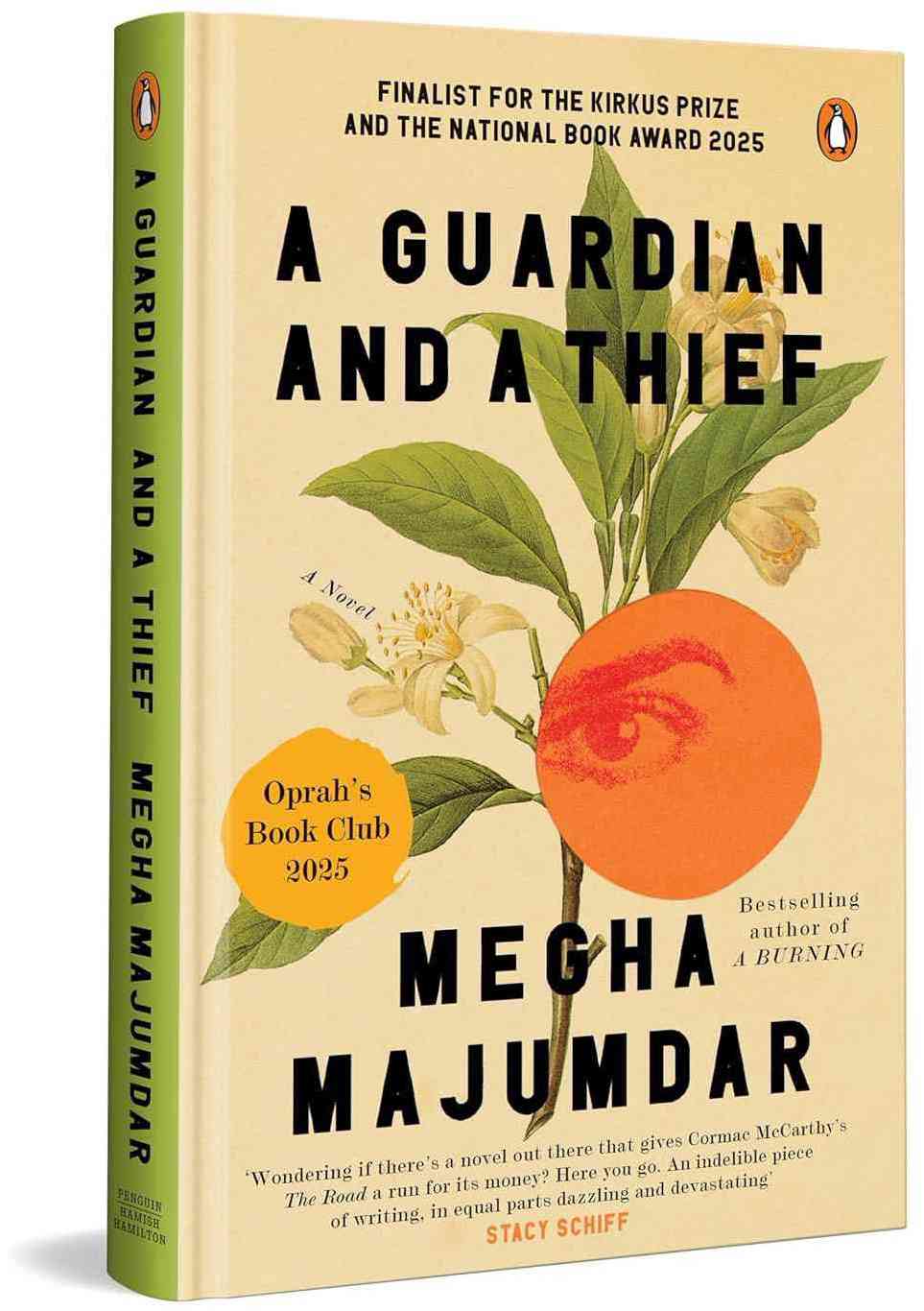
A Guardian and a Thief, Megha Majumdar, Penguin India.
