




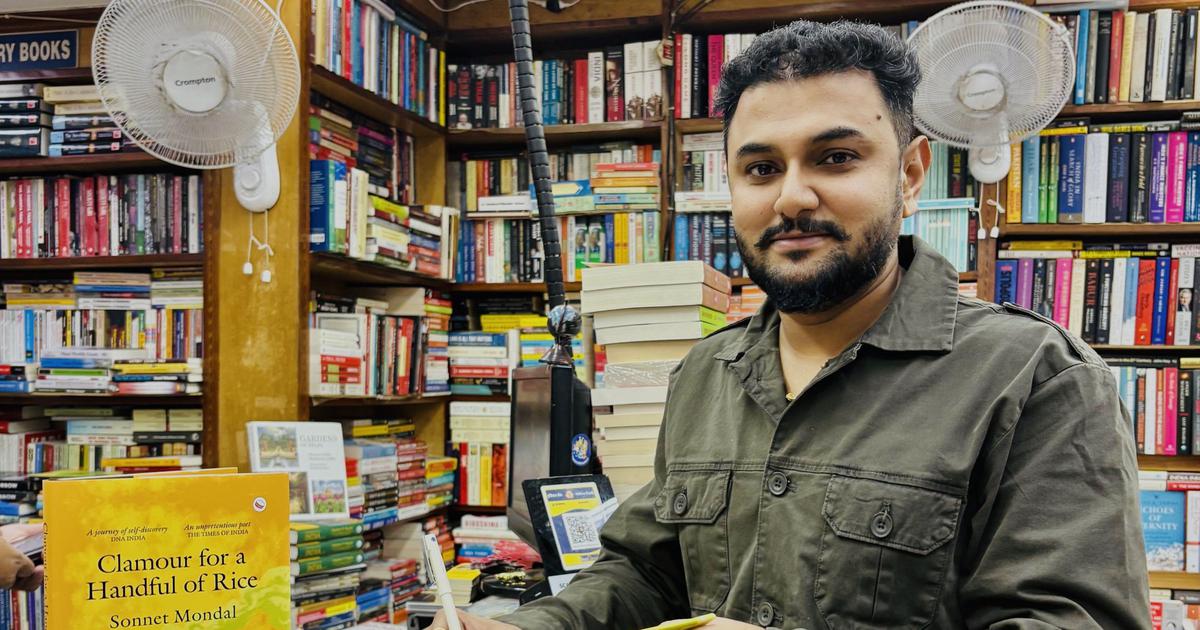
The poems in Sonnet Mondal’s Clamour for a Handful of Rice are full of the wreckage of war, but they also show the strange strength of humanity that survives in the middle of it all.
In its inception, the collection lays bare the violence of war with harsh unforgettable writing that won’t let you go. “What when a missile topples the dome of a mosque? / when it rips apart the clapper of a temple bell from its mouth? / Today a missile is stuck in the head of Buddha. / Where will the birds sit now?” At this moment, religion, landscape and nature all collapse into disaster. The holy emblems of faith – mosque, temple, the Buddha – are transformed into mutilated bodies. The issue of the birds – so innocent-seeming on the surface – begs an aching question: if strife invades even the bastions of sanctuary, where can innocence take shelter?
An ominous white
Many of Mondal’s images succeed by estrangement: We see something familiar in an unfamiliar state. “These days an unusual whiteness / besieges the sky. / The loud hush of shrouds/ and rubble dust make even the winds appear white.” Here, whiteness – typically the sign of purity – looks ominous. Grief bleaches the world, leeching the colour from the sky as if even Nature is exhausted. It recalls the sterile atmospheres of Celan’s “Death Fugue” and Darwish’s “A State of Siege” in which destruction is the ambience.
But Mondal’s poems are not merely concerned with the exterior. They keep coming back to the within, and violence makes itself at home in the mind. “My reflection quivered / in the glass of water / and the image of a thirsty child / appeared over my face.” Trauma is a mirror, shattering the distinction between self and other. This brings to mind the empathetic leaps in Primo Levi’s prose, in which suffering turns people into porous selves, and no one can remain untouched.
In a crooked house or the hollow of a dented room, Mondal demonstrates how memory fuses with objects. “Within the walls / wicks waited to cradle the fire / that bore enough memories to spread.” In these lines, memories are presented as flammable – they smoulder and require only the tiniest spark to set them alight. For here, fire is the source of both light and danger, an inheritance that can warm us or burn us – depending on whose hand reaches out to it.
The book keeps returning to poverty as no mere metaphor but a daily, bodily fact. “What do those who survive hunger think of love? / With empty stomachs and begging hands / why do they still smile / near car windows?” Mondal wonders with an almost unbearable tenderness. Hunger turns into a philosophical question: What is love when you are deprived of the body? How does hope endure in those who have no material basis to afford it?
One of Mondal’s most shocking truths is that society forgets things faster than the victims do. “We forget wars like / a drop of blood mixing in the sea / and then lift our shadows / to sail off behind the sun.” A photograph may be wiped easily, but a red drip that goes on forever makes us all anxious. People put conflict behind them, clean it up, and file it away. Then they go back to their normal lives, with the shadows of another day making them longer.
Nature and conflict
The psychological effects of war come back in lines like: “With no roof to hold your thoughts you search for peace even on nights of ‘no war’.” The outside world may have gone quiet, but the storm inside is still going on. Even quiet points the finger at you: “Every moment of silence/ hurls complaints against you.” Being alive is a matter of guilt. This reminded me of Japan’s post-war literature, such as that of Kenzaburō Ōe or Sankichi Tōge’s works, where peace is fragile and short-lived.
Mondal is skilled at mixing nature with conflict. Take, for example: “Her [tree’s] leaves couldn't bandage the war / and the ash around couldn’t blind the hate.” The tree, leaves, and ash in the organic world can’t fix what people break. Nature can’t keep up with how quickly violence happens. And it’s still there, watching, attempting, not quite succeeding, and surviving.
Still, there is always hope, even if it feels like an illusion. “Hope is a bullet-cracked mirror / clinging to a dressing table, / which belongs to a person / standing in front of a house.” This mirror doesn’t show a true image; it has cracks, distortions, and splinters. And yet it still “clings” – a gesture that mimics Beckett’s famous paradox: “I can’t go on. I’ll go on.”
Humanity itself is a contradiction: “Humans are the only animals/ that keep telling each other/ to be human.” This sentence serves as the scaffold of the collection. Mondal, through his poems, argues that moral goodness is not something we are born with but something we choose, fight for, and can easily lose.
In the middle of destruction, the labour of burying and remembering seems to stay at the edges: “The diggers will depart soon. / Memories will linger over the bodies / and the remnants will be moved into trucks and pockets.” The phrase “moved into trucks and pocket” makes death seem like a freak accident. One must cherish memories for as long as they have them.
Mondal’s politics is unwavering: “The politics of threat is like a swarm of bees. / We are trapped in their hive.” Threat doesn’t just make the world feel dangerous; it also makes an obfuscating environment that thwarts the masses. The picture in the lines makes one think of Yeats’s apocalyptic poem “The Second Coming,” in which the centre of control breaks apart into violence that seems biological and inexorable.
Even the heavens seem askew: “Today the sun hasn’t been born. / The darkness is as strange / as the invisible lines of my palm.” This is cosmic vertigo, a world without a dawn. Cycles in the sky lose their meaning. Fate becomes impossible to read. The poet is in the dark, trying to interpret his life as best he can with lines on his palms that are getting fainter and fainter and are now almost invisible.
Language is inadequate, and language feels necessary: “Every poem I’ve written feels like / it could have said more./ Perhaps what’s left unsaid is what stays / in the spaces between words.” This is a very brave admission.
The resilience of the natural world makes a return, cyclical and almost tragic: “In trying to uproot trees / you drop more seeds on the ground.” Nothing happens right away; fear builds up. This paradox is in line with the ideas of writers like Albert Camus, who said that revolution includes both refusal and invention.
Fear also has its patience: “Like dry wood, my fears / wait for the fire.” Mondal’s worries are not acted out but are only there, poised to catch fire at the first sign of trouble.
And some memories bear literal weight: “Too much weight lies beneath / bones / memories / wars / forgotten by the sun / but not by soil.” The sun can’t erase what the earth remembers. The Earth is a place where sadness is stored. This is similar to the rural memory in poets like Heaney, whose fields were full of buried history and unsaid violence.
Mondal is aware that memory fails: “Memories dissolve / before the next generation/ learns the names.” One of the book’s most important warnings is about how quickly people forget, which is dangerous in communities where conflict is common. History flies free and strikes twice if it doesn’t pass on names, stories, and wounds.
This brings out one of Mondal’s most striking observations: “History turns its face / to the next chapter / with ink but not with grief.” History remembers, but it doesn’t cry. It will write, but it won’t feel. The chroniclers don’t have to mourn; the people who are still alive and have memories in their bodies do.
Throughout the collection, Mondal has shaped this story into a circular structure instead of a linear one. His poems imply that pain never fully goes away; it comes back, transforms, and echoes. His work, on the other hand, doesn't give up hope. Even in the middle of the ruins, mirrors reflect, plants develop new seeds, birds rest their wings in new places, and memories press their heels into the earth.
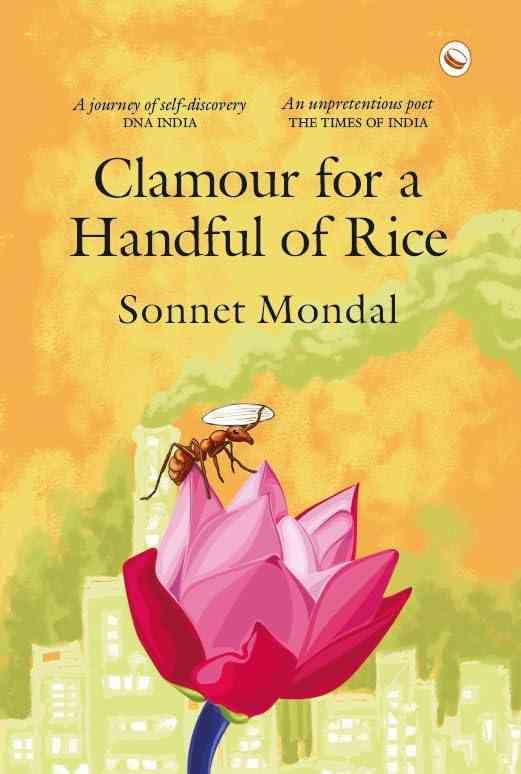
Clamour for a Handful of Rice, Sonnet Mondal, Copper Coin Publishing.
