








The Hindi-speaking region encompassing Rajasthan, Madhya Pradesh, Chhattisgarh, Jharkhand, Bihar, Uttarakhand, Uttar Pradesh and Delhi is the pulse point of India, where the nation’s rhythms converge – not only because of its geographical position, but also because of the impact it has on India as a whole. Even today, the popular idea of India in terms of religion, language, culture, fashion, food, entertainment, and politics emanates from the Indo-Gangetic plains. This should not be surprising given that the Hindi belt comprises 38.2% of India’s total area and is home to 42.2% of its population.
And yet the Hindi belt is the most impoverished region in the country. It is the most backward region of India, and one of the reasons, besides British colonialism (the UP-Bihar-Bengal belt was the first regions to be colonised), is the fact that politicians have kept the Hindi belt anchored to restrictive social ideas. The imagined past has been given primacy over the experienced present or the anticipated future. Caste- and religion-based politics have reduced the idea of democracy to community loyalty rather than the delivery of welfare.
It is said that whoever has political dominance over the Hindi heartland dominates Indian politics. This political importance stems in part from the religious influence it wields. All cities popularly associated with major Hindu gods are situated here, the key texts of Hinduism originated here, and the major Hindu religious sites are located along the banks of the Ganges, which flows through the centre of the Hindi heartland. The region is central to the development of Islam in India as well. Numerous institutions, ideologies and movements emerged from this region that impacted the Muslim communities worldwide like Darul Uloom Deobandh, Tablighi Jamaat, and Jamaat e Islami. Multiple Sufi shrines and seminaries are located in the Hindi heartland.
The creation of a heartland
The Hindi Heartland: A Study by Gazala Wahab arrives as a substantial intervention into India’s sociopolitical discourse, offering a magisterial 528-page examination of this region that exercises disproportionate influence over India’s destiny while remaining mired in paradox. It is a profound effort to study this region from a social, political and religious perspective, with the aim of examining its culture and language outside of the media-driven communal binaries that try to disregard certain experiences as foreign invasions while others are eulogised as the only legitimate cultural values. The book tries to re-investigate and reimagine the role of the Hindi heartland in the evolution of a multi-religious, multi-cultural, multi-ethnic and multi-lingual nation that defies all notions of a traditional nation state.
Wahab looks at the past of northern India to illuminate the path to the nation’s future. It is not merely a dive into history; it is a reminder that India was at its finest when people lived and worked together for their collective well-being, irrespective of religion or ethnicity. The ambition of the book is evident in its scope: to reclaim the northern plains from reductive narratives and examine how geography, history, and political engineering have shaped contemporary India’s most fractious yet formative region.
The idea of one region suggests congruity of language, demography and culture. However, the diversity along the Indio-Gangetic plains is unparalleled, suggesting that the construct of the Hindi heartland can be artificial and politically driven. The notion is often assumed to be a 19th-century political movement in which linguistics were subsumed. These facts have been reiterated in the statements of historians like Shahid Amin and politician Manoj Kumar Jha.
The author establishes early on that Hindi is in fact the region’s least unifying factor – eg, Garhwali speakers comprehend Mewari ones no better than Punjabi speakers understand Maithili ones, and yet the political elevation of the language has erased this diversity. This linguistic critique forms the foundation for her broader argument about artificial entities shaping national identity. Referring to this cultural heterogeneity across the heartland, Wahab writes, “What holds it together is an artificial political construct driven by opportunism”, and to her, the idea of the Hindi heartland is a rather amorphous idea, “which has impacted not just our contemporary politics, but our concept of the nation itself.”

The historical excavation in the book is formidable. In the nearly 100-page-long section on the history of the belt, the author traces the rise of the Delhi Sultanate, the Mughals, the Marathas, and the East India Company, mapping their successive imprints on the region’s political and cultural landscape. In the process the study touches upon numerous contentious and controversial issues like the collection of chauth tax, religious conversions, territorial sovereignty, and so on.
This study paints a picture of medieval India shaped by the intersection of the Advaita Vedanta philosophy propounded by Adi Shankaracharya in the eighth century, and Islamic belief, which had started entering the coastal and Southern India around the same time. The outcome was a religiously fluid society with multiple overlapping identities.
The consequences of the heartland
The mass conflagration of 1857 against the British was the culmination of multiple rebellions, from peasants to priests and not an overnight burst of anger. Resorting to a scorched earth approach, the heart of political authority of the Hindi heartland was cleansed of the rebels, with roughly 800,000 Indians dying as compared to 6000 British civilians. The book delves into the intricate details of the mutiny and the response of the colonisers that followed, identifying it as a rupture point, one whose aftershocks continued to shape governance, identity, and collective memory well into the colonial and postcolonial eras.
Wahab traces the causes of economic impoverishment of the region under British rule and the ways in which the myopic attitude of politicians perpetuated this impoverishment after independence. The author’s rootedness in the region infuses the book with personal accounts, giving it a semblance of a layered personal narrative that is driven by scholarly rigour; a work that balances archival research with lived experience.
The conversations and interviews presented in the book provide a contemporary texture and prevent the history from feeling parachuted in. These exchanges often weave intersections of caste, gender and religion without flattening the region into politically convenient binaries. Drawing on an important issue of caste, Wahab invokes sociologist SS Jodhka’s comments that like all hierarchies, caste was also an elite-forming process which was constantly evolving and depended upon numerous factors such as military power, economic power, and social power which refers to the amorphous concept of state and honour.
The reductive understanding of religious mobilisation is explained in great detail. Religion in the Hindi heartland is not only politicised but often weaponised, and the consequences of this are seen from Punjab to Bengal. The study suggests that everyday communalism and antagonism towards minorities particularly appeals to a younger post-globalisation generation. The treatment of Hindutva is particularly pointed. Wahab argues that the Hindi belt’s current politics represents an “acknowledgement of failure – failure on all fronts” that uses communal mobilisation to mask developmental deficits. She argues that the RSS has been pivotal in redefining the “idea of India” along overtly Hindu majoritarian lines, especially within the Hindi heartland. The polarisation turned what was once a space marked by cultural and religious pluralism into one increasingly characterised by exclusionary nationalism.
Wahab’s pointed critique of RSS details how the network of shakhas, educational initiatives, and grassroots mobilisation has gradually recast public discourse, fostering a narrative that valorises Hindu identity while marginalising minorities, particularly Muslims. In the later sections, she examines the rise of “temple politics” in the Hindi belt and focuses on three major temple-mosque land disputes, all located in this region; Babri Masjid/Ram Janmabhoomi is central to this discussion. Wahab treats these movements not as isolated “religious” episodes but as part of a long arc: colonial policies, the freedom struggle, and post‑Independence party competition, that normalised the Hindu majoritarian rhetoric in the Hindi heartland.
Wahab refuses to romanticise the heartland’s spiritual heritage or reduce it to clichés of backwardness. Instead, she confronts uncomfortable paradoxes: how the birthplace of secular nationalism also nurtured sectarian strife, how and why Ganga-Jamuni tehzeeb coexists with lynchings, and how socialist movements devolved into caste and religion-driven patronage systems.
The political tone of the study is unambiguously progressive, which is very refreshing, and it fills a glaring gap in Indian nonfiction. The study examines this whole region and studies patterns of transformations of social movements into caste based systems, the rise of temple politics, shared experience of economic marginalisation despite political centrality. This makes her work essential for understanding contemporary ideological battles across the Indo-Gangetic belt.
However, the expansiveness of the text also ends up as a limitation. The data-dense overarching arguments can sometimes overwhelm the reader and make simple understanding quite laborious. Wahab tries to expound on almost everything: from ancient mahajanapadas, to geography and economy, to recent communal politics and scope for the future. The breadth of the study often comes at the expense of its depth, presenting a helicopter view of some pertinent issues that warranted deeper engagement.
Still, The Hindi Heartland offers indispensable and at times overwhelming guidance to readers who wish to engage with the dynamics of India’s most influential region and how it is trapped between its pluralistic heritage and a divisive present. The book invites readers to engage critically with complex history so as to challenge the manufactured pasts that threaten the democratic futures. The study lays a terrain for future scholars and students to build upon.
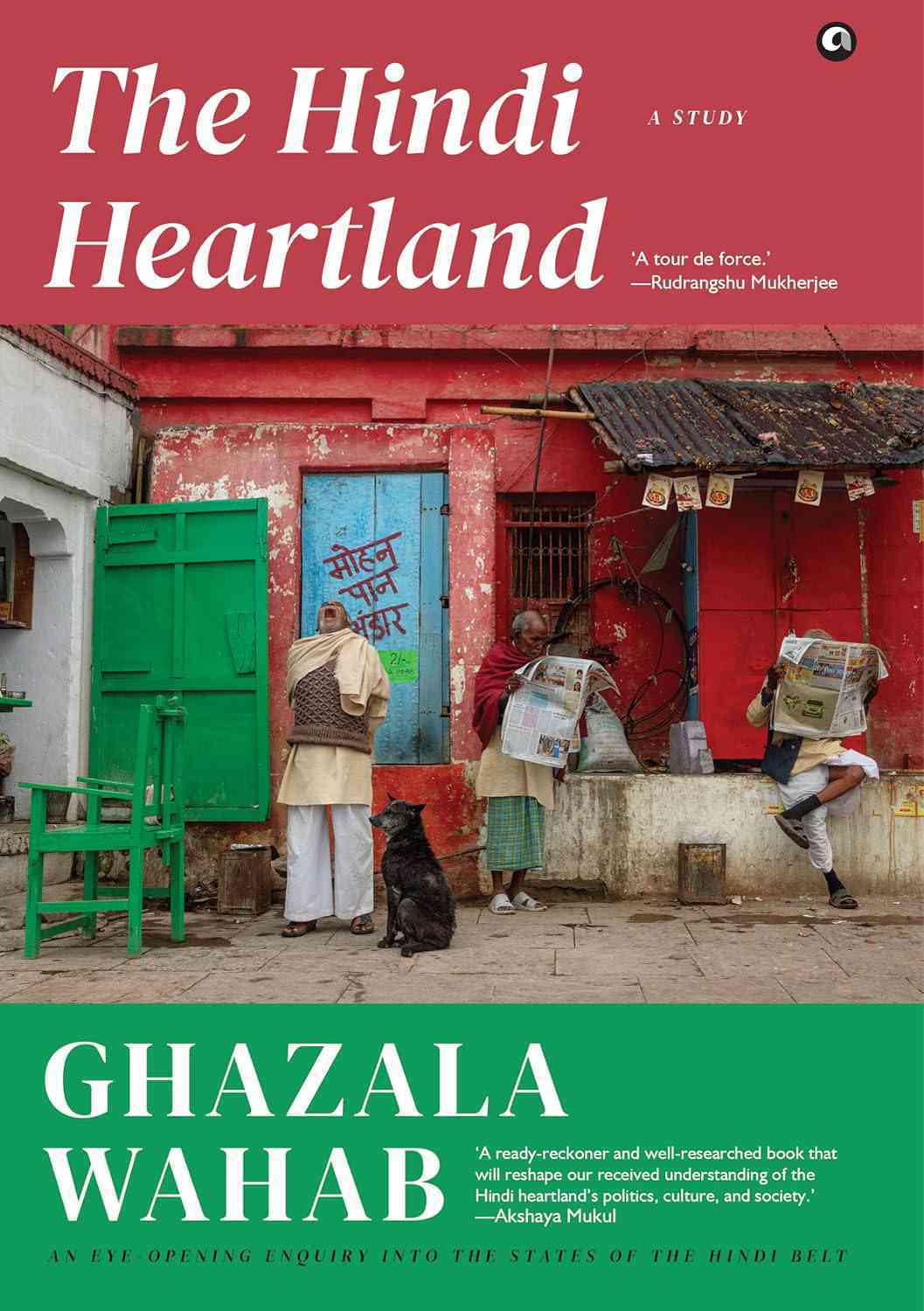
The Hindi Heartland: A Study, Ghazala Wahab, Aleph Book Company.
