








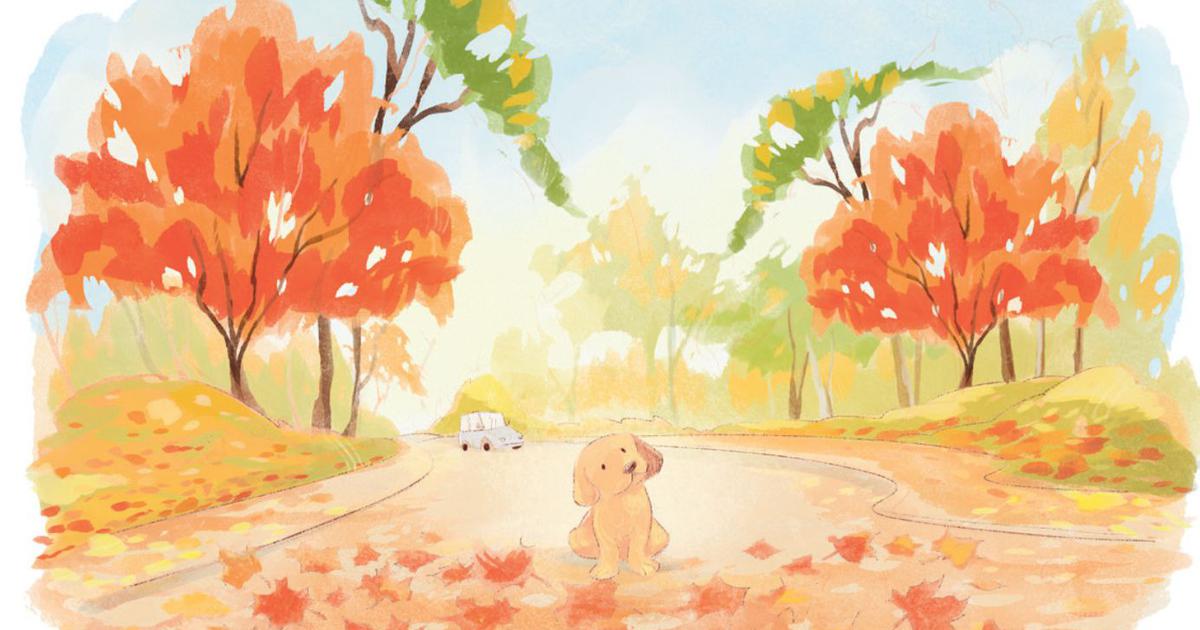
Winter was a baby when I experienced my first Ithacan fall. In the immediate early days of my walks with him, it would only be me staring at him, waddling by himself on the sidewalk. I only interfered when he started drifting towards the road, but other than that, his baby fur glistened in the dew collected from the pile of leaves he insisted on passing through. It was a sight to see. A small rebellion, I could allow it.
It would just be me, Winter and heaps of many-coloured leaves at daybreak like nature’s confetti, with only the dawn’s quiet whispers to keep us company. The ‘no soul in sight’ part was also because I chose streets that were rarely walked on by anyone other than those who lived there or had turned a wrong corner or, you know, anxious walkers with rashly adopted puppies.
On one of these chilly fall mornings, walking behind him, in an entanglement of thoughts, Winter stopped. Not suddenly, but noticeably. I stopped a few paces behind him. There was some sort of staring that was happening, but I could not figure out what the subject was. Whenever his head turned and the direction of the gaze changed, his cocked ears dangled with a lag. Was it a distant squirrel? A motorcycle (very rare)? The Cornell McGraw tower bells? After multiple head turns and floppy cocked ears, it became clear what Winter was looking at. He was looking at everything.
The sunshine, clean and newborn, grazed the top of his fur. The browns in the pile of leaves contrasted with the yellows and oranges. A flare cut through the dissipating fog. The air was still. The cars were quiet. The colourful sidewalk sloped up towards Cornell. And Winter stood there, with a planted stance, moving only his head, the fall sun now covering his entire body, known to rise swiftly so it can rush to set quickly as well.
I stood with him, my ignorance over the last several fall mornings becoming evident. All of this had existed while I walked through it daily. Winter, however, had taken in every moment, every morning, giving time to the most granular details of fall. It might not have been philosophical attention, but not all attention has to have meaning and depth. Sometimes just giving it is enough.
Does one have to be a minuscule puppy to be in awe of an Ithacan fall? I think not. But I suppose I could attempt at least half of what puppies do that lets them enjoy this: live only in the moment that exists now.
Towards the end of fall, I finally had the courage to go farther and farther with Winter, up the sidewalk towards the university, until it was, finally, his first day going all the way to Cornell. Classes had ended early, the nip hadn’t turned to a chill yet and the sun hadn’t set. It was a bit of a miracle, given his legs were only a few inches each, the size of baby carrots. Every few hundred feet I stopped to ask him if he needed to take a breath, but he never stopped (or responded), exposing who really needed to stop to catch their breath.
Nothing excited him more than being in a place for the very first time. The fact that there was something beyond what he thought were the limits of the world was celebrated in full glory. But he always wanted more and more and more, always looking outward, forward. He could find the most beautiful spot of grass to roll around in or the juiciest stick or the plumpest squirrel to chase, but he never stayed there; always onward, forward. His longest journey yet finally ended at the steps of Sage Hall, a place for me filled with not-so-great things daily. Delightfully though, this time, for the first time, Sage Hall felt like a tolerable place. Even though we never entered it, we sat on the grass near the steps. I’m not sure how much time passed, but just enough did, the fall sun was on the verge of a hasty goodbye.
Winter’s ears were cocked again. I don’t know if his tiny mind could comprehend the beauty of the stillness around us or the fact that he was tired that made him sit there. He had half of his furry buttocks on the freshly cut grass and the remainder on the jacket I laid out for him. The best of both worlds, really. Nothing particularly eventful happened during our hour there. All I remember is from that moment on, I came to Sage Hall every day with newfound courage, as if tucked away in my pocket, knowing that while I saw only fear in this building, Winter saw everything else. The memory of my evening with him right outside now wrestled with my anxiety, and at least half the time, I think it won.
On every walk to Cornell, at least one friend was added. Puppies generally attract attention, of course. But this one was a gentleman puppy, trotting through a jungle of the species that harbours the strongest community of cuteness aggressors: sophomore girls dragging their eye-rolling boyfriends to meet Winter from whichever corner of the street, house, café or balcony that they saw him. Repeated walks led to lots of familiar faces becoming more familiar. When we passed Collegetown Bagels to get on to the trail to Cornell, the crowd gasped to see something they were clearly waiting around to see all evening: How big was the stick Winter was carrying that day?
And sure enough, the stick would be several times his body weight. To the point where his trajectory would go slowly to the left as the weight of the stick took its toll, till I could intervene and course correct. But a tiny pup with a larger-than-life stick really is a sight to behold, and Winter was an ambassador. You could part the Red Sea again, with or without Moses, but you couldn’t part Winter and the stick he had chosen. It had to make it home.
Some days, the stick connoisseur would forget to find one due to other serious distractions of the squirrel and butterfly variety. Panic and realisation would kick in right as the trail ended, with limited stick options (pun intended). Winter would still manage, with a tiny twig that you could barely see, but had to play proxy for a stick, and so it did.
If you think a tiny puppy with an oversized stick is funny, you’ve just got to see him with a miniature one, strutting with pride, as if it were the trunk of a century-old oak tree.
Naturally, with his social credit escalating, I had to make conversation as well. And while I’m not saying I made any best friends for life because of him, I did have to take a deep breath and do something I had forgotten how to since coming to this country: speak to strangers. I had to tell them his name, I had to tell them how old he is and where I found him and what he does with those sticks in the end. (Piled at the entrance of the house for a week before discarding.)
This might be small talk with no deeper meaning to the naked eye, but when you are slipping down different darknesses of the mind daily, in a quiet town like Ithaca, it was a welcome fix to make it to the next day.
I suppose this affected how I saw Sage Hall and my classmates within it as well. I had the courage to ask them if we could hang out, the bravery, if one might, to look them in the eye and have a conversation long enough to let them know I needed to make a friend. And while not everyone I spoke to turned into someone I would call to my wedding someday, I did end up throwing a cosy fall get-together in Winter’s honour at our place downtown. I don’t know if it was Winter, me or my roommate’s popularity, but a decent number of classmates did show up. I didn’t have to pretend very much that evening. I could genuinely smile. And Winter, well, he was in a new pair of arms every time I turned to find him.
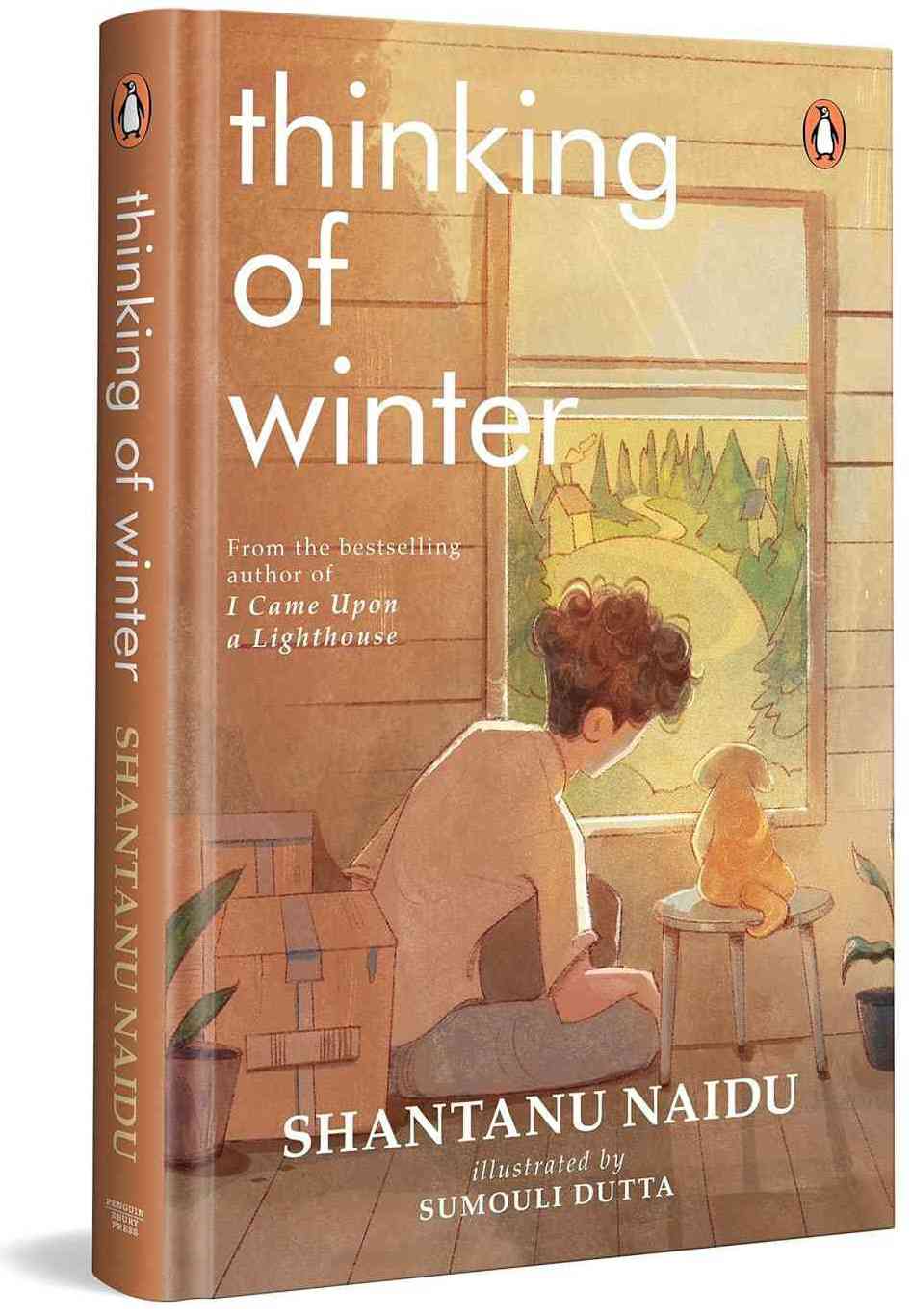
Excerpted with permission from Thinking of Winter, Shantanu Naidu, illustrated by Sumouli Dutta, Penguin India.
