











When I began my journey as an entrepreneur, I was a small man from a tiny country with big dreams. As I grew older, my dreams and hunger to build a business empire that touched every part of the globe grew bigger. It was not the money or profits I craved – it was the thrill of the chase. The endless strategising, the challenge of staying ahead, the joy of pitting my pawn against someone else’s knight kept me hooked.
I came from a long line of people who had left their native towns when trade dried up to fan across the Indian subcontinent in search of new opportunities, treading where even bullock carts did not go. A similar craving flowed in my veins to enter areas few dared venture and scale walls with “no entry” signs. I disliked the word “impossible” and had an overwhelming urge to ensure CG Global extended its footprint where others had failed to go.
My decision to expand also fits all the modern definitions of business expansion. The Chaudhary Group had plateaued. From this point, we needed to expand our avenues to grow, to generate revenue and profits. Opening new branches, forming alliances with other corporations, introducing new products and services was now a necessity. Else, we would stagnate.
I started exploring different avenues to fuel growth. One of them was the telecom sector.
My desire to venture into telecommunications dates back 40 years. The state of telephony in Nepal was dismal. Making trunk calls was excruciating. One would have to queue up at the telephone office for hours, even though Nepal’s first telephone line was laid in 1913. But progress was slow, and after several fits and starts, telephones were only thrown open to the public as late as 1960.
Mobiles became a buzzword in Nepal in the early 1980s, more than a decade after the first mobile phone was successfully operated in the United States in 1973. The Nepalese chatterati were ecstatic: “Mobiles are coming! Mobiles are coming!” they tittered gleefully.
My own exposure to mobile phones was probably a lot greater then than the chaps at the telecom offices or ministries, courtesy my frequent travels to Japan and Singapore. But my knowledge of the telecom sector, both in terms of technology and market, was negligible.
The prospect of entering the telecom market was exciting. As a young man always on the lookout for new ventures, my immediate reaction was: if others can do it, then why can’t we?
I did not try to burden myself with the ins and outs of the technology involved; that was a technocrat’s domain. I was concerned with conducting a feasibility study and figuring out if there was a market for mobile operators in Nepal.
I put my team in Pashupati Biscuits to work. It was a bad idea. What could employees of a biscuit factory understand about the workings of the telecommunications market? They came back with a skewed report; something I would only realise later. Barely 1 per cent of the Nepalese population were potential subscribers, they reported. The math came to roughly 1.5 lakh subscribers, way below the minimum critical mass required for the venture to be viable. It made no business sense to me, and I promptly lost interest.
It was a flawed choice based on an erroneous evaluation. Today, telecom penetration is almost 5 billion worldwide.
A few years later, there were fresh whispers that mobile operators would be invited to enter Nepal. This time, I took the matter more seriously and scouted around for a promising partner.
I approached Usha International, an Indian company based in Delhi which was trying to get a foothold in the telecom sector in India with a Russian partner. I got in touch with Anil Rai, then a young man and joint owner of the company with his three siblings. He was open to the idea and agreed to enter a joint venture with me in Nepal with his Russian partner for minority stakes. But the whole affair turned out to be a damp squib. Nothing moved either in Nepal or India. Usha International failed to find any space in the Indian telecom sector and ultimately moved on to greener pastures. The story was virtually the same for us in Nepal.
A few more years passed. In 1997, after sleeping on telecommunications for years, the government finally enacted the Nepal Telecommunication Act. Its preamble broadly stated: “…it is expedient to make the Telecommunications service reliable and easily available to the public, involve the private sector as well in Telecommunications Service and to regularise and systematise such service; now, therefore, Parliament has, in the 25th year of the reign of His Majesty King Birendra Bir Bikram Shah Dev…” This jump-started Nepal’s telecommunications industry.
Now that the telecommunications policy had been formalised, the Government of Nepal invited bids from mobile operators to start operations in the country.
Once again, I applied. I knew I needed a JV partner, and I wanted a strong one. I went to Mr RC Bhargava, Chairman of Maruti and also a Taj Asia board member. He was a close family friend and I admired him deeply. He was singularly responsible for Maruti’s growth story in India, and I trusted his judgment implicitly. “Sir,” I said, “I am planning to get into the telecom sector in Nepal and I am looking for a strong partner for the project.”
He thought for a minute. “I can set up a meeting for you with the Mittals of Bharati Telecom,” he replied. Bharati Airtel was a major telecom giant in India.
He introduced me to Rakesh Mittal, Vice Chairman and nonexecutive director of Bharati Airtel. Negotiations began. Several rounds of meetings followed. The discussions were professional and intense, a far cry from my last experience. I had finally found a company that understood the telecom business.
Finally, the Mittals signalled their interest. “Let’s get the licence and give it our best shot,” they said. I was delighted. They were huge in telecom; with them, we were sure to be successful.
Then came the catch. They wanted 51% of the stakes!
I refused. “This is my country, my turf. I have a 50-50 partnership with the Tatas; why should I accept a minority partnership with you?”
Bharati Telecom tried very hard to change my mind and offered me every kind of protection, including minority protection. They offered to make me the chairman of the company in the shareholders’ agreement and explained they were insisting on 51% because they had to show consolidation in their global balance sheet.
They were being very fair, but at that point, I did not see it and stuck to my guns.
The deal fell through.
In hindsight, it was a mistake. We lost a huge business opportunity and an early entry into telecom in Nepal.
In life, however, there are rarely any definitive endings except perhaps in death. Around five years ago, sometime in 2017, Nirvana met Sunil Mittal through our friend Naresh Trehan. The meeting was propitious, and relations were rekindled between the two families over dinner at his house. A few years later, when we broke into Nepal as an Internet Service Provider, we went in with Airtel technology. Nirvana publicly describes Sunil Mittal as his mentor in telecom.
In 2004, Dr BK Modi, an Indian industrialist who established Spice Global in 1980 and one of the earliest entrants in telecom in India, stepped in with some local partners and obtained the licence for Nepal’s first mobile operating company: Spice Nepal Pvt Ltd.
Just as his enterprise was settling in, the regime changed. A member of the royal family and some non-resident Nepalis edged out Modi’s local partner and bought out large shares in partnership with Visor, one of the most influential telecom groups in central Asia. Modi quit the company in 2006, and with his exit, Nepal’s first mobile brand, Mero Mobile, was born.
Then came a startling decree: the Government imposed a five-year ban, prohibiting anyone else from entering the telecom market. This naturally put paid to my own ambitions to enter the sector.
With no competitors, Mero was a runaway success. After making a killing in three years, its owners sold the controlling stakes of the company to Telia Sonera, a government-owned Swedish multinational, for a princely sum of 250 million dollars, considered huge in Nepal at the time.
Telia also had a free run. They renamed Mero to Ncell. Meanwhile, the rest of us cooled our heels and waited for the ban to elapse. The stipulated five years passed by the time I had learnt enough about telecom to understand that it was a real money-spinner.
When the ban lifted, we immediately applied.
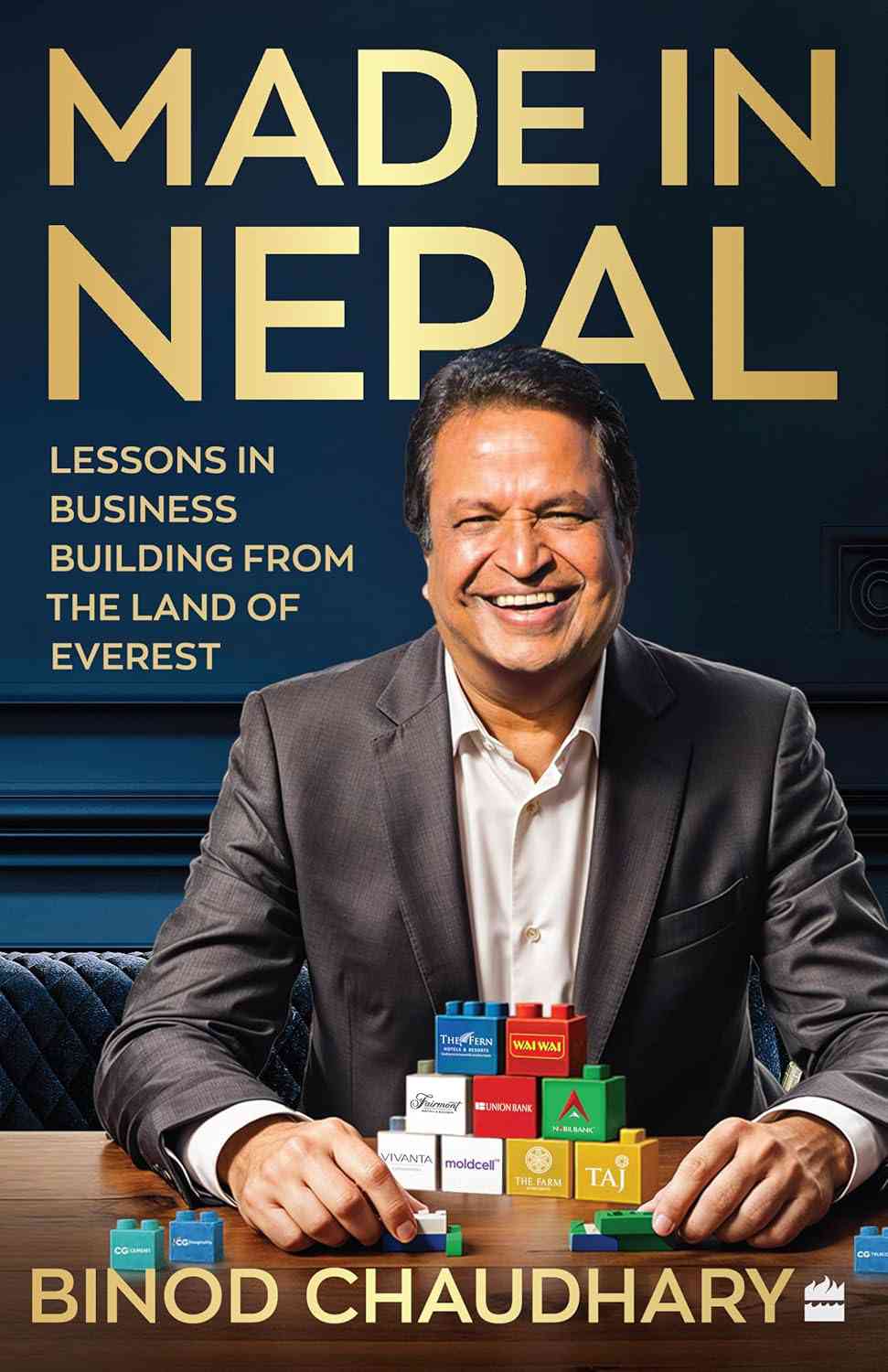
Excerpted with permission from Made in Nepal: Lessons in Business Building from the Land of Everest, Binod Chaudhary, HarperCollins India.
