











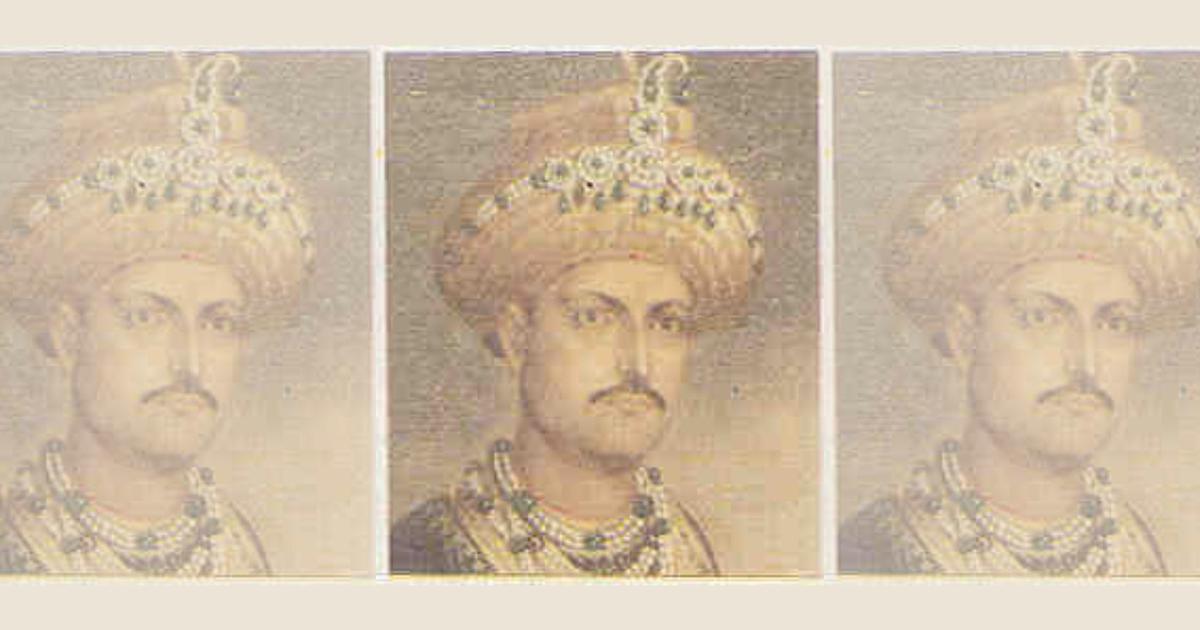
A dynasty of nawabs ruled Awadh, in a subsidiary alliance with the East India Company, from the mid-18th century. Many Englishmen moved into the province to trade, farm and set up plantations. These business houses were protected by Company soldiers, who were paid from the revenues of the Awadh State. The same resources were used by the business houses to supply soldiers to advance the Company’s interests in other parts of India. The arrangement became increasingly detrimental to the Awadh exchequer. The policy of the Governor-General, Sir John Shore, not to directly intervene in the affairs of the Awadh State was reversed when the Company was faced with a nawab who was openly hostile to its increasing influence. The fate which the rebel king had to meet does not paint Company rule in a glorious light and is one that apologists for colonisation might wish to forget.
Alas, it could not be found. There was a frantic search, but still it could not be found. Lost forever was the tragic history of a grave built from lime, sand and brick – and that for the paltry sum of ten rupees.
This is the Kasiabagan Graveyard. Just as the South Park Street Cemetery belonged to the English, Kasiabagan belonged to the Muslims. Two chapters in history buried in two places. One era, one country, two races. One the victor, the other the defeated. The victors sleep in South Park Street Cemetery – the losers, in Kasiabagan.
Din Muhammad, a boy from the adjoining slum, offered to help us find the grave. He knew the burial ground – and knew also that some nawabs were buried there. Of course, he did not know where the graves could be found, but he could read Urdu. He showed us the way eagerly.
The Kasiabagan Graveyard was, truly speaking, Calcutta’s oldest and foremost Muslim cemetery. Sadly, few are acquainted with its glorious past today. They are not moved by the fact that among the eminent who sleep here forever are the nawabs of Mahishur and Awadh.
In this vast area, the graves of nawabs lie forgotten and in a state of utter neglect. The local sawmill stores plywood here and the slum-dwellers use it to dry cowdung cakes in the sun. Din Muhammad shook his head in dismay. He realised that it would be impossible for him to discover a nawab in this cache.
Nevertheless, we searched. We searched until the morning sun had run its course. But our valiant efforts failed to reveal the existence of the mausoleum built at a cost of ten rupees! Perhaps the strength of this meagre sum was insufficient to support the structure against the ravages of 150 years! Perhaps decrepitude and neglect had combined to destroy the tomb and assimilate it with the earth. Perhaps no vestige of the tomb could have survived the onslaught of such unpardonable apathy.
In 1794, Nawab Asaf-ud-Daula had celebrated the wedding of his son, Wazir Ali, with great pomp and splendour, for the then princely sum of 30 lakh rupees. Wazir was his foster son, but this was no reason for the Nawab to spend less, for he was the heir to the throne. He was the future Nawab of Awadh. There were month-long festivities. Invitees came from home and abroad – and even the English interlopers were lavishly entertained.
Three years later, in 1797, Asaf-ud-Daula breathed his last. Wazir Ali ascended to the throne of Awadh. He might well have lived as long as his father and might well have been buried with the same kingly honours. But that was not to be. The young Nawab was a rebel. And as rebellious as another nawab – Siraj-ud-Daula from Bengal!
The English soon saw that Wazir Ali was a foe. He might not be able to defeat them, but he could make life very difficult. It was necessary to be vigilant and to come up with a scheme. They adopted a policy that had been used when dealing with Siraj-ud-Daula. A subversive was identified amongst the immediate family of the Nawab in the person of Sa’adat Ali Khan – the Nawab of Awadh from 1798 to 1814. With the help of this traitor, the English ousted Wazir Ali and rewarded the renegade with the throne of Awadh. Wazir Ali was banished from his state.
The unfortunate Nawab did not have the power to undo this punishment. He travelled to Benaras where, on January 14, 1799, he was summoned to the office of the Resident, George Cherry, who would decide on the deposed Nawab’s next destination. When Cherry came out to receive the Nawab, he was taken unawares. Wazir Ali had not come alone. He was accompanied by his brigade of loyal and fearless soldiers. Cherry had no means of escape and was killed, along with a Captain Conway and a Mr Graham.
Wazir Ali’s enraged followers then proceeded towards the courthouse, where the courageous Chief Judge, Mr Samuel Davis, was able to prevent them from inflicting more harm. According to hearsay, the approach to the court was through an extremely narrow alley, and Davis was able to resist the deposed Nawab’s attempt to enter the court with the aid of a single spear!
Wazir Ali and his soldiers managed to escape to Gorakhpur and subsequently to Jaipur. He remained rebellious till he was eventually captured by the English and deported to the Company’s capital city – Calcutta. This marked the beginning of the English atrocities to liquidate the Nawab.
Under their purported judgment, the rightful heir to the throne of Awadh was condemned to live in an iron cage in a dark room in Fort William. He, who was long accustomed to a luxurious existence, lived his bonded life in utter deprivation. This royal prisoner was not given even the most basic facilities required by a human being. He went hungry and did not get a single drop more than his fixed quota of water. In spite of this barbarous treatment, Wazir Ali lived on for 17 long years as a witness to the brutality of the English. It was when he finally left behind his miserable earthly existence that the unyielding Nawab escaped forever from the grasp of his oppressors. It was the month of May in 1817.
But even his death did not satisfy the English. Such was their vengeance that the keepers of Fort William decreed that not a paisa more than 70 rupees was to be spent on the preparations for his burial. The grave in Kasiabagan served as an example of their utter callousness until time and apathy destroyed it. Din Muhammad has no idea of the extent to which his compatriots have relieved the English by wiping out this monument to their injustice.
The contemporary English knew that 23 years previously, when this young man had got married, the arrangements made had been sumptuous. Many high-ranking sahibs had been invited and extravagantly entertained. So what? Their decision to spend a derisory 70 rupees on his funeral arrangements was insensitive in the extreme. The amount left to pay for the grave could not have been more than a tenner!
Why did the English want to bury the Nawab of Awadh in a grave which cost only ten rupees? Did they want to teach a lesson on the fate that could befall a rebellious native – or perhaps, sermonise on the judgment of god on earth? One thing is certain – they unquestionably managed to record their parsimony in the pages of history! The grave at Kasiabagan remained a testimony to this for a long time. In truth, it matters little that we cannot see it today. The grave built with ten rupees may not be extant, but the history of Wazir Ali is very much alive – and that history will live on.
Excerpted with permission from Sripantha’s Kolkata, Sripantha, translated from the Bengali by Anita Kar, Ratna Books.
