





In the early hours of December 18, 1961, Lieutenant Noel Kelman and a group of fresh recruits under his command were aboard a small Indian naval vessel slicing through the Arabian Sea, headed towards the Portuguese-held Anjediva island, off the Goan coast. They were part of the Indian Navy’s 80-member beach-landing team. Their mission: to capture the island from the Portuguese. This attack was a crucial part of Operation Vijay, the Indian armed forces’ three-pronged assault by land, sea and air to take back Goa after 450 years of Portuguese rule.
Kelman and his crew were not expecting too much trouble. Earlier, when they had been aboard the INS Trishul, a British-built anti-submarine warship, lookouts noticed that the Portuguese garrison on the island had hoisted a white flag on top of a hill. In war, a white flag is a universal call for truce, surrender or a desire to communicate peacefully. But as Kelman’s boat made towards the shore, the Portuguese opened fire with machine guns from the rampart overlooking the beach. Five sailors were killed, and Kelman was shot in both thighs. Bleeding and in pain, he continued onward, zigzagging to make it difficult for the gunners on shore to aim. Behind them, INS Trishul fired back, and quickly the Portuguese realised it was wiser to lay down their arms.
Since Goa is part of India today, you can probably guess how it ended. (India won!) For the Indians, the two-day war is called the liberation of Goa. The Portuguese called it the invasion of Goa. 22 Indians and 30 Portuguese were killed in the fighting. The Portuguese, who had been the first European power to colonise India over four centuries earlier, were the last to leave.
In 1498, another set of Indian sailors in long, narrow boats were cutting through the dark waters of the Arabian Sea, making their way to another historic encounter with the Portuguese. The sailors, probably fishermen, must have been nervous as they approached three strange ships lying off the port of Capocate, a few miles north of Calicut. The ships did not look anything like they had seen before. In the setting sun, the enormous hulking ships must have resembled threatening beasts of the sea, their huge masts and their flapping sails like giant dorsal fins towering over them, and the long metal cannons sticking out of their sides like the whiskers of a menacing mutant catfish.
As the sailors approached, they called out to those aboard the first wooden ship in Arabic, “Where are you from?” “Portugal!” replied a voice from far above them. (Arabic was the language of the open seas.) The fishermen must have decided that the Europeans were here to trade. They were … sort of.
Word quickly spread of the arrival of the strange Europeans. The next day, on shore, a pair of Tunisian Muslim traders bumped into some of the Portuguese. Instead of a friendly greeting, they exclaimed: “May the devil take you! What brought you here?” in Castilian (similar to Spanish).
Their answer? “Christians and spices.” They were not lying.
Religion and trade – this is why Vasco da Gama (c. 1460–1524) set off with a fleet of four vessels on 8 July 1497. He reached Calicut in May 1498. When he returned to Lisbon, he and his surviving crew had sailed a distance greater than that around the world at the equator.
For centuries before Vasco da Gama’s famous voyage, Europeans had to pay very high prices for spices, cotton and silk coming from the east. Arab traders and Venetian merchants controlled all trade from east to west, making enormous profits in the process and refusing to share access to these routes with anyone else. The poor Europeans had to either eat bland, flavourless foods or pay an arm and a leg for simple spices like pepper, cardamom and cloves, which the Arabs shipped from India and southeast Asia (the Europeans called all these lands the “Indies”).
On top of trade jealousies, there was the longstanding enmity between Christians and Muslims. For centuries, the two had fought over religion, territory and trade. Between the eleventh and the thirteenth centuries, Europeans had fought nine religious wars trying to reclaim Jerusalem, the Holy Land, from Muslim rule. By the time of Vasco da Gama, the Crusades were part of a romantic history, but the crusading spirit was still alive. The kings of Portugal, like many European monarchs, wanted to extend the Christian realm,1 find Christian allies and deal a crushing blow to Islam (while also bringing home cheaper spices!).
Vasco da Gama was all ready to do just that. He wanted to convince the local king – who he believed was Christian, since he clearly wasn’t Muslim – to join forces with the Portuguese and defeat the Moors. And while they were at it, he wanted the king to trade with him.
Da Gama soon realized that the zamorin of Calicut was not so easy to impress. The Portuguese might have heard of the rumoured wealth of eastern kings, but nothing prepared them for what they saw in the zamorin’s court – large gold cups, silver jugs, a gilt canopy and a king bedecked in jewels. The gifts that da Gama had brought from Portugal paled in comparison; they were laughable (and the zamorin’s courtiers did laugh).
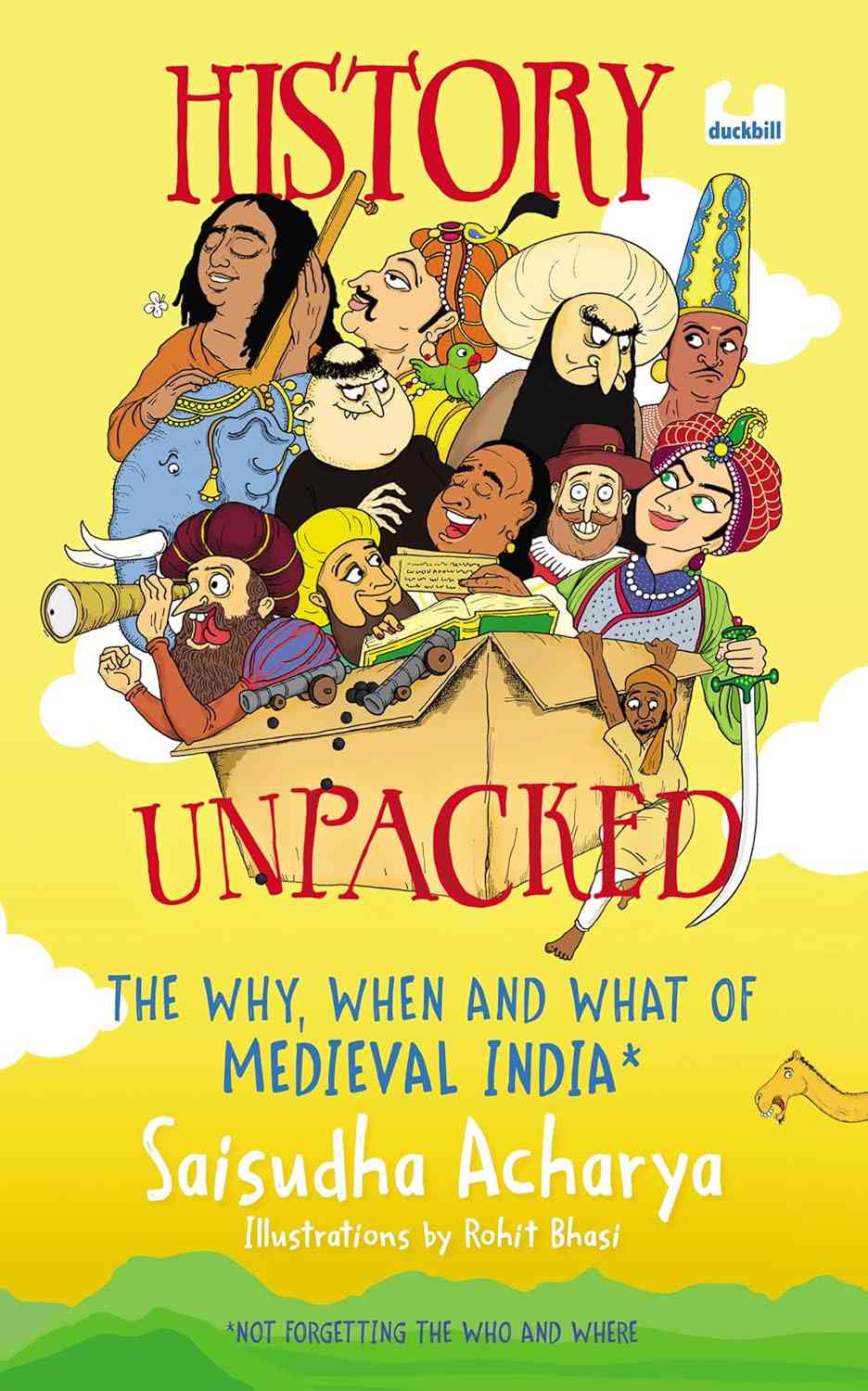
Excerpted with permission from History Unpacked: The Why, When and What of Medieval India (Not Forgetting the Who and Where), Saisudha Acharya, illustrated by Rohit Bhasi, Duckbill.
