












“They were both old, even if they weren’t aware of it in their day-to-day life. In a few years, they would be dead. Was the stray cat found one night in the street really the cause of…?
He mustn’t give in. Joseph wasn’t the only issue. It was him she had wanted to get at through the cat.”
Belgian writer Georges Simenon wrote Le Chat in French in 1967. It has been recently translated into English by Ros Schwartz as The Cat.
The plot, on the face of it, is quite sweet – an elderly man and woman, both widowed, marry to spend the rest of their lives together. It is not a marriage of a successful romance, but one of convenience. She would like to have a man around to fix things when they fall into disrepair; he, on the other hand, has never lived alone. A companion is welcome. What could have been a practical enough arrangement quickly dissolves into a domestic hell. We first meet Émile and Marguerite on an evening when they aren’t talking – the couple communicates by exchanging notes, sometimes no longer than a couple of words. We will soon find out that they do not speak to each other at all.
A domestic hell
Neither has anything to say to the other. Marguerite has made her dislike of Émile well known. She hates his uncouth ways, a sharp contrast to her refined, gentlemanly first husband who played in the Paris opera. As for her, she comes from a wealthy, landed family, and in fact, the street she lives on is owned by her. She is not lacking for wealth or class, and it is only after marrying Émile that she realises how incompatible they are. She prides herself on eating frugally, dressing modestly, and being mild-mannered. She understands neither Émile’s voracious appetite nor his love for cigars, wines, and stinky cheeses. His hairy, coarse skin repulses her – so unlike her dead first husband’s soft, pale skin.
For his part, Émile is not dependent on Marguerite for money. He has plenty saved up and receives a tidy pension too. His gripe with Marguerite has less to do with their temperamental differences and more with her killing his pet cat, Joseph. The stray that Émile rescued from a building site proves to be a thorn in Marguerite’s side. She cannot stand him or their mutual devotion. Émile believes Marguerite killed the cat by feeding him rat poison. So incensed he is by her daring that he too does not think himself above causing her a similar heartbreak – he mutilates her pet parrot so badly that the bird eventually succumbs to its injuries. Not the one to accept defeat so easily, Marguerite stuffs the dead bird and remounts it in its cage – a reminder of Émile’s animal violence and her declaration of permanent animosity.
If Marguerite seems unable to move on from her first husband’s death, so does Émile evoke his first wife Angéle’s memories who was as coarse and boisterous as he is. Marguerite’s sexual frigidity makes him long for Angéle’s vigour. Their compatibilty, as seen by Émile, had less to do with mutual affection and more with their inclination to share a good laugh and have a good time. While it is unclear what Marguerite’s stand on loyalty might be, Émile’s is clear – he has exercised free will in having relations outside his marriages. Angéle made no fuss about it and Marguerite prefers to turn a blind eye.
Their odd marriage escapes nobody’s notice, especially the neighbours and the folks at the market who can make no sense of their relationship. The butcher and the delicatessen owner laugh privately when the husband and the wife queue up separately to buy their groceries. They do not cook for each other or even eat together – each keeps their supplies under lock and key, lest the other were to pilfer or worse, poison it.
In sickness and in health
Simeon establishes the predictability of their routine, where each day overlaps with the other – long afternoons where one keeps out of the other’s way, followed by stuffy evenings where no words are exchanged. All their passions are spent, except for revenge, of course. When Marguerite starts hosting the coarse-tongued Madame Martin at home, Émile worries that the lies Marguerite feeds her about him will become town chatter and he will be put away. To avoid an even worse fate, he packs himself off to Nelly, the owner of a watering hole, proposing that he lodge with her in exchange for rent. The arrangement, though quite pleasurable for Émile, does not work out.
In the meantime, curious things happen. Away from Marguerite, Émile starts to worry about her health – a hypochondriac though she is – wondering how he’d cope if she were to die. He has watched his mother and first wife die; he’s paranoid about history repeating itself. He cannot deal with another death. Marguerite, on the other hand, grows tired of Madame Martin and shows her the door – effectively putting to rest Émile’s fears.
Amid a changing city – construction projects have taken over their Parisian rue – only Marguerite and Émile’s hatred for each other remains unchanged. The Cat, for all its resentment and animal murders, is a story of love at heart. The ghastly instances of abuse are not without humour – it is easy to think of the vindictive couple as bickering children, albeit with more power to cause real harm. Death and murder loom large over the marriage, neither able to predict what will come for them first. Though pathetic and undesirable such a “love” might be, The Cat portrays the extreme view that many marriages threaten to dissolve into – a reluctant acceptance of the (now intolerable) spouse if only from a habit of mutual dependence.
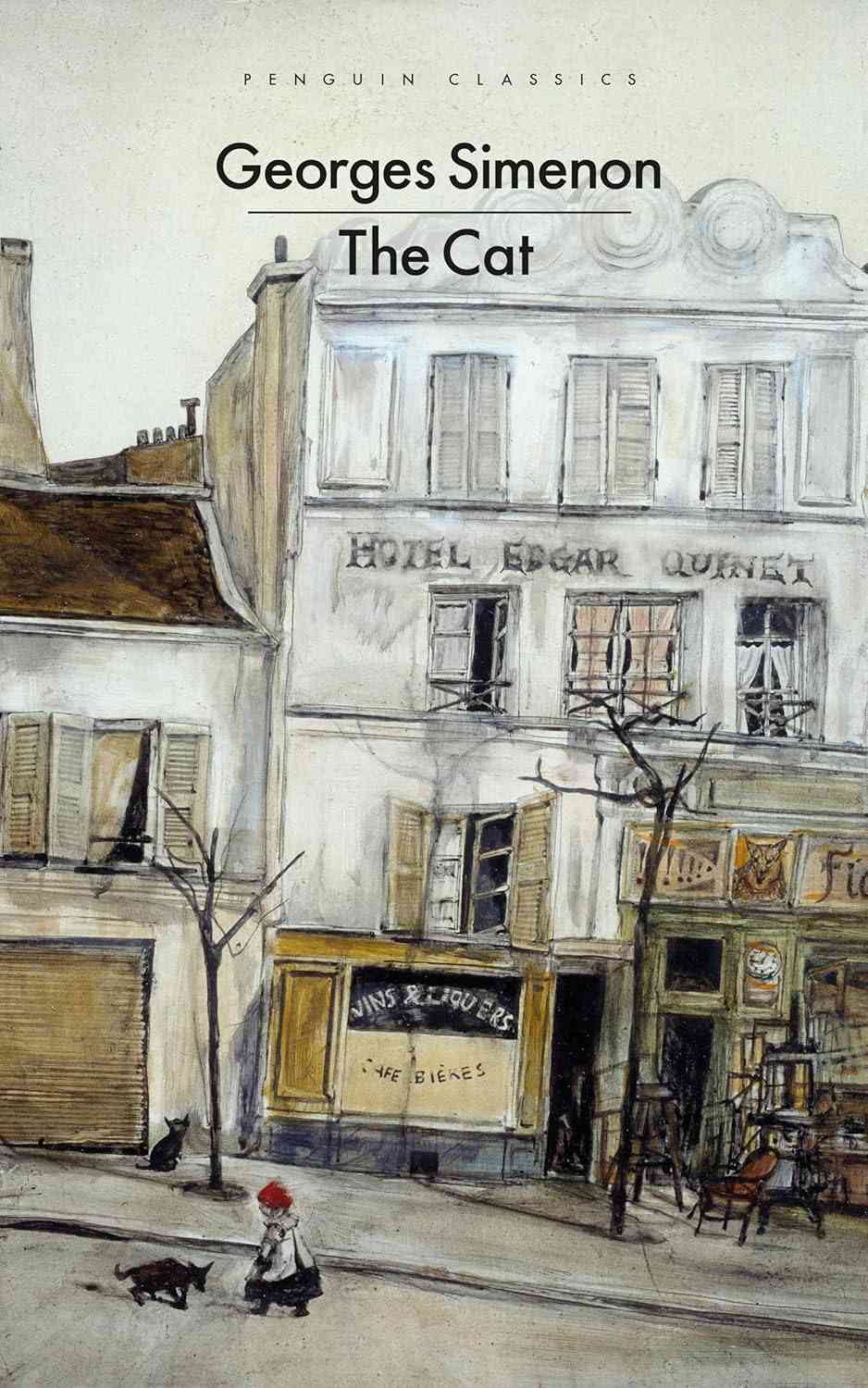
The Cat, Georges Simenon, translated from the French by Ros Schwartz, Penguin Classics.
