










How did the Manusmriti bind Friedrich Nietzsche and B.R. Ambedkar in a tangle? How and why do they come to radically different conclusions about the Manusmriti? While Nietzsche bestowed glowing praise on this text in 1895, Ambedkar consigned a copy of it to flames in 1927. In The Ambedkar–Nietzsche Provocations: The Genius of the Chandala and the Gospel of the Superman, author Ankit Kawade, recipient of the Navayana Dalit History Fellowship, comes to terms with these contradictions. Here’s an edited excerpt from the Introduction, where Kawade explains how and why he came to yoke the two contrarian thinkers.
During my time as an undergraduate in Pune from 2013 to 2016, I often walked past a plush duplex house named “Manusmruti”. This homage to the ancient Brahmanic lawbook, Manusmriti or Manavadharmasastra, was unusual. The owner named on the plaque was a high-caste Hindu woman. What may have caused her to name her house after a 2000-year-old text notorious for its derogatory treatment of women and non-Brahmins?
The disparaging views expressed in the Manusmriti about a large section of humanity are no longer a secret. In November 2022, Tamil Nadu’s Viduthalai Chiruthaigal Katchi, an anti-caste political party from southern India, distributed 100,000 copies of a 32-page booklet containing excerpts from the Manusmriti for free. Thol. Thirumavalavan, the leader of the party, wrote a concise introduction to this booklet. The purpose was to “expose” the origins of the Hindutva ideology. He referred to this campaign as a political stand and described the Manusmriti as the “political manifesto of [the] RSS [Rashtriya Swayamsevak Sangh]”, the Hindu nationalist paramilitary organization. For Thirumavalavan, contemporary Hindutva was simply the bearer of the historical legacy of discrimination against non-Brahmins and women of all castes inaugurated by the Manusmriti.
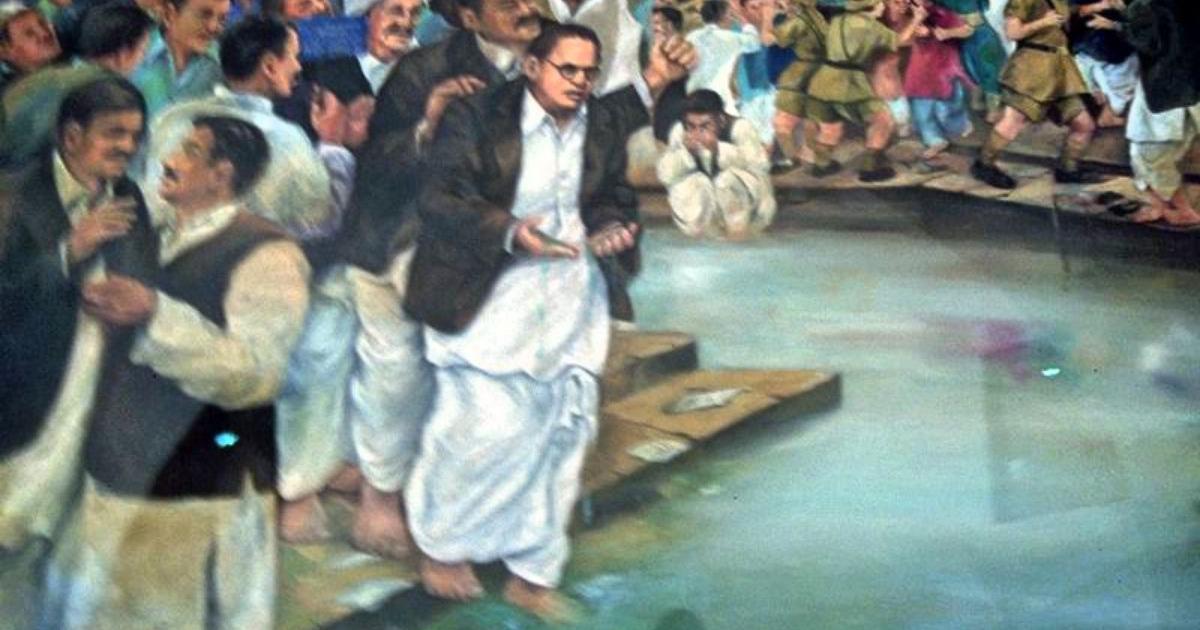
More than 200 years have passed since this ancient lawbook was first translated into English in 1794 by the British Orientalist scholar, philologist, and jurist Sir William Jones (1746–1794), and a little less than a hundred years since modern India’s most revolutionary intellectual, BR Ambedkar (1891–1956), publicly burned a copy in 1927 in Mahad, a small municipal town in western India. In that time, the Manusmriti and its elusive (or even absent) author “Manu” have come to enjoy a religious and symbolic revival.
In 1989, a ten-foot-tall statue of Manu, the progenitor of mankind according to Hindu mythology, was installed in the premises of the Rajasthan High Court in Jaipur. Never officially inaugurated, it was ostensibly built as part of a “beautification” drive. The statue prompted multiple protests and contestations. Within months, the Rajasthan High Court ordered its removal. The pioneering political organiser, strategist, and founder of the Bahujan Samaj Party (BSP), Kanshi Ram – who can be credited with lending the term “Manuwadi” (follower of Manu) popular and political currency – protested against it. However, due to a public interest litigation (PIL) filed by Acharya Dharmendra, a leader of the militant Hindu right-wing organisation Vishwa Hindu Parishad (VHP), the court order for the removal of the statue was stalled in 1989. This PIL, pending for more than thirty years, is said to be the oldest writ petition filed in the Rajasthan High Court. The last hearing in this case in 2015 was disrupted by a protesting group of around four hundred Brahmin lawyers, who feared the removal of Manu’s statue due to renewed protests by Dalit rights activists.
In October 2018, Kantabai Ahire and Sheela Pawar, two Dalit women from Aurangabad, Maharashtra, travelled to Jaipur and sprayed black paint on the statue. They were arrested on charges of “hurting religious sentiments”. In December 2022, the Congress leader Jairam Ramesh said that such a statue within High Court premises was wholly inappropriate in a nation governed by Ambedkar’s Constitution. However, the Congress party, which is in power in the state at the time of writing, has yet to show any interest in removing the statue. In February 2023, the Supreme Court dismissed a PIL demanding the removal of the statue, on the grounds that a similar PIL was pending before the Rajasthan High Court.
Growing up in an Ambedkarite family in Vidarbha, Maharashtra, the names of Manu and the Manusmriti were familiar to me. A frayed, worn-out Marathi copy of The Buddha and His Dhamma in my grandparents’ house marked my first foray into the thought-world of Ambedkar. When my siblings and I were handed this text, we were told how “Babasaheb”, as he is fondly called in most Ambedkarite households, had written this work after his decades-long study of Buddhism. We were told that his study yielded the judgment (phaisla) that the Buddha’s dhamma was the most rational (buddhimatta) and the most ethical (nitimatta) of all world religions, especially contra Brahmanic Hinduism. For my grandparents, the text that epitomised the Brahmanic worldview was the Manusmriti. They had never read it, but knew a few verses (in Marathi translation) from memory. We were also told how a man like Ambedkar, who had around fifty thousand books in his personal library, had publicly burned a copy of this book in order to reclaim our manuski (human dignity), something that was denied to us by the Manusmriti.
Later in my undergraduate years, as a student of German in Pune, when I encountered the writings of Friedrich Nietzsche (1844–1900), I was shocked. Why had Nietzsche bestowed glowing praise on the Manusmriti in his 1895 text The Antichrist? Why was he using a term like “Chandala”, which I had previously known (and heard) only as an abuse used generically against all Dalits or against something or someone perceived as “lowly” or “disgusting”? This set of early encounters has led to The Ambedkar–Nietzsche Provocations, a comparative investigation of how Nietzsche and Ambedkar interpreted the Manusmriti in their writings.
Widely regarded as the most authoritative compendium of Hindu law, the Manusmriti is part of the Dharmashastra tradition of ancient Brahmanic thought, which, along with the Dharmasutras, constitutes a body of texts dealing primarily with jurisprudence. Set in metrical verse consisting of shlokas of thirty-two syllables, the Dharmashastras recorded the normative mapping of ancient Brahmanism, a sweeping worldview of how things and beings ought to be. The Sanskrit scholar and philologist Patrick Olivelle says: “Composed probably in the middle of the second century CE, [The Laws of] Manu represents a watershed in the history of Dharmasastra when the scholarly tradition of debate and disagreement of the previous centuries was abandoned … and the authoritative voice of the author rises to drown out all dissent.” The Manusmriti is also the Dharmashastra which has produced the most textual engagement in Brahmanic literature, with nine commentaries written by authors from circa the 7th (the earliest known commentator, Bharuchi) to the 17th century CE (the last known commentator, Manirama).
Against this lineage of laudatory reception, Nietzsche and Ambedkar enter the scene as its modern interpreters. Their interpretations are undergirded by what the French philosopher Paul Ricoeur calls a “hermeneutics of suspicion”. Ricoeur distinguishes between “recollection of meaning”, constituting one pole in the practice of textual interpretation, and the “exercise of suspicion” inaugurated by the writings of Karl Marx, Nietzsche, and Sigmund Freud in the European philosophical tradition. While “revelation”, “reminiscence”, and “restoration” are the primary modes of handling meaning in the hermeneutics of faith, “demystification” and “deciphering” constitute the fundamental characteristics of the hermeneutics of suspicion. These antipodes distinguish a believer from a critic.
In my estimation, Nietzsche and Ambedkar are two of the most consequential modern practitioners of the hermeneutics of suspicion. While Nietzsche seeks to “transvalue” the fundamental tenets of Christian morality, Ambedkar tries to exhume the violence buried within the Manusmriti. The text surfaces in both their writings at different historical junctures and for disparate purposes. While Nietzsche looked at it from a distance with an exoticising – perhaps even an Orientalising – eye, finding in its rigid hierarchies a sign of strength against the turgid egalitarianism of modern Europe, Ambedkar saw it as the blueprint for an apparatus of hierarchy and domination that he intimately knew and suffered.
Nietzsche and Ambedkar exert an unparalleled force in the history of what Marx called “criticism of religion”. The depth with which the value of the dominant religions of their respective contexts is probed and challenged in their works is perhaps unmatched in the history of modern philosophy. One explicitly declared himself the “antichrist”, while the other swore that he shall not die as a person who calls himself a Hindu, and led the largest recorded religious conversion in 1956 to Buddhism.
This book seeks to fulfil three interrelated aims. First, it tries to associate two significant moments in the history of the modern reception of the Manusmriti and ancient Indian thought, where Nietzsche and Ambedkar constitute two of its significant world-historical readers and interlocutors. This engagement becomes even more significant since Ambedkar had read at least two of Nietzsche’s books, Thus Spoke Zarathustra (1883) and The Antichrist (1895), and most of his references to Nietzsche directly relate to his reading of the Manusmriti. This book is the result of a certain “entanglement” between the history of modern Indian and German political philosophy.
Second, it aims at providing an understanding of the central conceptual concerns of Nietzsche’s and Ambedkar’s philosophies through their interpretations of the Manusmriti. Finally, and perhaps most importantly, this book demonstrates the global salience of what can be called, in its broadest sense, “Dalit history”. Nietzsche’s and Ambedkar’s interpretations of the Manusmriti take this sacred text out of the hallowed and puritanical confines of intended readerships and authorships, and work towards breaking the hermeneutics of innocence that have historically characterised popular and academic receptions of the Manusmriti in South Asia. While Nietzsche’s appropriation of the untouchable name “Chandala” from the Manusmriti for his own purposes is an example of the global or European reach of “Dalit history”, Ambedkar’s refutation of
Nietzsche’s reading of the Manusmriti in his late writings gives us reason to think through the multiple and contradictory intellectual and political consequences of Nietzsche’s anti-egalitarian thought outside Europe.
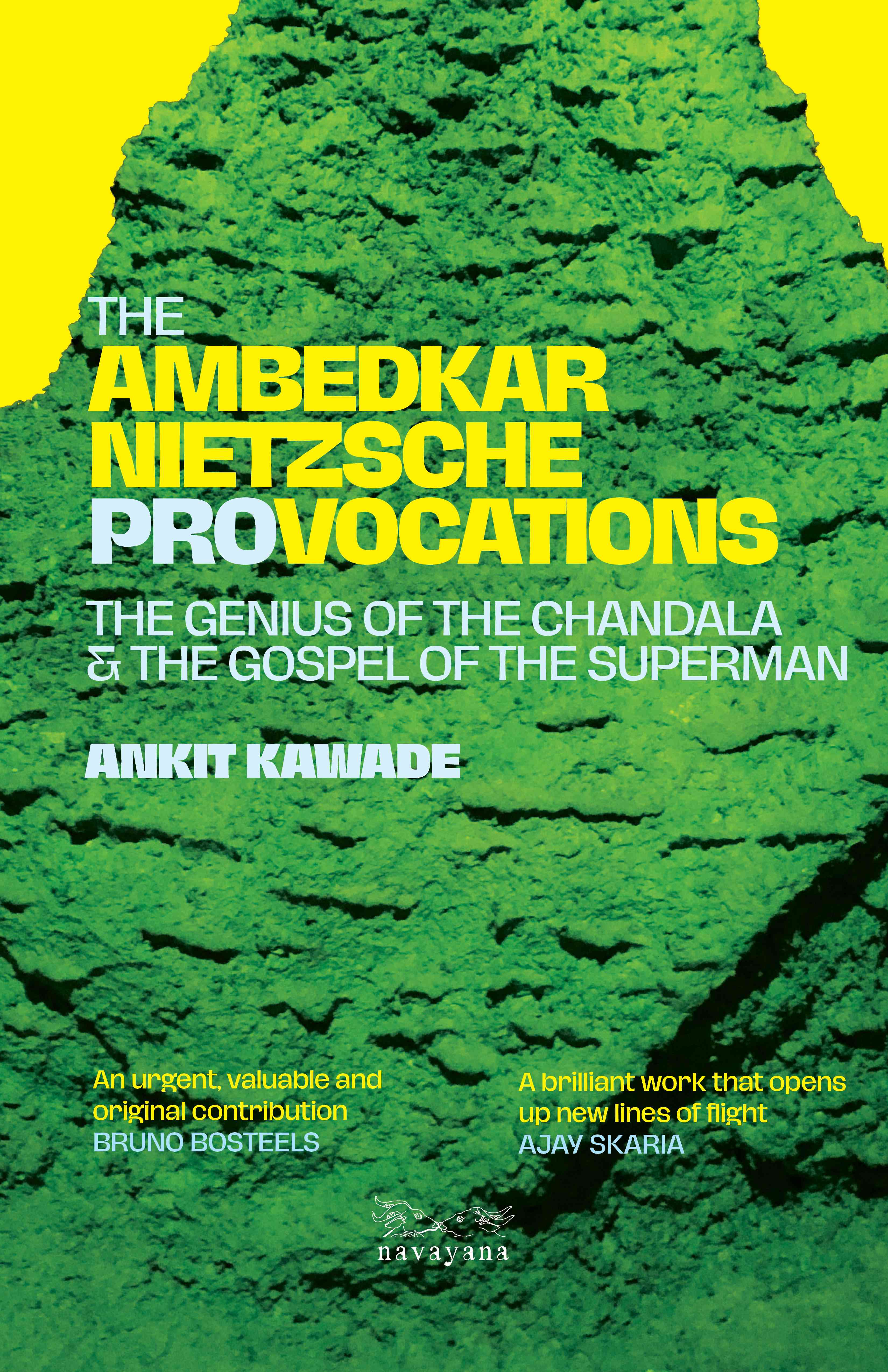
Excerpted with permission from The Ambedkar–Nietzsche Provocations: The Genius of the Chandala and the Gospel of the Superman, Ankit Kawade, Navayana.
