







“One day my children can ask me how a revolution happens, and I’ll serve them up the answer on a silver platter engraved with a gun and a sickle. What actually, really happens after a revolution is something I’ve never heard anyone ask out loud.”
Shida Bazyar’s novel, The Nights are Quiet in Tehran, translated from the German by Ruth Martin and shortlisted for the 2026 International Booker Prize, assumes greater clarity and urgency given the ongoing Iran–America/Israel war. A general dislike for America and a distrust of Israel have long existed among Iranians, and it is perhaps this, coupled with Iran’s strongman politics, that has resulted in the unexpected upper hand over the America-Israel axis.
1979–2009
Bazyar’s novel follows two generations of a family from 1979 to 2009, through protests against the monarchy and the Shah and Obama’s presidential inauguration. Bookended by these two historical events, a family sifts through exile, migration, and homecoming while organising and hoping for a new dawn.
The story starts in 1979, when the Iranian Revolution is in full swing. American-backed Shah Reza Pahlavi has been ousted. There is no new leader and the Ayatollah’s Islamic movement is gaining strength. There are whispers of not just regime change, but an overturn of Iran’s cultural makeup. The possibilities of women’s freedom being curbed, religious orthodoxy taking centre stage, and a more aggressive form of fascism begin to seem all the more real. Behzad, a college student, becomes an active member of the communist movement, charged by both idealism and ignorance. They have overthrown the Shah, but the road ahead is just as hazy. Amid the fear and doubts, Behzad falls in love with Nahid, a comrade. They get married. The couple is in exile in West Germany, their hearts still in Iran.
The second section begins in 1989. This time, the narrator is Nahid. Strong-willed but realistic, Nahid knows she’s an alien in this new country. Most of her time is spent learning the language and reading children’s books, in addition to raising the babies and listening to the news from Iran. Her fiery spirit has been dampened by practical concerns. The revolution is over – the Ayotollah’s terror has been unleashed and a democratic Iran is a distant dream.
Nahid’s life of material contentment brings her little comfort – she is intensely lonely and her talent or education is of no use here. As a mother, she worries about her daughter chewing gum and wearing garishly coloured leggings. Life in Iran might have been tough, but there was warmth, colour, and love. In Germany, everyone and everything looks the same. There are earnest attempts to recreate beloved Persian foods with whatever is available. Behzad too has lost his spark – he has put on weight, drinks beer, and tries too hard to impress his neighbours. Nahid’s loneliness is two-fold – nothing here is like she had envisioned. It is Nahid’s voice that is most affecting in the novel. She is truly in a limbo – unable to restart her life like her husband or accept the new culture as her own like her children. The post-revolution life looks something like this: When the dust has settled, all you’re left standing all alone amidst the ruins.
The next sections are narrated by Laleh and Morad, their children, and the epilogue by Tara, the youngest child.
The new years
Laleh and Morad, who were both born in Iran, have no memories of it. They are as German as their peers but their “foreign” upbringing alienates them. In MUN-style debates at school, Laleh is made to represent Iran and is often questioned whether her opinions are her own or her country’s. Naturally, no other student asked to clarify their stance. A family trip to Iran befuddles Laleh – the excess of love, history, sensory memories. Her cousins quiz her about life in Germany and take her for beauty treatments – despite everything, they are still girls and worry and delight in the same things that girls all over the world do. Then there is Morad, “Mo,” who sees German students protesting for free tuition and young people across the Middle East mobilising for the Arab Spring. To him, both movements are equally distant. Whatever he knows about the Islamic Revolution, in which his parents participated, is through what he has read online. He decides to join the movement for free tuition – this is his political awakening.
The Nights are Quiet in Tehran once again reminds us that the personal is always political. Through a multi-generational first-person narrative, we see how exile and political asylum shape families and redefine history. Even within the family, each deals with alienation and belonging differently, grappling with the unique immigrant experiences of their time. What was a watershed moment in Behzad and Nahid’s is a Google search for Mo. In mere 30 years, history becomes blurry – is this then a betrayal of one’s roots or simply the nature of time? Through harrowing memories of revolutions past and the first-person narrative of a nuclear family growing up between two cultures, the novel is as much Iranian as it is universal in its themes of movement and constant recalibration of identity.
Also read:
International Booker shortlist: Wives cry tears of blood in ‘The Witch’
International Booker shortlist: Daniel Kehlmann’s ‘The Director’ novelises the art of propaganda
International Booker shortlist: The cost of living as a free woman in ‘She Who Remains’
International Booker shortlist: Ghostly men and ghosts of men in ‘On Earth As It Is Beneath’
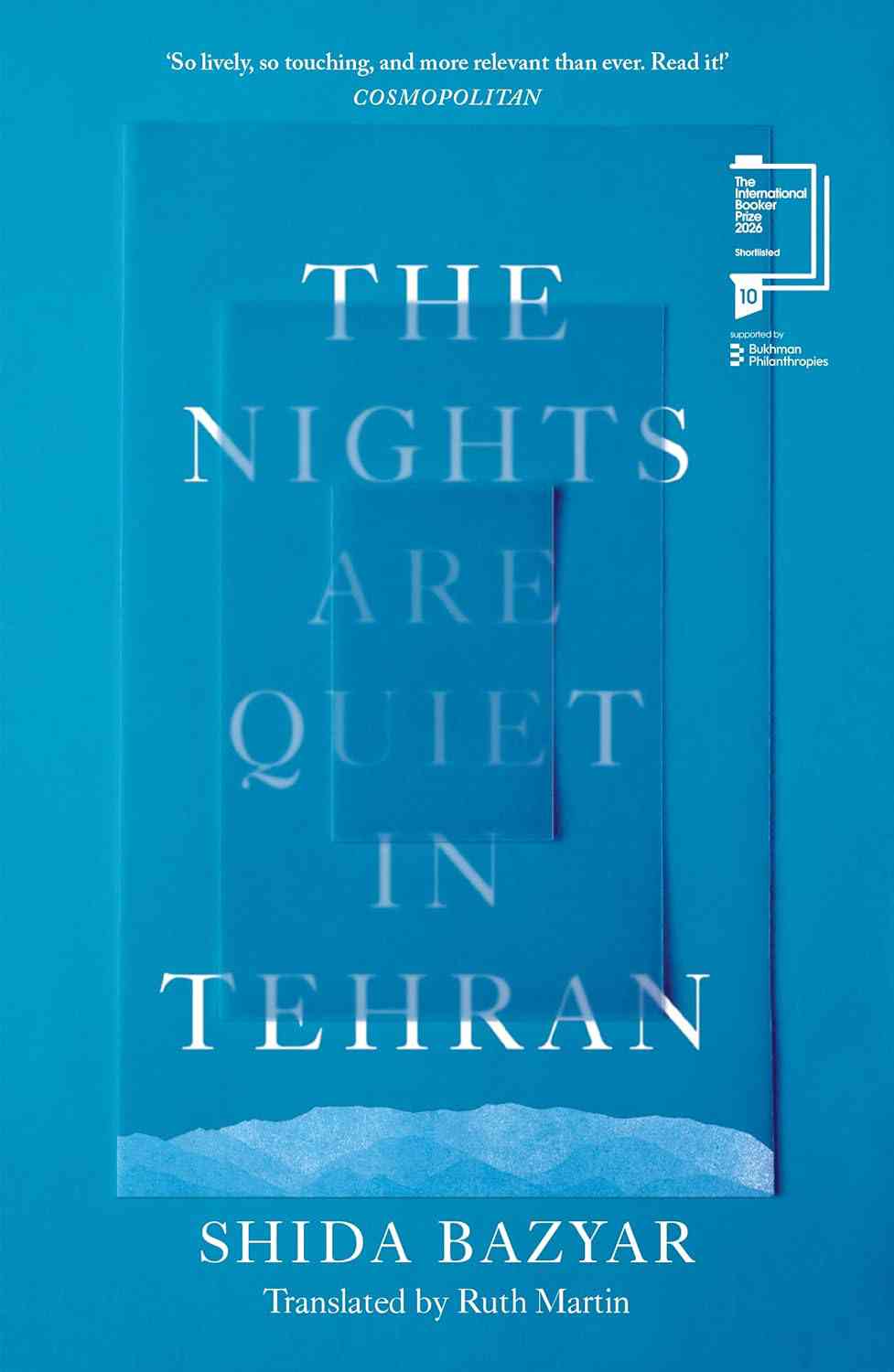
The Nights Are Quiet in Tehran, Shida Bazyar, translated from the German by Ruth Martin, Scribe Publications.
