







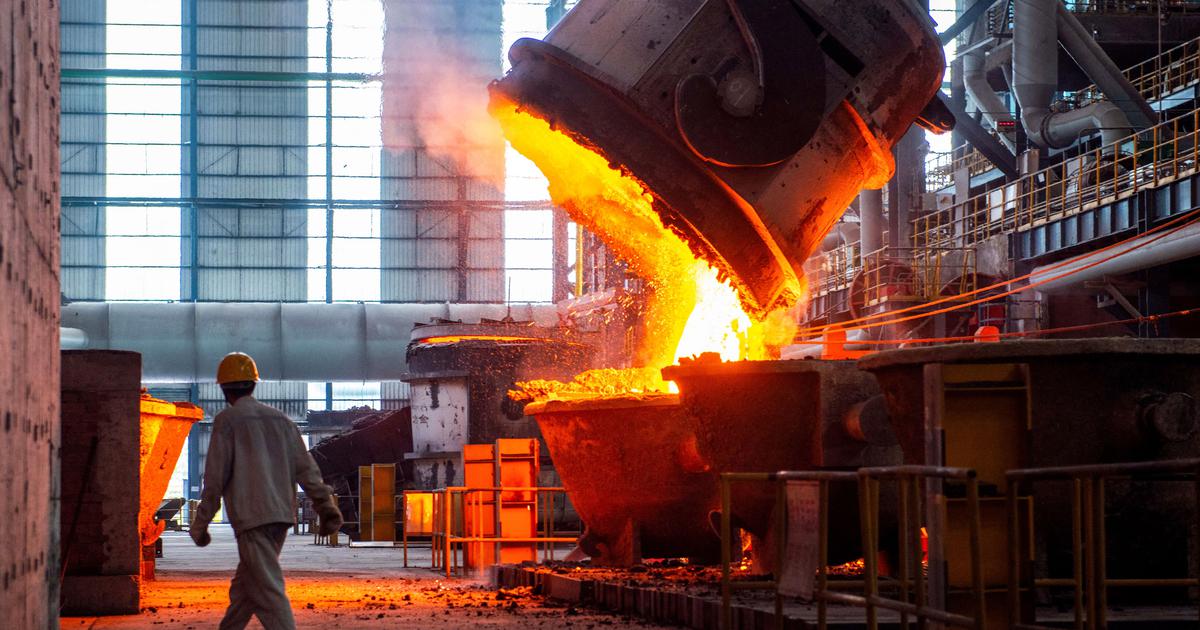
On the afternoon of June 8, as K Pydiraju was handling a reservoir to collect molten steel in the Steel Melt Shop-1 of the Rashtriya Ispat Nigam Limited steel plant in Visakhapatnam, there was a massive explosion in a ladle overhead.
The ladle was filled with molten steel that had a dangerously high temperature of 1,600 degrees Celsius. It spilled on the shop floor, causing an inferno within seconds.
Eight workers died instantaneously. Videos showed blackened bodies on fire on the shop floor. When bodies were eventually carried away on stretchers, they were charred beyond recognition.
Pydiraju, a contract worker who did casting work at the plant that is owned by the Union government, was slightly farther away. He and five others suffered burn injuries.
“He was conscious but critical,” said KM Srinivas, who works in the same continuous casting department and helped rush Pydiraju out. “He had suffered over 90% burns.”
A video of Pydiraju, in an ambulance, asking both his children to study well went viral. He was first taken to the steel plant’s general hospital. “There is no burn unit there despite this being an industrial sector,” Srinivas said. “He was referred to a hospital in the city an hour away.”
On June 10, Pydiraju succumbed to his injuries, bringing the death toll to nine.
Since 2025, there have been six major industrial fire incidents in India, including in the Vizag plant. They have claimed at least 70 lives.
Pydiraju worked under Shaikh Zakeer, a chargeman responsible for shop floor production. Zakeer said that a year ago, a similar accident claimed the life of another worker at the plant.
“Back then, the management stressed on standard operating procedures to prevent mishaps,” Zakeer said.
This year again on June 10, within hours of Pydiraju’s death, the plant’s general manager issued a circular. Scroll has seen a copy. It asked workers to “strictly adhere to safety norms and standard operating procedures in the line of production process”.
But workers blame the management for creating conditions that are leading to safety lapses. They blame a manpower shortage, non-adherence to the standard operating procedures and high production pressure for the accident.
Taking cognisance of the matter, the National Human Rights Commission has issued a notice to Andhra Pradesh’s chief secretary for a detailed report.
Staff shortages and safety hazards
The blast occurred in a continuous casting department, which transforms molten metal into solid, semi-finished shapes such as billets or slabs.
Srinivas said that in this process raw materials such as ferro manganese, ferrosilicon and aluminium are added to molten steel.
“The quality of raw material is important,” Srinivas said. “It is equally important that no moisture is left behind. The entire procedure requires a certain amount of time.”
He added: “Often there is production pressure and the processing time is cut short. That is a safety hazard.”
These procedures also require working under high temperatures. Foreman Zakeer said that production demand is so high that “workers hardly take a break from the heat to rest outdoors”.
He alleged: “One employee is doing a job meant for two, sometimes three.”
Pampana Bhanumurthy, a general foreman, said that over the years, a large number of employees have been asked to take voluntary retirement but new recruitment has not been undertaken
The total manpower at the Rashtriya Ispat Nigam Limited steel plant is approximately 18,000. Of these workers, 8,000 are permanent and 10,000 are contractual employees, Bhanumurthy said. “This is half of the required strength,” he said.
About three years ago, Zakeer said, the management changed the salary structure of the workers. “Instead of a fixed salary, they said we would get a salary based on our production output,” he said. “If production is 70%, my salary is 70% of the Rs 50,000 that I used to get earlier.”
This has added to the pressure on workers to produce more, even at the cost of physical exhaustion and their own safety. The union approached the labour court challenging the management’s decision to link salary with production output, but the case has been dragging on, workers say.
Workers said that since 2014, the Union government has been pushing for the plant to be privatised, a move that the union has resisted.
“They say that the plant is making losses and the production is poor,” Zakeer said. “But nobody is talking about increasing the manpower.”
Andhra Pradesh Deputy Chief Minister Pawan Kalyan said that a three-member committee will look into the allegations and announced that kin of the permanent employees who died will receive Rs 1.7 crore compensation.
“It is a lie,” Srinivas alleged. “The ex gratia is just Rs 25 lakh, as far as we know. The rest is PF [provident fund] and insurance amount. That is not compensation.”
Here is a summary of last week’s top stories.
Free and fair polls? The Supreme Court dismissed a petition by Congress leader Meenakshi Natarajan challenging the rejection of her candidature for the Rajya Sabha elections in Madhya Pradesh. The bench declined to exercise its writ jurisdiction citing Article 329 of the Constitution that bars courts from interfering in electoral matters.
However, it allowed Natarajan to file an election petition challenging the poll result before the High Court.
Natarajan was the Congress’ sole candidate for the June 18 Rajya Sabha elections in Madhya Pradesh. Her nomination was rejected on Tuesday after the Bharatiya Janata Party claimed that she had withheld information in her affidavit about a criminal case against her in Telangana.
The Congress leader contended that only criminal cases where charges have been framed need to be disclosed but she had only received a notice from a magistrate.
While the BJP has sufficient MLAs in the state to get only two of its candidates to win, a third was also declared elected unopposed after Natarajan’s nomination was rejected.
Indian crew under attack. New Delhi twice summoned the United States’ chargé d’affaires after strikes by the US military on commercial ships in West Asia for allegedly violating sanctions and the blockade.
The US military’s actions were “unacceptable” and undermine the safety of maritime commerce, the Ministry of External Affairs said. It added that the diplomat had been asked to convey New Delhi’s concerns to Washington and ensure that the US military units operating in the region take measures to prevent the loss of civilian life.
This came after three Indian seafarers were killed on Wednesday when the US military struck a Palau-flagged commercial tanker off the coast of Oman. Twenty-one members of the crew had been rescued.
On Thursday, 20 Indian seafarers on board another ship were evacuated after it was struck off the Omani coast. On Monday, 24 Indian seafarers were rescued from a tanker Marivex after it was targeted by the US.
Trinamool implodes. Three Trinamool Congress Rajya Sabha MPs have resigned since Monday, and two of them quit the party amid internal divisions after it lost the West Bengal Assembly elections to the Bharatiya Janata Party in May.
In the Lok Sabha, at least 20 of the TMC’s 28 MPs, led by party leader Kakoli Ghosh Dastidar, wrote to Speaker Om Birla on Monday, declaring their support for the ruling National Democratic Alliance.
Last week, at the state level, expelled MLA Ritabrata Banerjee claimed that a group of 58 of TMC’s 80 legislators had been recognised as the party’s legislature wing in the Assembly.
Anant Gupta explains why the Trinamool Congress is collapsing like a house of cards.
Also on Scroll last week
- A tourist rush is swamping Himachal Pradesh – and the environmental cost is heavy
- ‘We want accountability’: Voices from the Cockroach Janta Party’s protest in Pune
- Watch: How heat affects you depends on your pincode
- A Sangh organisation is leading the demand that Christian tribals be delisted
- Bihar to Bengal, the great Indian disenfranchisement now has the Supreme Court’s approval
- India must realise that resilience isn’t an economic strategy – it needs a clear economic philosophy
- The chipped cup, the service lift and other things I had forgotten about India
- Bimal Roy’s ‘Do Bigha Zamin’ and the never-ending race against poverty
- Review: In ‘Main Vaapas Aaunga’, to love is to remember and to remember is to love
- ‘Raakh’ review: A sordid tale of depravity with a few grace notes
Follow the Scroll channel on WhatsApp for a curated selection of the news that matters throughout the day, and a round-up of major developments in India and around the world every evening. What you won’t get: spam.
And, if you haven’t already, sign up for our Daily Brief newsletter.
