





May 24, 2008, Samu’a
Imagine a village on a brown rocky hill. A tractor, a few donkeys, a horse or two, a jumble of stone houses. Imagine the access road to the village, meant to connect up with the larger road that flows into the main north-south route from Jerusalem to Hebron. Imagine a tall mound of compacted earth and rock that blocks the access road completely – one of the 540-odd roadblocks that the Israeli army has put in place throughout the occupied West Bank. Ten meters to the south of the blocked road and parallel to it runs a dirt path that now serves the village; yellow taxis, minibuses, and private cars hobble along it to the point where it somehow impinges on the highway. So what is the point of the roadblock? That is one question.
Samu‘a, like everywhere else in these parts, has a sad history. On November 13, 1966, a few months before the Six-Day War, an Israeli reprisal raid here killed three villagers and wounded 96. The soldiers also destroyed a large part of the village. One Israeli officer was killed. Samu‘a had no connection whatsoever to the incident that set off the reprisal. Then came the war, partly set off, the experts say, by the raid. Did the raid serve any sensible purpose? That is another question.
Today we are going to take apart the roadblock with our bare hands and a shovel or two. We know it’s a quixotic plan. Probably the soldiers won’t let us achieve this goal; and even if we do succeed, the army will simply rebuild the barrier, reinforcing it this time with immovable concrete, within hours. All this is certain. Why, then, are we doing this? That question, at least, has an answer.
It is late morning by the time we turn up at the entrance to Samu‘a. Some eighty or ninety villagers, young and old, are waiting, milling rather aimlessly around the blocked road that is lined on one side with ancient olive trees. We thought we would be joined by a large party from the Combatants for Peace, but we soon learn that the main bus of Combatants has been stopped by the police—who are, as always, well informed – at the Tunnels on Highway 60 near the southern edge of Jerusalem. Another busload coming north from BeerSheva was turned back by police at the Green Line, before they could enter Palestinian territory. That leaves us, one minibus full of Ta‘ayush volunteers and observers, including my good friend Jyotirmaya Sharma from Hyderabad (on his first visit to Israel-Palestine) and Yael, a documentary filmmaker from Toronto. A small group of Combatants, young men and women led by Moshe Pesach, has somehow managed to make their way here by private cars. Ezra, the real hero of South Hebron, has brought along his nephew Shimon, just returned from a long trip to Australia; Shimon has never been in these hills and seems to have no clear idea of who is who out here in the Wild East. He knows there are settlers, and Palestinian villagers, and soldiers of various kinds, and policemen, but quite naturally he finds it difficult to make sense of the undecipherable jigsaw that presents itself to his fresh eyes. Why, he asks me, have they put this useless roadblock here? That question again.
The soldiers are, of course, waiting, too – a small row of reservists, as it turns out, perched on a ridge overlooking the battleground-to-be. They are, as usual, weighed down by their guns and tear-gas canisters and ammunition and who knows what else. That is one thing about soldiers: they are always carrying heavy things around, from one arbitrary point to another. This seems to be their true purpose in life; I remember it all too well. It is hot by now, and they are surely sweating in their uniforms and black boots. Some of them nonchalantly keep their guns trained on us. I wonder when their reinforcements will turn up. I wonder how much time we have.
Might as well begin. At first it is a simple enough matter of moving aside the surface rocks. The mound definitely looks capable of resisting our collective efforts: we poke at it, we kick it, we scrape away the top layers, but it is as if we have made no dent. After some time a pickax and a shovel or two appear. They help. It is pleasant working under the sun, side by side with the Samu‘ans. At the same time, there are those familiar, insidious thoughts. Though I’m not fond of the symbolic, today’s effort will, I know, be only that. Maybe “only” is not the right word.
Moshe, meanwhile, is addressing the soldiers – trying, I think, to ensure that they stay on their ridge and don’t start shooting rubber bullets. “This is your chance,” he says to them, patiently, calmly, slowly articulating the words so he can be sure they are heard. “You can meet real people today – the people you think you have the right to control, the people you don’t allow yourselves to see. You think they’re your enemies, but everyone here is devoted to peace. They just want to be free, and they will be free, and not through violence. Come down and talk to them. Listen to what they have to say.” And so on. The soldiers look right through him. Beside him stands a Palestinian doctor from Halhul, not far down the main road, and he, too, has much to say to the soldiers. He speaks to them in English. “Someday you will put down those guns. You will take off those uniforms. You will come over to our side. You don’t believe me, but I know that it is true. You will let your real nature, your goodness, come out. Then you will not understand how you could stand there, threatening me, today.”
By now these soldiers are far from alone. An impressive array of police jeeps and armored vehicles have joined them; and we recognize the police officer who has arrived from Kiryat Arba to take command of this dangerous crisis. He is heavyset, heavy-jowled, short of stature, and mean; we know him from long experience in these parts. He takes the megaphone and barks at us, as is his wont: “What you are doing is illegal. Stop at once or face arrest.”
Sometimes I wonder if they will ever realise that their threats only spur us on.
Amazingly, by now the once-large mound has been whittled down almost to ground level, but there is a major problem: an enormous boulder has been exposed, clearly the lynchpin of the whole foolish edifice, and it doesn’t look like we can move it. Ropes are brought from the village; we tie them to the boulder, we line up along the length of the road and, at the signal, strain and pull together, but the stone won’t budge. We try again and again, as the snarling from the direction of the soldiers becomes more raucous and insistent. I notice that a detachment from the Yasam – Israel’s dark-clad riot police, not famous for their tender ways – has also pulled up beside the other military vehicles. I can guess what comes next.
First, however, we make one or two last-ditch attempts.
A tractor backs up toward what is left of the barrier, and the ropes circling the boulder are attached to it from behind. The tractor groans, tries to drag the rock away. The ropes slip off. We tie them again. They slip off again. I am not sure how many times this hopeful ritual is performed before the Yasam come rushing at us down the road, over the dirt we have dug away, over the stones, past the decapitated roadblock, toward the village. The Palestinians, familiar with such moments, retreat hastily toward their homes and the olive groves. For our part, we mostly melt away at the side of the road. So far, no one has been hurt.
Moshe tells me later that he was sure they were about to shoot; he could see their fingers itching at the triggers. Thankfully, something held them back today – the photographers perhaps? Who can say? These things don’t look so good on the evening news. But at Saffuriyya in the Galilee, just ten days ago, the riot police ran amok, and many peaceful demonstrators were hurt. Maybe there is no rhyme or reason. I’m glad they didn’t shoot.
This is not quite the end; the story twists back upon itself to allow a happy irony to emerge. Ezra has parked his big black car on the side of the main access road, far from the scene of conflict, close to the village, and taken off for some safe haven; he can’t afford to get arrested. He has so many trials pending, an organic cumulation from years of active struggle to help the people of South Hebron, that a new arrest may land him in jail for long months. The keys to the car are, however, in the ignition, and innocent Shimon is sitting by the wheel. The police drag him from the car which, they now inform us, they intend to tow away – on the truly astonishing charge of obstructing the flow of traffic. I can only admire their ingenuity, since they are the ones who blocked this road in the first place with the barrier we have just dismantled. Let no one say the police of South Hebron are uncreative. Yet they may not notice the irony, for when Shimon asks them, with blank incomprehension, why they are taking away the keys, they pounce on him and arrest him, of all people. Amiel and Assaf try to intervene and are arrested as well, this time on the charge of obstructing a policeman who is discharging his duty. The three are carted off to the waiting vans, Shimon evidently horrified and confused. We can hear him asking them plaintively, over and over, “But what did I do wrong?”
Another good question. I guess it was a good day, as days go in the South Hebron hills. The internet news channels carried the story: a mixed group of Palestinians and Israelis took apart a roadblock near Samu‘a before the security forces charged and made arrests. Perhaps it seems a matter of little consequence, to say the least, something on the very edge of invisibility and beneath the threshold of meaning. And so it is. Perhaps it wasn’t really worth the effort. When the Tel Aviv bus of the Combatants finally managed to get through, some hours later, the Yasam riot troops were still waiting for them; they made three more arrests and broke the arm of one young Israeli girl, a computer programmer who was taken to the hospital and then, with her new cast, to the Kiryat Arba jail. Ezra, lured by the purloined car keys to the same police station, was arrested as soon as he went in (that is what they wanted from the start); he spent the night there, until someone realised, in the morning, that they had no warrant to tow away his car after all. So he was sent home. He’ll be back tomorrow or the next day, and we’ll be coming back, too.
Some risks are worth taking, but it’s better not to ask why. Then there are the risks that you have to take if you want to feel human. Perhaps one of those children from the village who watched us pulling at the rope, Jews and Arabs, young and old, men and women, before the soldiers charged, will remember this day, and the memory will change his life. I know Jyotirmaya won’t forget: a Gandhian moment in the middle of nowhere, with no obvious results – all the better for that. A dusty sweetness infused the day. Maybe our doctor friend is right, and eventually the soldiers will put down their guns. After all, every one of the Combatants for Peace used to carry one, and look where they are today. I’m sure the roadblock is back by now, the village taxis are creaking over the parallel dirt track beside the olive trees, the shepherds have been attacked again, the settlers have stolen another Palestinian field or two, and some imbecile of an officer, even as I write, is sitting in his headquarters happily planning another raid.
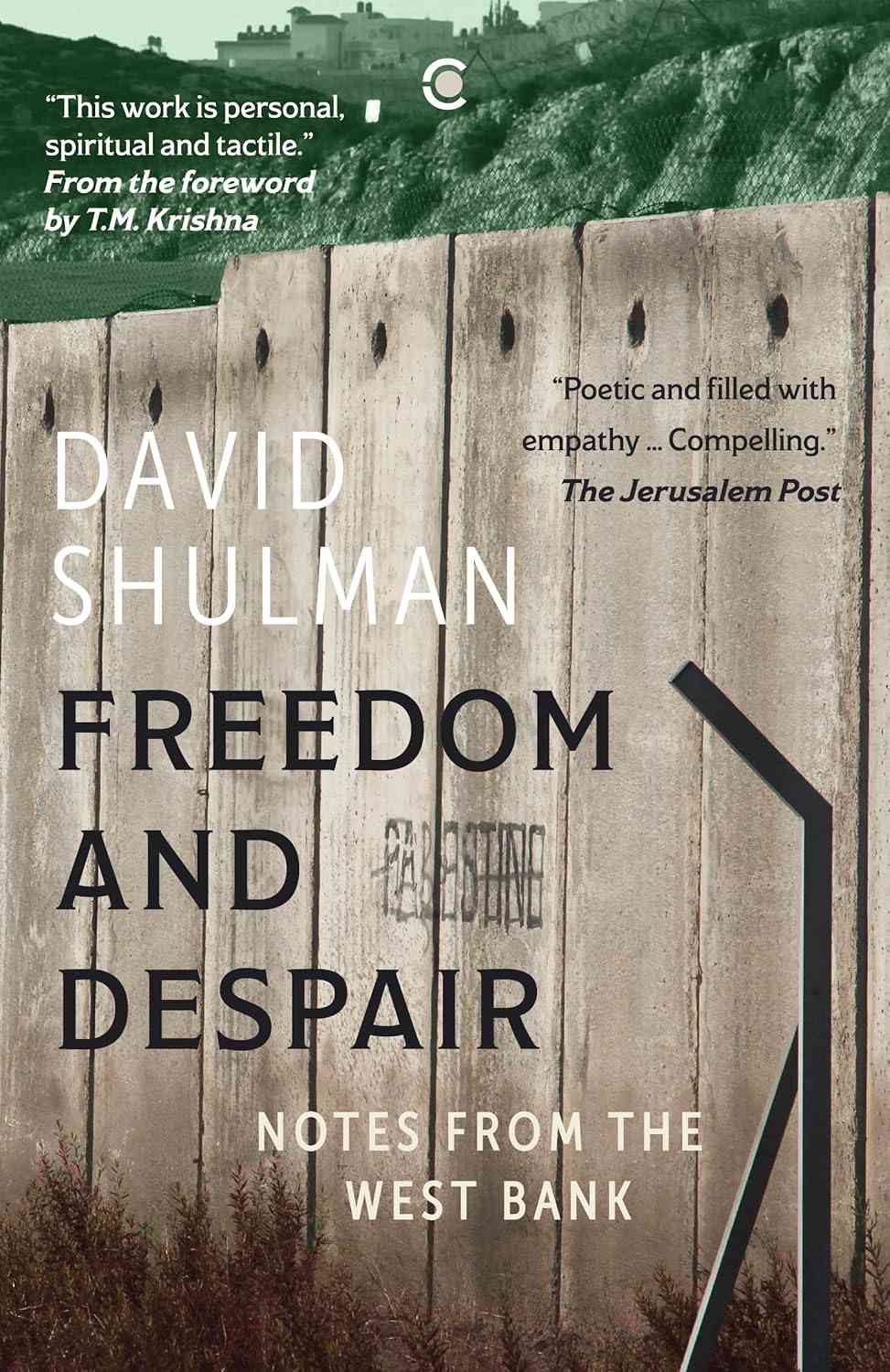
Excerpted with permission from Freedom and Despair: Notes from the West Bank, David Shulman, Context/Westland.
