



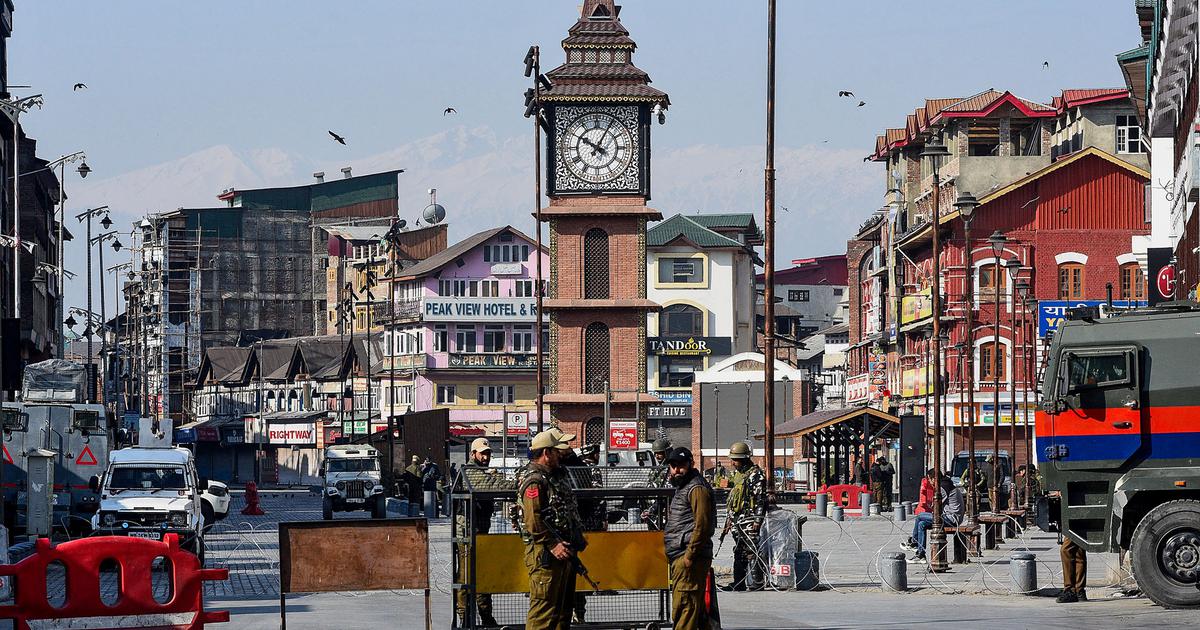
Few Kashmiris have not heard the name of Insha Mushtaq. Even if they haven’t heard her name, almost every Kashmiri is likely to have seen an image of her disfigured face.
On July 11, 2016, as protests broke out in southern Kashmir’s Shopian district, Mushtaq, as you’d expect any curious adolescent to do, opened her window to see what was happening in the street below. Three days earlier, the security forces had killed popular militant commander Burhan Wani in an encounter and the Valley was angry. In a flash, Mushtaq’s face was hit by a volley of pellets fired by security personnel trying to quell protesters.
The pellets hit her face, skull and eyes. That was the last time she saw anything. Mushtaq’s bloodied face, with dozens of small wounds caused by pellets, has come to exemplify the horrors unleashed by the use of pump action pellet guns by security forces in Kashmir.
She wasn’t alone. In 2018, Mehbooba Mufti, the Jammu and Kashmir chief minister at the time, informed the state Assembly that more than 6,000 persons had been injured by pellet guns in Kashmir between July 2016 and February 2017. Of these, 728 had been hit by pellets in their eyes.
At least 54 persons had their vision impaired due to pellets. Between July 2016 and August 2017, seventeen civilians succumbed to injuries sustained from pellets, data presented in Parliament showed.
International media outlets such as The Guardian and The New York Times described the action by the security forces as the world’s first “mass blinding” and an “epidemic of dead eyes”.
However, the makers of actor Ajay Devgn-starrer film Chauhaan seem to believe that the pellet guns inflicted only “limited damage”. In a 2.24-minute teaser released on June 25, Devgn’s voiceover describes traditional crowd control methods such as tear gas, water cannons and pellets used by security forces in Kashmir as ineffective.
Pellet guns were first used in Kashmir during the 2010 summer uprising when the Centre, during the tenure of the Omar Abdullah government, introduced pump action shotgun pellet guns as an “alternative method” for crowd control. That year, more than 100 civilians were killed in police firing during the protests.
The Chauhaan trailer has outraged Kashmiris. “The movie is bluntly demanding more violence against Kashmiris next time they dare to come out on the streets,” said a political observer in Srinagar. “At the same time, it negates the suffering of thousands who have been killed, wounded or blinded by pellets or tear gas shells in Kashmir.”
However, for many the teaser is hardly surprising. For several years, Kashmir’s turbulent history has provided grist for Bollywood creators looking to generate xenophobic content that portrays Muslims as bloodthirsty invaders, traitors and conniving radicals.
Many of these projects have been endorsed from the highest realms of the power.
Chauhaan, through its action and bravado, tries to showcase a protagonist adept at dealing with Kashmiris for whom even pellets aren’t enough.
But in Kashmir, pellets represent death, ruined lives, blinded youngsters, maimed faces and a nightmare. There is an army of people across Kashmir whose bodies still carry these metal balls because the doctors extracting them will cause even more damage.
Millions of Indians may have watched the Chauhaan teaser. Mushtaq is unable to be among them. Who cares, anyway, when it’s only “limited damage”?
Here is a summary of last week’s top stories.
Ram temple embezzlement case. The Rashtriya Swayamsevak Sangh urged Hindus to “thwart the conspiracies of anti-Hindu and anti-national forces”, who it claimed were trying to exploit the case about the alleged embezzlement of donations made to the Ram temple in Ayodhya.
The general secretary of the Hindutva organisation, Dattatreya Hosabale, said the alleged thefts from the donation boxes at the temple had “deeply hurt the sentiments and faith of the entire society and Ram devotees”.
He added that the RSS expects the Shri Ram Janmabhoomi Teerth Kshetra Trust, which manages the temple, to treat the matter as an extraordinary one and “take effective steps to rectify all shortcomings in temple management and operations”.
This was the first public response of the RSS, the parent organisation of the Bharatiya Janata Party, since allegations emerged.
Voting rights and electoral outcomes. Twenty-three Opposition parties sent a letter to Chief Justice Surya Kant expressing their concern about the special intensive revision of electoral rolls.
Trinamool Congress MP Sagarika Ghose said that the Opposition had urged the judiciary to look into the manner in which the exercise was “being manipulated” by the Bharatiya Janata Party.
The decision to write to the chief justice was taken at the INDIA bloc meeting on June 8. Though the Dravida Munnetra Kazhagam and the Aam Aadmi Party had skipped the Opposition alliance meeting, they also signed the letter.
Bengal political crisis. Eggs and vegetables were thrown at Trinamool Congress office in West Bengal’s Krishnanagar when party MP Mahua Moitra was inside. On social media, she alleged that “goons” from the Bharatiya Janata Party were responsible. In a video she shared online, a group of persons were seen carrying the BJP’s flag.
The police were also at the spot. “These are no public outbursts,” Moitra said. “These are coordinated BJP attacks. See the BJP flags.”
The TMC alleged that West Bengal has been “spiralling into unchecked violence, fear, and absolute anarchy every single day” since the BJP came to power in the state.
Also on Scroll last week
- An SBI manager questioned in Ayodhya ‘theft’ case was a tenant of Ram temple trustee
- To counter drugs, Ladakh promotes alcohol. Experts say it won’t work
- Why a scholar of citizenship is taking on Bengal SIR exclusions
- How the ‘cockroaches’ at the Jantar Mantar sit-in are keeping themselves busy
- In MP village, Adivasi farmers’ land goes missing from digital records
- As Kshama Sawant runs for US Congress, she’s hoping to shake up both Democrats and Republicans
- El Niño likely to intensify as India’s monsoon advances slowly
- As US switches focus in the Pacific, it’s time for New Delhi to strengthen ties in the Indo-Atlantic
- ‘Pritam and Pedro’ review: A light-hearted exploration of friendship and redemption
- ‘Isakapatnam’ review: Lots of bluster but remarkably little to say
Follow the Scroll channel on WhatsApp for a curated selection of the news that matters throughout the day, and a round-up of major developments in India and around the world every evening. What you won’t get: spam.
And, if you haven’t already, sign up for our Daily Brief newsletter.
