





Long before contemporary debates about migration, multiculturalism and belonging, Dublin was already home to a striking and unconventional figure: Mir Syed Aulad Ali, a Muslim scholar from northern India who became one of the city’s most distinctive intellectual and social icons in the nineteenth century.
His life unsettles many modern assumptions – about religion, identity, and integration – by showing how an early migrant Muslim was not merely accepted into Irish society, but helped shape its cultural and intellectual life.
Today, many associate the presence of Muslims in Ireland with post-1950s student migration, particularly from Africa. Yet, as historians like Craig Considine have noted, many Irish people are surprised to learn that South Asian Muslims were arriving in Ireland as early as the nineteenth century. Mir Aulad Ali stands as the most vivid example of that forgotten history.
From Lucknow to Dublin
Mir Syed Aulad Ali was born in Shahabad near Lucknow, in the princely state of Awadh, one of North India’s most culturally refined regions before its annexation by the British in 1856. He was the son of Mir Zamin Ali, an employee of the Awadh court, and belonged to a respected Sayyid family – an inference drawn from his name, as “Mir” was commonly used among Sayyids.
Records suggest he had connections with the nawab of Awadh and served briefly at court before leaving India.
Mir Aulad Ali served as the Persian tutor to Mirza Muhammad Jawad Ali Shah, the younger brother of Nawab Wajid Ali Shah, the king of Awadh. When Mirza Muhammad Jawad Ali Sikandar Hashmat Bahadur was appointed commander-in-chief of the Awadh army, Aulad Ali continued in his service as an aide-de-camp to his former pupil.
He accompanied Mirza Jawwad to England in 1856, along with the king’s mother and a delegation, to plead the case of Wajid Ali Shah before the British Crown.
Aulad Ali stayed in London and grew fond of the city. It was during his stay there that he came into contact with some British scholars that resulted in him receiving an offer to work as a teacher in Dublin, Ireland – an opportunity that would lead his life in an unexpected and enduring direction.
Dr. William Wright was Professor of Arabic, Persian and Hindustani at Trinity College and took up the same position at Cambridge in 1861.
— Danny Boy (@Care2much18) April 12, 2025
Mir Aulad Ali (28) appointed as his successor.
He became one of the most beloved figures in Trinity, holding that position for 37 years. pic.twitter.com/44owR0PLXC
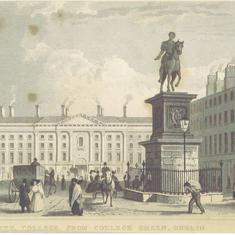
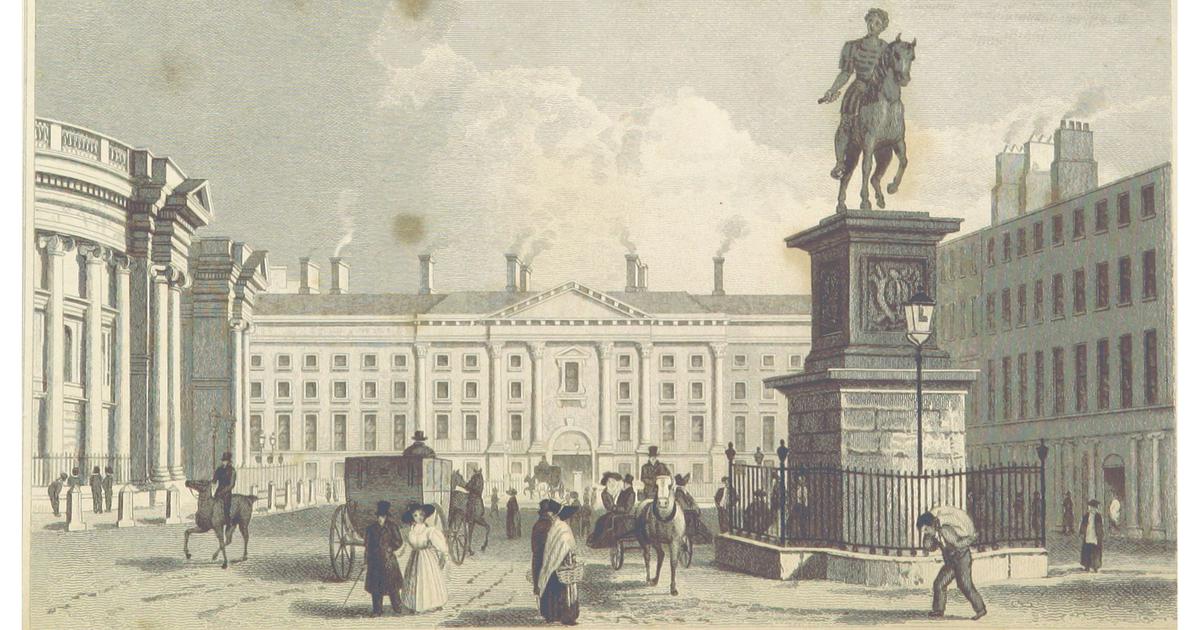
Trinity College Dublin had long sought to establish itself as a centre for Oriental studies, rivalling Oxford and Cambridge. When William Wright, the first professor of Arabic, resigned in 1861 to take up a prestigious post as Syrian Record keeper at the British Library, Trinity appointed Mir Aulad Ali as his successor.
His credentials were examined in October of that year, and he was appointed professor of Arabic and Hindustani on a renewable seven-year contract, with an annual salary of 100 pounds – which was increased as his reputation grew.
By 1873, his remit expanded further, and he became professor of Arabic, Hindustani, and Persian, a position he would hold for nearly 40 years. During this time, Mir Aulad Ali trained generations of students, including civil servants destined for service in British India. He was widely regarded as an exceptional teacher, particularly in Hindustani languages, and earned admiration across academic circles.
His influence extended beyond the classroom. The Athenaeum once remarked that his temporary absence – when he returned to Lucknow to visit family – would be “a sensible loss” to the university. He advised leading Orientalists such as EH Palmer and translated Bosworth Smith’s Mohammed and Mohammedanism into Urdu, further cementing his scholarly reputation.
Man about town
Mir Aulad Ali was no ivory-tower academic. He became a familiar and colourful presence in Dublin’s social world, known simply as “Mir.” Dressed in the traditional attire of northern India, he attended formal events hosted by the Lord Lieutenant and the Marchioness of Abercorn, guided visiting dignitaries around Trinity College, and in 1890 even served as one of the guides for the Queen of Romania during her visit.
He was also a man of surprising physical prowess. At Trinity’s gymnasium in 1872, he captivated crowds during the annual “assault of arms”, a fencing and martial skills competition attended by hundreds. Demonstrating the Indian martial art of binwat, he swung heavy wooden clubs through complex routines – reportedly without removing his ordinary coat, earning prolonged applause from an astonished audience.
Irish language champion
Perhaps the most striking aspect of Mir Aulad Ali’s life was his deep commitment to Ireland itself. Decades before the Gaelic League was founded, he became a passionate advocate for the Irish language. After arriving in Dublin, he learned Irish and went on to become a founding member of the Society for the Preservation of the Irish Language in 1877.
Minutes from the society reveal that he attended almost every weekly meeting at 9 Kildare Street. He held night classes, encouraged men and women of all social classes to learn Irish, and spoke tirelessly at public forums.
In 1887, he argued that Gaelic should be restored as a core element of the Irish education system. English, he acknowledged, was necessary for business and law – but Irish, he insisted, must remain a living language. If it were allowed to die in its own land, he warned, “no words would be strong enough” to condemn that failure.
In this sense, Mir Aulad Ali was fighting for Ireland a generation before the cultural nationalism of the late nineteenth century took formal shape.
Complex religious life
Although born a Muslim, Mir Aulad Ali’s religious life was complex. He married a Christian woman, Rebecca, who remained active in the Church of Ireland, and their son, Arthur Aulad, was raised Christian. Mir himself appears to have become less observant over time, yet he did not abandon his intellectual defence of Islam.
When an anonymous article in The Irish Times attacked Islam as outdated and morally flawed, Mir Aulad responded with a forceful rebuttal. He corrected basic errors – such as the use of “Mahomet” and “Islamism” – and rejected claims that slavery and polygamy defined Islam.
The author, he wrote, confused the failures of individual Muslims with the principles of the religion itself.
At the same time, his actions often transcended religious boundaries. In 1878, he helped raise funds for the Turkish Relief Fund, while the Lord Mayor reminded Dubliners that an Ottoman sultan had once donated generously to Irish famine relief. Solidarity, for Mir Aulad Ali, was not confined to creed.
Mir Aulad Ali died of a heart attack on July 14, 1898. Despite efforts by his son to secure a Muslim imam from London, his funeral was conducted by a Church of Ireland minister. He was buried in Mount Jerome Cemetery, within consecrated ground– an unusual honour at the time, when even Catholics were excluded from such burial spaces.
His tombstone bears a verse from the Gospel of Matthew: “They shall come from the east and west, and shall sit down with Abraham, Isaac and Jacob, in the Kingdom of Heaven.”
Remembered by figures such as WB Yeats, George Bernard Shaw, James Joyce, and AE (George Russell), Mir Aulad Ali lived on in Irish cultural memory. Yeats, in Reveries over Childhood and Youth, evoked him as a symbol of belief and imagination – a man who, as a child, had once “seen a vision in a pool of ink, a multitude of spirits singing in Arabic”.
Dublin Magazine declared, “It was our pleasant experience in those days when his turban adorned the streets of Dublin.”
More than a curiosity or an exotic footnote, Mir Syed Aulad Ali was a Dubliner in the fullest sense: a scholar, a teacher, a linguist, a social presence, and a cultural bridge between East and West. When his turban adorned the streets of Dublin, it did not signal otherness – it became part of the city itself.
Khalid Bin Umar is a history enthusiast with a keen interest in heritage, Sufism, and biographical narratives.
