







Armed forces must be ready for extended conflicts, says Rajnath Singh
The defence minister added that in the current era, national security was not just the domain of the military, but required a ‘whole-of-nation approach’.
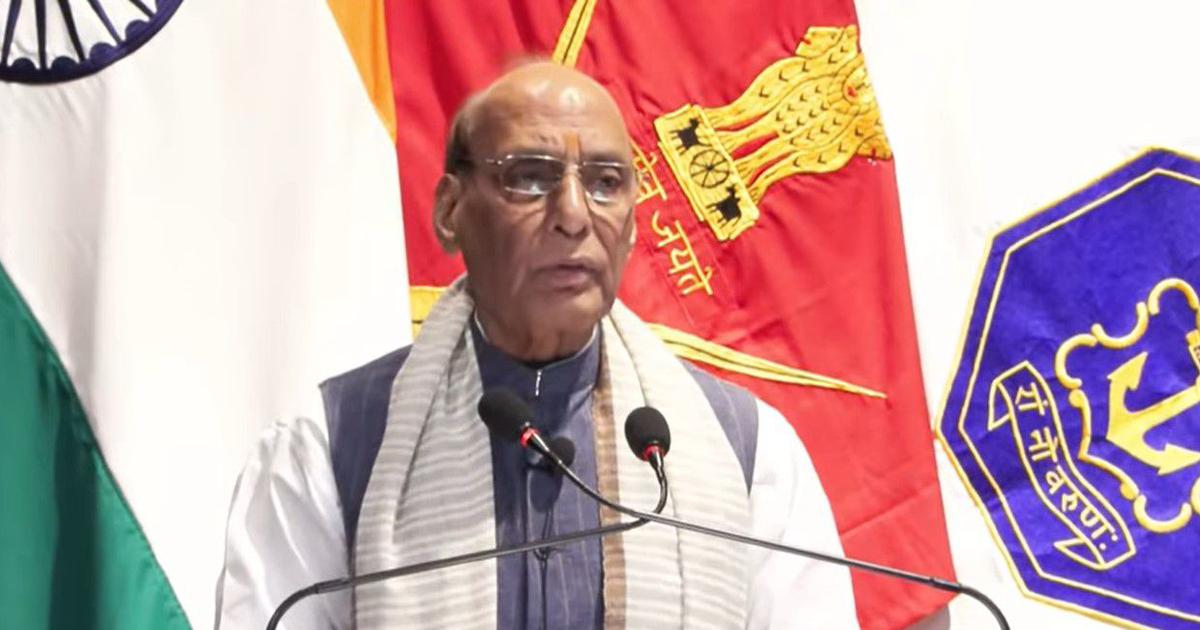
The Indian armed forces must be prepared for diverse security challenges, from short-term conflicts to wars stretching up to five years, said Defence Minister Rajnath Singh on Wednesday.
“In today’s era, wars have become so sudden and unpredictable that it is very difficult to predict when any war will end and how long it will last,” Singh said, speaking during an event at the Army War College in Madhya Pradesh’s Mhow.
The defence minister said that the country must be prepared for the possibility of a war stretching “for two months, four months, a year, two years, even five years”.
Speaking at ‘Ran Samwad’ in Mhow. https://t.co/VpgCaGA06Z
— Rajnath Singh (@rajnathsingh) August 27, 2025
In the current era, any conflict affects the whole country, said Singh. He added that major components of security have come to encompass a country’s economic systems, industrial structures, technological capabilities and educational systems.
“Therefore, the scope of defence preparedness cannot be limited to the armed forces alone,” Singh told the gathering. “National security is no longer just a matter of the Army, but has become an issue of a whole-of-nation approach.”
The minister added: “We do not want anyone’s land, but we are ready to go to any extent to protect our land.”
Singh said that Operation Sindoor, India’s military operation against terror camps in Pakistan and Pakistan-occupied Kashmir, was a great example of the country’s indigenous platforms and weapon systems.
“Its achievements have once again underlined that in the times to come, self-reliance is an absolute necessity,” Singh said. “We have indeed made significant progress on the path of self-reliance, but there is still a long way ahead.”
India launched Operation Sindoor on May 7 in response to the terror attack in Jammu and Kashmir’s Pahalgam, which killed 26 persons on April 22. India claimed to have struck nine terrorist camps in Pakistan and Pakistan-occupied Kashmir during the strikes.
The Pakistan Army retaliated to the strikes by repeatedly shelling Indian villages along the Line of Control in Jammu and Kashmir. At least 22 Indian civilians and eight defence personnel were killed in the shelling.
India and Pakistan on May 10 reached an “understanding” to halt firing following the four-day conflict.
