







Parliament clears VB-G RAM G bill to replace MGNREGA amid Opposition’s protest
Opposition MPs criticised the Union government for ‘bulldozing’ the bill through the Upper House and held an overnight demonstration.
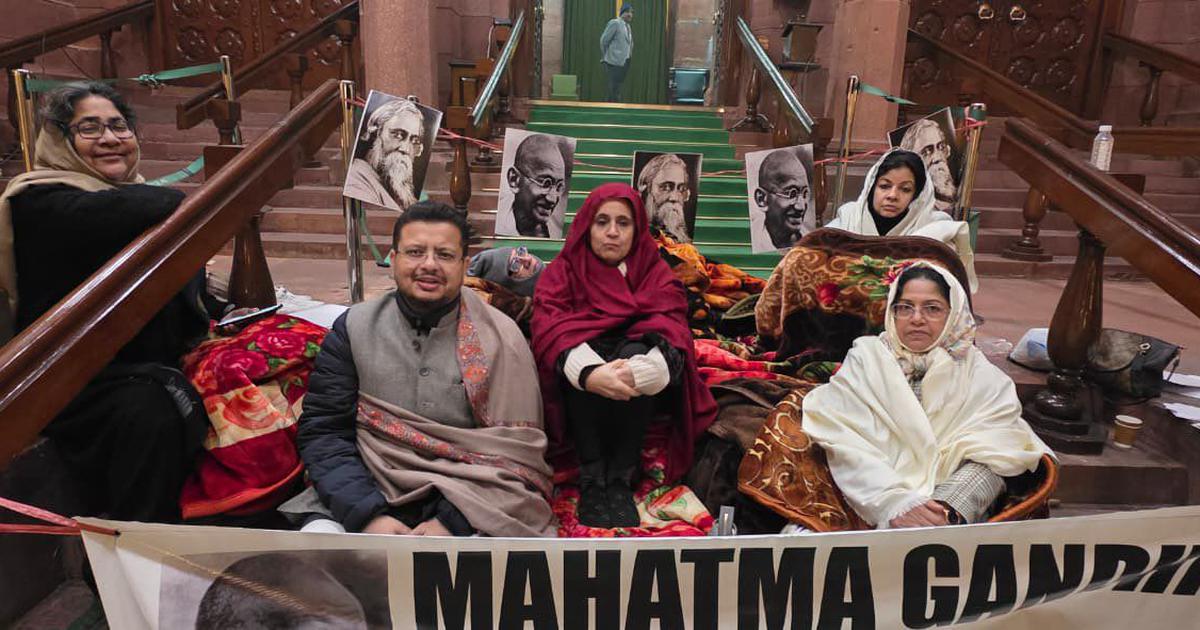
The Rajya Sabha after midnight on Friday passed the 2025 Viksit Bharat – Guarantee for Rozgar and Ajeevika Mission (Gramin) Bill to replace the 2005 Mahatma Gandhi National Rural Employment Guarantee Act amid protests by Opposition parties.
It was cleared by the Lok Sabha on Thursday, even as Opposition members stormed the well of the Lower House shouting slogans against the Union government for dropping the name of Mahatma Gandhi from the scheme.
The bill will now be sent to the president for assent.
The MGNREGA was introduced in 2005 by the Congress-led United Progressive Alliance and aimed at enhancing the livelihood security of households in rural areas. The scheme guaranteed 100 days of unskilled work annually for every rural household that wants it, covering all districts in the country.
While the wage bill for the scheme is borne by the Union government, the states share the cost of materials and administrative expenses.
The new bill proposes increasing the number of guaranteed working days to 125 from 100 and raising the state’s share of the costs to 40%.
After the bill was passed by voice vote in the Rajya Sabha, Opposition leaders criticised the Union government for “bulldozing” the draft legislation through the Upper House and held an overnight protest inside the Parliament complex.
In a social media post, Trinamool Congress’ Rajya Sabha deputy leader Sagarika Ghose said the Opposition MPs were protesting the manner in which the Narendra Modi government had introduced the “anti-poor, anti-people” bill.
“With just five hours’ notice, this bill was given to us,” she said. “We were not allowed a proper debate.”
The Trinamool Congress leader added: “Our demand was such an important bill should be sent to the select committee and let the Opposition parties examine it, let the Opposition parties discuss it, let all stakeholders discuss it, but no.”
Opening the Congress’ statement against the bill in the Rajya Sabha, party MP Mukul Wasnik said that the MGNREGA was passed unanimously in Parliament after undergoing scrutiny, reported The Hindu.
“Can the government say the same thing about this legislation?” he asked, adding that the bill was introduced just days before the Winter Session was to conclude.
The session, which began on December 1, will end on Friday.
“Did you speak to the state governments before increasing their financial liability?” Wasnik further asked. “Were they taken into confidence? And if it has been done, can the government table those consultations in the House?”
All India Anna Dravida Munnetra Kazhagam MP M Thambidurai criticised the Union government for increasing the state governments’ share of the cost of the employment guarantee scheme.
He said that if states are to bear 40% of the costs, then they should also get 100% of taxes and other cesses that the Centre collects.
The AIADMK is an ally of the Bharatiya Janata Party in Tamil Nadu.
The proposed legislation states that the Union government will determine the state-wise normative allocation for each financial year based on “objective parameters”. It also proposed that only the Union government can notify rural areas in a state where the scheme will be implemented.
As per the bill, the governments in the North East states, Himalayan states (Uttarakhand and Himachal Pradesh) and the Union Territories with legislature (Jammu and Kashmir) will contribute to 10% of the scheme’s funding.
The Centre will bear all costs in Union Territories that do not have a legislature.
The proposed legislation retains the provision that a person is entitled to a daily unemployment allowance if work is not provided within 15 days of applying under the scheme. The cost of the allowance will be borne by the state governments.
Also read:
BJP chief ministers wanted MGNREGA to include farm work. Modi government’s bill goes another way
‘A bill to destroy MGNREGA’: Why experts fear the worst from new job guarantee bill
