









‘Sar tan se juda’ slogan challenges the authority of law, India’s sovereignty: Allahabad High Court
While hearing a bail plea, the bench observed that the slogan incites people to an ‘armed rebellion’.

The Allahabad High Court on Wednesday observed that shouting the slogan “gustakh-e-nabi ki ek saza, sar tan se juda, sar tan se juda” constitutes a challenge to the authority of the law, and the sovereignty and integrity of India.
The slogan translates to “the only punishment for disrespecting the prophet is beheading”.
A bench of Arun Kumar Singh Deshwal made the observation while denying bail to a person accused of being involved in the violence in Bareilly in September.
The court observed that the slogan incites people to an “armed rebellion” and is punishable under Bharatiya Nyay Sanhita section 152, which pertains to acts that endanger India’s sovereignty, unity and integrity.
The single-judge bench of the High Court also said that the slogan was against the basic tenets of Islam. It added that the slogan does not have any trace in the Quran or other Muslim religious texts.
The court further said that shouting religious slogans such as “‘nara-e-takbir’ followed by ‘Allahu Akbar’”, “Jo bole so nihaal, Sat Sri Akal”, “Jai Shree Ram” or “Har Har Mahadev” was “not an offence unless they are maliciously used to intimidate persons belonging to other religions”.
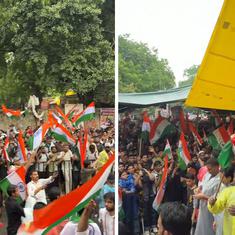
The prosecution argued that on September 26, two leaders of the Muslim community allegedly incited a crowd to gather at a college to demonstrate against “atrocities as well as lodging false cases against the Muslim youth”.
Despite prohibitory orders barring the assembly of more than five individuals having been in place, a crowd of more than 500 persons allegedly gathered and shouted slogans against the government and called for beheading, the prosecution alleged.
A clash broke out when the police tried to intervene, the prosecution argued.
Denying bail to one of the persons accused in the violence, the court said that while the Constitution guarantees freedom of speech and expression, the right is subject to reasonable restrictions.
Shouting the slogan that calls for beheading is “not only against the constitutional object but also a challenge to the lawful authority of the Indian legal system”, the court added.
The bench said that there was sufficient material showing that the bail applicant “was part of an unlawful assembly which not only raised objectionable slogans challenging the authority of the Indian legal system but also caused injuries to police personnel and damaged public as well as private property, which is nothing but an offence against the state and he was arrested from the spot”.
