







Top updates: Trump says he asked China’s Xi Jinping not to supply weapons to Iran
After the peace talks collapsed, the US president had threatened countries with a 50% tariff if they gave weapons to Tehran.
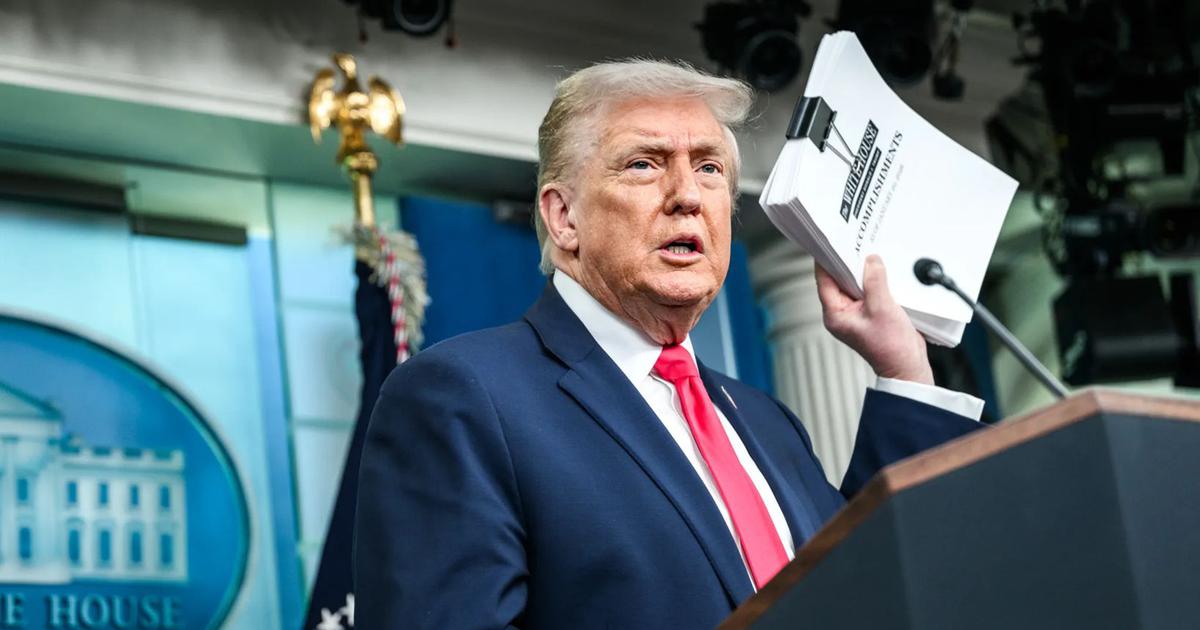
United States President Donald Trump on Tuesday told Fox Business that he has asked his Chinese counterpart Xi Jinping not to provide weapons to Iran.
Xi told him that Beijing was not supplying ammunition to Tehran, Trump claimed in an interview broadcast on Wednesday.
After the peace talks with Iran collapsed on Sunday, Trump had threatened countries with a 50% tariff if they supplied weapons to Iran.
Here are more top updates from the conflict in West Asia:
- A delegation led by Pakistani military chief Asim Munir arrived in Iran for talks on resuming the negotiations between Tehran and Washington, Al Jazeera reported. The delegation will convey a message from the US and plan for the second round of talks, said Iranian state-owned news agency Tasnim.
- Trump claimed on Tuesday that the war with Iran was “close to over” and that Tehran wanted to make a deal with the US “very badly”. “I think it’s close to over, yeah,” Trump said in an interview to Fox News. “I view it as very close to over.”
- The US and Iran had begun peace talks in Islamabad on April 11, but the negotiations ended the next morning without an agreement to end the war in West Asia. However, Trump told The New York Post on Tuesday that additional talks with Iran “could be happening over the next two days” in Islamabad.
- The US president did not say who will represent the country in the possible second round, but said that he would not take part. Pakistan had proposed to host a second round of talks in Islamabad before the two-week ceasefire between Washington and Tehran ends on April 22.
- Trump also told The New York Post that he was not happy with reports claiming that the US had asked Iran to suspend its nuclear enrichment programme for at least 20 years during the talks held in Islamabad. “I’ve been saying they can’t have nuclear weapons, so I don’t like the 20 years,” he was quoted as saying.
- The US military claimed that within 36 hours of the country implementing a blockade of Iranian ports, US forces have “completely halted economic trade going into and out of Iran by sea”. The US Central Command said that the blockade has been “fully implemented as US forces maintain maritime superiority in the Middle East”.
- On Tuesday, US Secretary of State Marco Rubio hosted the first direct talks between Israel and Lebanon in several decades, Reuters reported. Both sides said they held positive discussions, although it was not clear if they arrived at any framework for peace.
- Israeli ambassador to the US Yechiel Leiter claimed that Lebanon’s government made it clear during the talks that it would no longer be “occupied” by Iran-backed militant group Hezbollah, Reuters reported. He did not say whether Israel would stop its attacks on Lebanon. Lebanese ambassador Nada Moawad said the preliminary meeting as "constructive", adding that she called for a ceasefire.
- Lebanon’s President Joseph Aoun expressed hope that the dialogue would lead to an end to his country’s suffering, The Guardian reported. However, he said that stability “will not return to the south if Israel continues to occupy its lands”.
- Foreign ministers of 17 countries, including the United Kingdom, France and Australia, urged Israel and Lebanon to “seize this opportunity” and bring about lasting peace in the region. They called upon “all parties to urgently deescalate and seize the opportunity offered by the ceasefire between the United States and Iran”.
The war
The US and Israel launched an attack on Iran on February 28, claiming that Tehran’s action posed an existential threat to Israel. Washington acts as a guarantor of Israel’s security. Iran retaliated by striking Israel and US military bases in the region and targeting major cities in Gulf countries.
Tehran also effectively blocked the Strait of Hormuz, the narrow waterbody connecting the Gulf to the Arabian Sea, for most international commercial vessels, triggering a global energy crisis. About 20% of global petroleum supply passes through the maritime chokepoint.
Washington and Tehran had on April 8 agreed to a two-week ceasefire to allow further negotiations to end the conflict. While Israel, which was not involved in the talks, has not struck Iran since the ceasefire took effect, it has continued to attack Lebanon. However, peace talks that were held in Islamabad collapsed on Sunday.
Israel has been claiming that Iran is close to obtaining a nuclear weapon, which could alter the regional security balance. Tehran has long maintained that its nuclear programme is for civilian purposes.
