











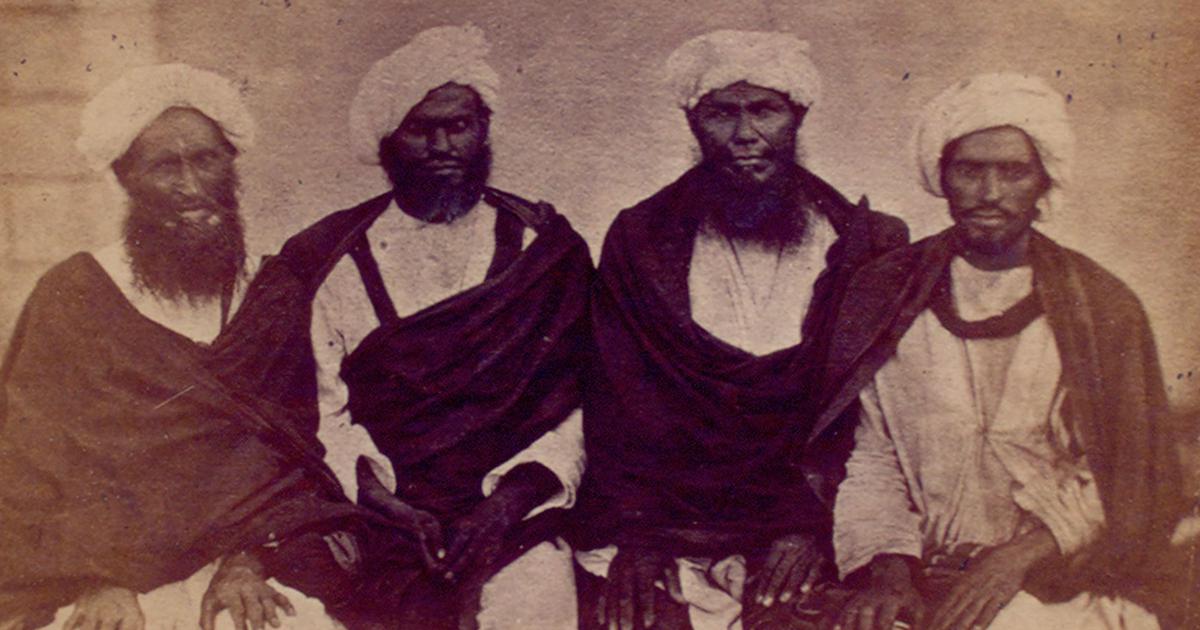
In colonial-era India, Afghans and Pashtuns were often seen in sharply different ways by Indians and the British. On one hand was the world of Rabindranath Tagore’s Kabuliwala, where an Afghan fruit seller and a little girl in Calcutta shared a quiet, affectionate bond. On the other was the imagination of the British Empire, where Pashtuns, or Pathans, were cast as a looming threat.
Writing in 1920, Arthur Conan Doyle defended the Empire by arguing that if the British left India, Pathans would raid and loot cities like Bombay. He compared this to how “the Picts and Scots flowed over Britain when the Roman legions were withdrawn”, invoking a familiar imperial fear of disorder following retreat.
Doyle’s claim drew on a wider pattern in the English press, which portrayed Pathans as dacoits based on inputs from colonial authorities, who viewed Afghans as a threat to their hold over India.
In 1908, The Daily Telegraph cautioned that the Pathan “gazes south with unremitting determination”, likening the community to panthers waiting to pounce on their Indian prey. “Waiting, always waiting,” the newspaper wrote, “the Pathan bides his time, till the strong hand of the Ferenghi shall be weakened or removed, and the lock of the gate shall be broken.” It even cited a lullaby Afghan mothers were said to sing to their children: “India is rich; Indian women are fair, my son; Indian cattle are fat, my son – when shall my son go south?”
Such fear was widespread across the Empire. In January 1910, The Evening News in Sydney warned that “India, fat with the accumulated wealth engendered by the long Pax Britannica, would be an invitation to all the fierce and adventurous from Peshawar to Herat”, adding that “the Afghan gun would weigh more in the scale than the paper plans of the Bengalee”.
Ironically, many Pathans had become subjects of the Empire when their lands were captured by the British following the victory in the Second Anglo-Sikh War in 1849. This annexation technically granted Pathans from what would later become the North-West Frontier Province the legal right to reside in other parts of India, including the south. But, as they migrated to southern India in the early 20th century, they were stereotyped as potential dacoits.
Coordination cell
In 1906, the British, who had maintained a significant presence in Bangalore for over a century, proposed applying the first four sections of the Foreigners Act of 1864 to deport Afghan nationals and Pathans from the North-West Frontier’s tribal regions, a buffer zone between India and Afghanistan.
The 1864 Act was designed to restrict the entry and movement of those deemed foreigners. The first section defined a foreigner as anyone who was not a “natural born subject of Her Majesty” or a “Native of British India”, while the second section placed the burden of proof on the individual to prove they were not a foreigner. The third section empowered local governments to ask foreigners to leave India, while the fourth enabled them to deport foreigners. Much of the current laws concerning foreigners in India are based on this 1864 legislation.
Because the administration of Bangalore outside the British-controlled cantonment fell under the Wodeyar dynasty, the British Resident in Mysore requested that the princely state’s darbar enact similar legislation to handle “Asiatic non-Indian vagrants”. It was eventually decided that a new police Act within the state would address these individuals.
Over the following year, reports surfaced of Afghan dacoits looting Hindu temples across western and southern India. AT Arundel, a Home Department official, noted in a 1906 memo that a group of Pathans had invaded and “held up” Pudukkottai, cementing their fearsome reputation.
Colonial rulers began to suspect that a small cell of 11 Pathans was coordinating these robberies from Bangalore. “It seems a little extraordinary that the police force in a place like Bangalore cannot manage eleven Pathans without special rule and regulation,” V Gabriel, another Home Department official, wrote in a memo. “But in Southern India, an upcountry Muhammadan appears to be looked on as a most ferocious dangerous creature; Azizuddin, a Lahore Kakezai, now on the Prince of Wales’s staff, was spoken of in Berar as as a ‘terror,’ while an unfortunate Kabuli named Ataullah Khan inspired such fear in the Raja of Pudokota that he had to be deported to Quetta.”
Not everyone in the south was intimidated. Home Department files speak of a case where a group of dacoits who had looted a temple in Cape Comorin (now Kanyakumari) were themselves ambushed by a gang of Tamils, who made off with the loot.
Alternative workaround
Stuart Mitford Fraser, the British Resident in Mysore, maintained in a letter to the Foreign Department that Bangalore was a “rendezvous” for criminal operations, citing the Cape Comorin and Goa temple dacoities as proof. He said 11 Pathans had settled in Bangalore, while over 300 had visited the city in five years, about half of whom were considered liable for action under the Foreigners Act. In the past, he wrote, preventive provisions of the Criminal Procedure Code had been used against “certain Pathans” and some of them even jailed.
Fraser’s hatred of the Afghans was shared by other officials in the colonial bureaucracy. HA Stuart, director of criminal intelligence, expressed a marked hostility when he advocated stronger measures against “suspicious and criminal Pathans who infest parts of India”.
Officials debated whether a new Mysore police law would suffice to deal with the dacoities or if the Foreigners Act should be enforced. Stuart argued that while the Pathans in Bangalore did not commit crimes locally, they acted as a “rallying point” for “gangs of badmashes” from the frontier. “I want to destroy this chain of posts,” he wrote, advocating deportation powers for the Resident.
The Foreign Department, however, raised objections. JM Macpherson of the Foreign Department cautioned that the definition of “foreigner” might need an amendment to ensure European British subjects in Bangalore were not included, something the administration clearly wanted to avoid. He also questioned whether the Act, in its existing form, applied to Bangalore’s Civil and Military Station or granted deportation powers to a Resident in a princely state.
Macpherson proposed a workaround: “instead of applying those sections of the Foreigners Act to Bangalore, a short and simple special local law, embodying the necessary parts of those provisions, should be notified.”
In April 1906, the colonial government approved applying the first four sections of the Foreigners Act to Bangalore, “provided that references to ‘British India’ and the ‘Local Government’” were read as referring to the “Civil and Military Station and the Resident in Mysore respectively”. With this permission in place, the Foreign Department asked the Home Department to pass the “short and simple” law.
This new law ensured that the British could throw out the Afghans from Bangalore at will.
More than a century later, the city, now Bengaluru, hosts a small community of Afghan students and asylum seekers, some still awaiting recognition from the United Nations. With the British long gone, Afghans are no longer viewed through the colonial lens of criminality.
Ajay Kamalakaran is a writer, primarily based in Mumbai. His latest book, Colombo: Port of Call, has been published by Penguin Random House.
