



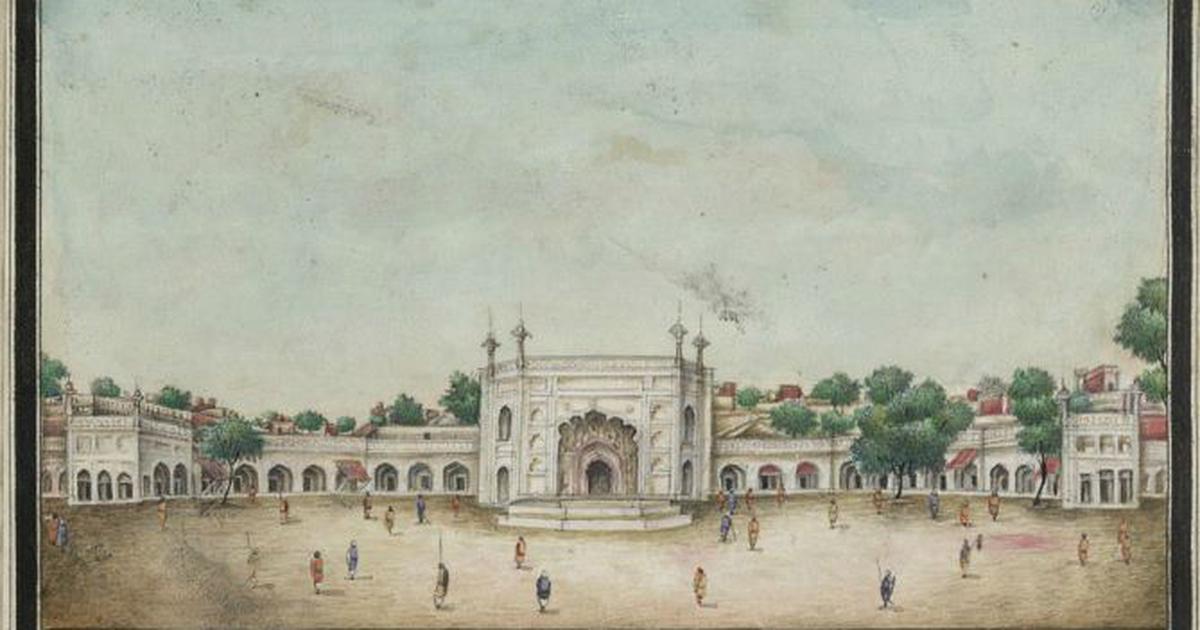
Commissioned by Jahanara in 1650, Town Hall (as it is known today) was first known as “Begum ki Serai”. That Shah Jahan personally visited the serai and oversaw the work his daughter had done underscores both its significance and Jahanara’s standing in the imperial family. This two-storey serai covered approximately 1,674 square feet and contained ninety rooms, each adorned with exquisite frescoes. Entering from the Chandni Chowk side, visitors were greeted by a spacious courtyard, complete with a large pool, greenery and a network of water channels. A mosque occupied one corner, while a balcony on the upper level afforded a superb view of Chandni Chowk.
The ground level featured arcaded rooms along with shops offering crockery, toys, bangles and clothing. Tall bastions flanked each side and the entire structure gleamed in white limestone. Two entrances welcomed visitors: one facing Chandni Chowk’s main thoroughfare and another leading to a garden called “Begum ka Bagh”. Jahanara found inspiration for this design in a comparable serai in Isfahan, Iran. In 1658, the French traveller François Bernier, who visited the Mughal Empire, praised the serai in his accounts:
The other edifice in Dehly to which I would draw your attention is what they call the Karuansara of the Princess, because it was built by the celebrated Begum-Saheb, Chah-Jehan’s eldest daughter, of whom I have so often spoken in my history of the late war. Not only this Princess, but all the Omrahs who wished to gain the favour of the old Monarch, embellished the new city at their own expense. The Karuansara is in the form of a large square with arcades, like our Place Royale, except that the arches are separated from each other by partitions, and have small chambers at their inner extremities. Above the arcades runs a gallery all around the building, into which open the same number of chambers as there are below. This place is the rendezvous of the rich Persian, Uzbek, and other foreign merchants, who in general may be accommodated with empty chambers, in which they remain with perfect security, the gate being closed at night. If in Paris we had a score of similar structures, distributed in different parts of the city, strangers on their first arrival would be less embarrassed than at present to find a safe and reasonable lodging. They might remain in them a few days until they had seen their acquaintance and looked out at leisure for more convenient apartments. Such places would become warehouses for all kinds of merchandise, and the general resort of foreign merchants.
Begum ki Serai was far from an ordinary traveller’s inn; it functioned more like a luxurious medieval hotel. The 17th-century Italian traveller Niccolao Manucci observed:
This is the most beautiful sarae in Hindustan, with upper chambers adorned with many paintings, and it has a lovely garden in which are ornamental reservoirs. In this sarae there put up none but Mogul and Persian merchants. The king went to view the work that had been done for his beloved Begum Saheb, and he praised her energy and liberality.
Adjacent to the caravanserai, Jahanara constructed one of the city’s largest hammams (public baths), measuring roughly 180 feet by 60 feet, complete with multiple rooms and porticos. It served two key purposes: providing bathing facilities for travellers residing in the serai and supporting pilgrims visiting Fatehpuri Masjid, at the end of the street, who traditionally performed ablutions before entering. Beside the hammam stood an octagonal pool, once shimmering under the moonlight – chandni reflecting softly in its waters – which gave the street its iconic name: Chandni Chowk.
It might be hard to picture now, but this part of Shahjahanabad was once the glittering crossroads of the world. Turbaned merchants from Bukhara, jewel traders from Yemen and Ottoman envoys adorned in silk brushed past each other under the same archways. The air was heavy with the scent of rosewater, while the streets echoed with chatter in Persian, Arabic, Uzbek, French and Hindavi. And water fountains, pools and canals were the soul of the city. Today’s parched Delhi would barely recognize its watery past. As the nineteenth-century historian Sir Sayyed Ahmad Khan recounts:
Chandni Chowk [or the Moonlit Square, so called because of its beauty when seen on moonlit nights] lies beyond the platform that houses the police station [Kotwali Chabutra].10 It is a 480-goz bazaar, with a 100-goz square [chowk] that has a square tank [hauz] in the centre. It is the 100-goz square that is called Chandni Chowk. It is beyond my ability to describe its beauty and attraction. The evenings are magical here with the youth, princes and nobles coming for an evening stroll and entertainment. Very attractively built shops line both sides of the square, selling all kinds of wares. There is nothing in the world that is not sold here.
Merchants travelled vast distances to bring their goods to Chandni Chowk. Traders from Turkey, Zanzibar, Syria, Yemen, Arabia, Iraq, Khurasan, China and Tibet set up shop alongside Europeans from England and Holland. Their wares turned the market into a treasure trove: rubies from Badakhshan gleamed alongside pearls from Oman, while fresh fruits from Kashmir and Central Asia added splashes of vibrant colour. Weapons, fine cloth, perfumes, elephants, horses, camels, exotic birds, water pipes and delicate sweets filled the air with a symphony of sights, scents and sounds.
Even the East India Company merchants found their place here, offering tapestries, wool and broadcloth to the discerning nobility. The streets were alive with the sounds of haggling, the aroma of sweets and spices, and the colourful sights of dancers and storytellers. The bazaar, however, was more than just a place of trade. It was alive with energy and entertainment. Boys and girls danced in front of shops to the rhythm of passing crowds, their movements a joyful distraction. Storytellers sat cross-legged on carpets, weaving tales of fasting and hardship during Ramadan or recounting the tragic saga of Husayn during Muharram, their voices drawing listeners into distant worlds.
The shops, small and neatly partitioned, were tucked under arcades. Thin walls separated one establishment from the next, and behind each shop, a door opened to a compact warehouse where merchants stored their surplus goods. Above these warehouses, the shopkeepers, along with their families and servants, lived in modest quarters, creating a lively blend of commerce and domesticity. The kahwakhanas of Chandni Chowk, which were spread across the city, were not merely coffee shops; they were vibrant hubs of intellectual exchange, cultural interaction and poetic expression. These establishments, scattered across the bustling lanes of Shahjahanabad, offered steaming cups of aromatic qahwa – strong, spiced coffee often infused with cardamom. The warm, inviting atmosphere made the kahwakhanas a favourite gathering place for scholars, poets, merchants and nobles alike. Inside them, the air buzzed with animated discussions. Scholars debated philosophy, ethics and politics, while poets recited their latest ghazals and sought critique from their peers. The walls often bore calligraphic verses from Persian and Urdu poetry, lending an artistic touch to the ambience. These coffee houses became informal academies, where ideas flowed as freely as the coffee, shaping the intellectual and cultural fabric of the city. The clientele of the kahwakhanas was as diverse as the streets of Chandni Chowk itself. Merchants paused between transactions to exchange news from distant lands, while travellers shared tales of their journeys. Courtiers and nobles occasionally graced these establishments, drawn by the charm of lively conversations.
On many evenings, musicians would join in, filling the space with the soulful strains of the sitar or the rhythmic beats of the tabla, creating an atmosphere that blurred the lines between the mundane and the sublime. For poets, the kahwakhanas were especially significant. It was here that they tested their verses before an audience that was both critical and appreciative. The gatherings often turned into impromptu mushairas (poetry recitals), where the brilliance of Mir, Sauda or Ghalib might have lit up the night. The debates and discussions in these spaces inspired some of the greatest works in Urdu and Persian literature.
Excerpted with permission from Badass Begums: The Incredible Women Who Shaped Mughal India, Anoushka Jain, HarperCollins India.
