





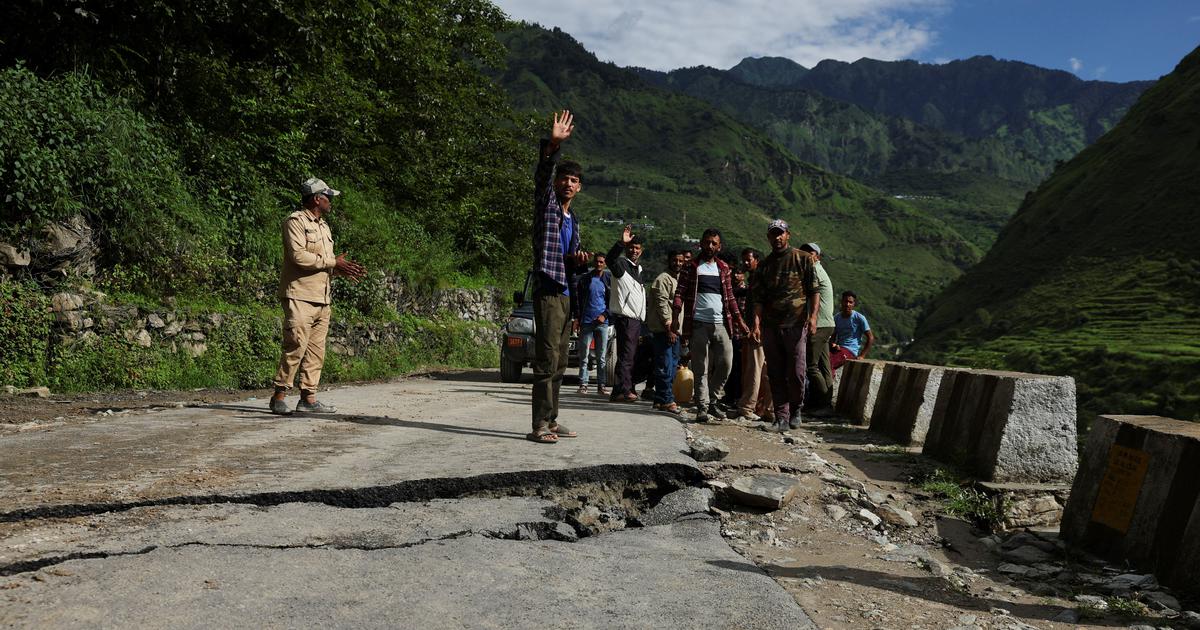
Were roads never built to Chardham (“How the highway to Hinduism's holiest shrines became a death trap”)? Whenever hills are cut, landslides follow for at least three to five years until the unstable areas become stable. Instability has been compounded by large-scale deforestation since the 1910s when a huge part of the forest cover was cut till the Chipko movement brought attention to devastation.
If roads are not widened, there may be accidents what with huge SUVs vying for space with smaller cars, not to mention the frequent bad driving manners of big car owners. So cursed if you do or don’t. Don’t try to make a living by criticising others. – Debasis Basu
***
Good work on the video on Chardham landslides but I feel it is incomplete (“On the road to Chardham, a landslide every two kilometres”). As shown in the video, there is data on when the road was built, the day and timing of landslide, and the weather condition. You now need high-resolution digital elevation models to understand the slopes above and below the road, calculate rock the mass and work out the instability factor.
Engineers cut rock mass along the road and do not understand how the rock mass above is going to behave. You also need to look into stratigraphy, which is the study of rock layers, and aspects of rock facies, which examines rock characteristics, and their strength and regolith thickness, or deposits, over the slope. Work this out and you have the solution.
If you are not geologist, collaborate with one for help. There is a desperate need for guidelines for making road in landslide prone region. Hope this comment helps. – Dhananjay
Trump’s Venezuela move
This is a stupid article (“When India needed support, Venezuela stood firmly by its side”). Politicians then and now have different objectives. It is a different matter that Venezuelans stood by India back then when their representatives were elected through a democratic process unlike now when their leader has not been democratically elected and has exploited his people and destroyed the economy.
[Editor’s note: In April 2013, Nicolas Maduro was elected president with a narrow victory margin. His opponent demanded a recount. In June 2013, the National Electoral Council said its audit found no discrepancies in the result.]
Venezuelans in Venezuela and outside are rejoicing the removal of Maduro since he had ensured the capture of all institutions, from the military to the courts and election commissions. How many Venezuelans has this writer spoken to? I personally know many who are overjoyed. It’s not a case of opposing imperialistic powers but that someone realised the oppression of the Venezuelans as well as the fact that, strategically, Maduro had allowed the presence of China, Russia and Iran in America’s backyard, threatening the country’s security.
Trump has solved two problems in one go. Also, Venezuela’s oil infrastructure is poor. Gaining from Venezuela’s is a distant objective but the people of Venezuela will also benefit from the oil economy which has been destroyed by Maduro. – Mohit Chuganee
***
Oil is big business and Americans are fixated on suspected losses due to Venezuela’s oil sale. This leads to other conclusions, like Venezuela sending illegal migrants through the south Mexican border. But jumping to wrong conclusions and making a country and its president a scapegoat for a whole lot of crimes of a whole lot of impoverished, poverty-stricken people of many South American nations is an easy way threaten real criminals. – Paul John
Ladakh must learn from Bhutan
Wonderfully put (“Why steel roofs in Ladakh are a sign of the region’s political and social crises”). This is the price of modernity. I was posted in Leh in the mid-1980s but even in those days the change was becoming apparent. It is sad but the old order must make way for the new. We must learn from countries like Bhutan and Switzerland: preserving ecology and maintaining a clean environment is the main focus. – DS Sarao
Don’t target Sambhaji Raje
Kindly mention the names of historians who have recorded Sambhaji Raje as a “debauched” and unfit ruler (“Harsh Mander: How Nazi cinema finds a reflection in Hindutva films”). The speakers should not have dragged Sambhaji Raje into this debate without thoroughly examining genuine books in Marathi. Check the work of a genuine historian and if you are satisfied, remove this sentence yourselves. – S Malode
