








As I write this, it’s Republic Day in India – the day we celebrate the Constitution as not just a founding text but a promise that a diverse country can hold together without turning difference into suspicion. And yet this year I spent Republic Day thinking about another constitution, another democracy, and how quickly the ground beneath it can become unstable.
I live in the United States now. Over the last month, the administration of US President Donald Trump has made brutal immigration enforcement the most visible function of government, replacing the quiet work of law enforcement with public spectacle – raids, intimidation and the steady production of fear.
In December, Trump described Somali immigrants as “garbage”. He said he didn’t “want them in our country”, words that landed like a dog whistle and a directive in Minnesota, home to the largest Somali community in the US.
When a leader begins to speak about some people as disposable, the machinery of disposal follows.
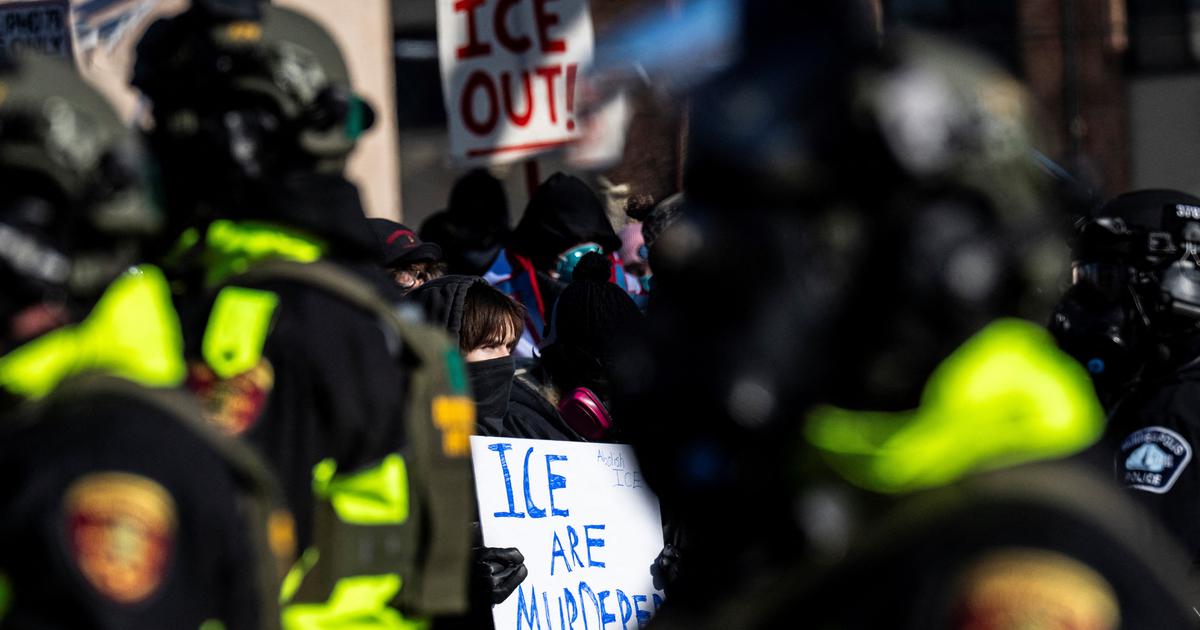
Many around the world know Minneapolis through brutal images: the killing by the police in 2020 of an African-American man named George Floyd and the protests that followed. In January 2026, it became the focus of attention again – this time because federal immigration forces surged into the Twin Cities of Minneapolis-St Paul under what the administration calls “Operation Metro Surge”.
The deployment has been so expansive, it has triggered court challenges over whether the operation amounts to unconstitutional coercion.
And then there was the killing.
On January 7, an Immigration and Customs Enforcement official shot and killed a woman named Renée Good who was acting as a voluntary “legal observer” to monitor the police and security forces at protests and during their operations.
The video travelled fast because the details were unbearable and familiar: a federal agent, a civilian, the flash of force presented afterwards as procedure. In the weeks since, the city has seen another fatal encounter with federal agents – the death of ICU nurse Alex Pretti who was also observing ICE operations, deepening the sense that law enforcement has slipped into something closer to abject criminality.
The NYT did an excellent job debunking the allegations that Renee Nicole Good was trying to use her vehicle as a weapon. Justice for Renee Nicole Good.https://t.co/3ZQK3FeBBW pic.twitter.com/lQrsV72VAA
— Christopher Bouzy (spoutible.com/cbouzy) (@cbouzy) January 8, 2026
I’m part of an organisation called Hindus for Human Rights. Since November, our members in Minnesota had been warning that ICE presence was intensifying and that neighbourhoods were bracing for what was coming. But it’s one thing to know a crackdown is happening. It’s another to stand in it and feel how it changes the air.
After Renée Good was killed, a multifaith group in Minneapolis – Multifaith Antiracism, Change & Healing or MARCH – put out a national call to clergy and faith leaders, explicitly echoing civil rights leader Martin Luther King Jr’s call to Selma in 1965: come bear witness; come put your body where your mouth is; come make it harder for the state to do what it wants to do in the dark. I heard that call and knew I couldn’t keep my ethics abstract. I went.
What I found was not a “protest weekend”. I found a city trying to defend itself.
The organisers began by stripping away the comfort of symbolism. We were trained in nonviolent resistance and, more importantly, in understanding the difference between a march that makes participants feel righteous and a practice that actually interferes with power.
We heard from local faith leaders, union organisers, and families who were living the crackdown as a daily reality: detentions, disappearances into custody, the constant calculation of risk.
Then we went out.
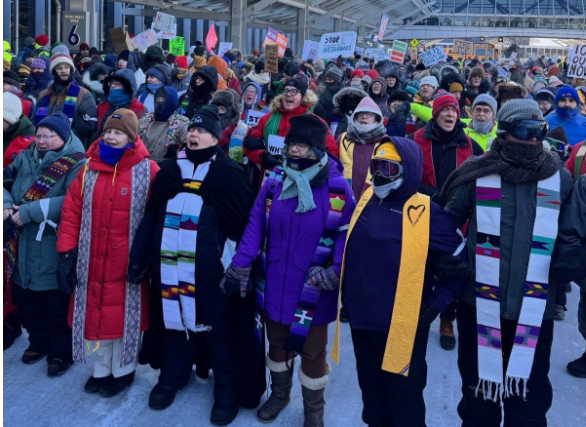
Some actions were public and direct, like demonstrations at the Minneapolis-St Paul airport and at the Bishop Henry Whipple Federal Building (an ICE base of operations) that ended in arrests. But what with me most was the quieter, more granular, and more terrifying work of neighbourhood patrols.
Since the surge began, local volunteers have been doing what Minnesota refuses to do – watching the watchers. They track vehicles, document encounters, warn neighbours and try to interrupt ICE abductions as they are happening with noise, numbers and visibility. In just a few hours riding with them, I saw how fast a regular street corner can become a site of state violence – how quickly “papers, please” becomes physical domination.
At one point, an agent deployed tear gas. For minutes I couldn’t see properly; I couldn’t breathe well. The point was not only dispersal. The point was the lesson: we can do this to you whenever we want.
By the time we joined a massive march through the centre of the city, the temperature was bitter – the kind of cold that makes the body negotiate with itself. And still the streets filled. That defiance wasn’t performative. It felt like a civic instinct: when the state starts hunting your neighbours, neutrality becomes complicity.
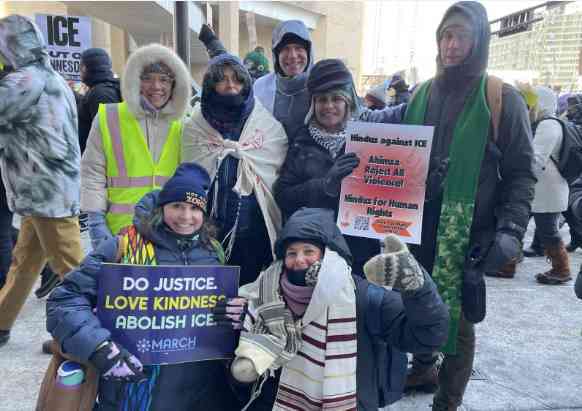
Here is the argument I want to make, to Indian readers watching all of this from a distance:
Democracy rarely collapses in one dramatic moment. More often it is thinned out through exceptions – a permanent emergency where law becomes a costume for force. The target changes by geography: in India, it is often Muslims, Dalits, Adivasis, dissenters; in the US, it is migrants, Black communities, and anyone who stands too close in solidarity. But the structure rhymes: define a population as suspect; invest state agents with complete impunity; treat rights as privileges that can be revoked; call it security; demand gratitude.
And if you’re waiting for a single villain to blame, you will miss how the ground was prepared.
America’s current brutality did not appear from nowhere in January 2025. The infrastructure of deportation has been bipartisan for years. Under Barack Obama, the US carried out more than three million formal removals – part of the reason immigrant rights organisers called him “deporter in chief”. Under Joe Biden, removals surged again, reaching 271,484 in fiscal year 2024 – the highest since 2014, according to ICE’s own year-end reporting.
Donald Trump did not invent cruelty, but he executes it with greater show. He takes what was already permissible and makes it loud – and then uses the noise to normalise more.
India knows this rhythm intimately. We have watched the slow conversion of law into a weapon: sedition and anti-terror laws used to criminalise dissent; mobs performing “justice” while police look away; institutions hollowed out while the language of nationalism performs moral cover. Constitutionalism has been abandoned while the flag is still being waved.
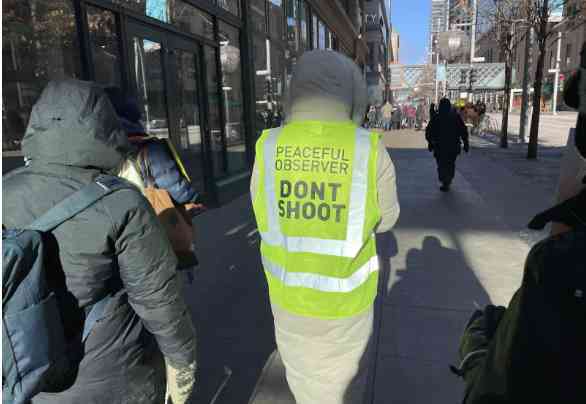
There is another uncomfortable link, and Minneapolis forced me to look at it without flinching. I travelled to Minneapolis with the delegation organised by Rabbis for Ceasefire. Some of us had traveled together to the West Bank in 2024 and saw what occupation does to daily life: the armed presence that makes itself ordinary; the bureaucracy that turns humiliation into routine; the impunity that teaches you the law will not protect you.
In Minneapolis, those memories returned in waves. We had seen this before.
Palestinian solidarity is where many progressive “interfaith” spaces in the US break down for me. Since October 2023, I’ve watched people speak brilliantly about justice in the abstract while refusing to name Palestinian suffering in the concrete. I’ve worn a keffiyeh in those rooms as a small act of insistence and been told, more than once, that the symbol is “too much”, that the language is “triggering”, that clarity should be postponed for comfort.
But in Minneapolis, with people who were already refusing silence about Gaza, the conversation could be honest: the same US state that bankrolls Israeli domination abroad has perfected the techniques of domination at home – and exports the moral logic that makes it legible. Different histories, different stakes, yes. But a recognisable architecture of control.
Still, Minneapolis also offered a lesson I didn’t expect to feel so viscerally: the ethics of emergency.
Federal agents claimed Alex Pretti, 37, forced their hand on a Minneapolis street Saturday morning, alleging he “violently resisted” disarmament until the officers fired “defensive shots.”
— The Wall Street Journal (@WSJ) January 25, 2026
Bystander footage appears to tell a different story. https://t.co/2zHwDkaGy7 pic.twitter.com/cK0tq4izGt
People there are standing together now – across ideological differences that are real and not trivial – because a community under siege cannot wait for perfect alignment. They are building mutual aid networks. They are driving children to school when parents are afraid to step outside. They are sharing food, rent, medicine, and spare rooms.
They are doing what governments always tell citizens to do in national mythology, but rarely reward: protecting one another without asking for purity.
Which brings me, as a Hindu Indian American, to a question I can’t avoid.
Why were there so few of us on the streets?
Part of the answer is fear. Many Hindus in the US are immigrants or in mixed-status families. If the state is making examples of people, stepping forward can feel like volunteering to become one.
But part of the answer is also political confusion – and, if we’re honest, moral failure. A slice of the Hindu diaspora has spent years defending majoritarian politics in India: applauding the targeting of Muslims, rationalising state violence as law and order, treating constitutional secularism as expendable. In that climate, Trump can look less like a warning and more like a familiar kind of strength – until his machinery turns toward you.
This is where Republic Day should stop being sentimental. The Indian Constitution is not a trophy. It is a discipline. If we only invoke it when we are the ones under threat, we have already betrayed it.
What I carried back from Minneapolis is not a strategy memo. It’s an image: a city learning, again, how to refuse.
Selma, Alabama – where marchers faced state violence on the Edmund Pettus Bridge in March 1965 – is often described as holy ground in American civil rights memory. After marching there, Rabbi Abraham Joshua Heschel famously said, “I felt my legs were praying.” That line matters because it refuses the lie that conscience is only interior.
Minneapolis, for me, now sits in that same category of places that change what you think ethics is allowed to demand.
On Republic Day, Indians are invited to rehearse pride. I want us to rehearse something harder: constitutional courage – the kind that does not wait for the threat to arrive at our own door; the kind that recognises occupation when it is done in our name; the kind that treats democracy as dharma.
Sunita Viswanath is the executive director of Hindus for Human Rights and a long-time human rights activist based in New York.
