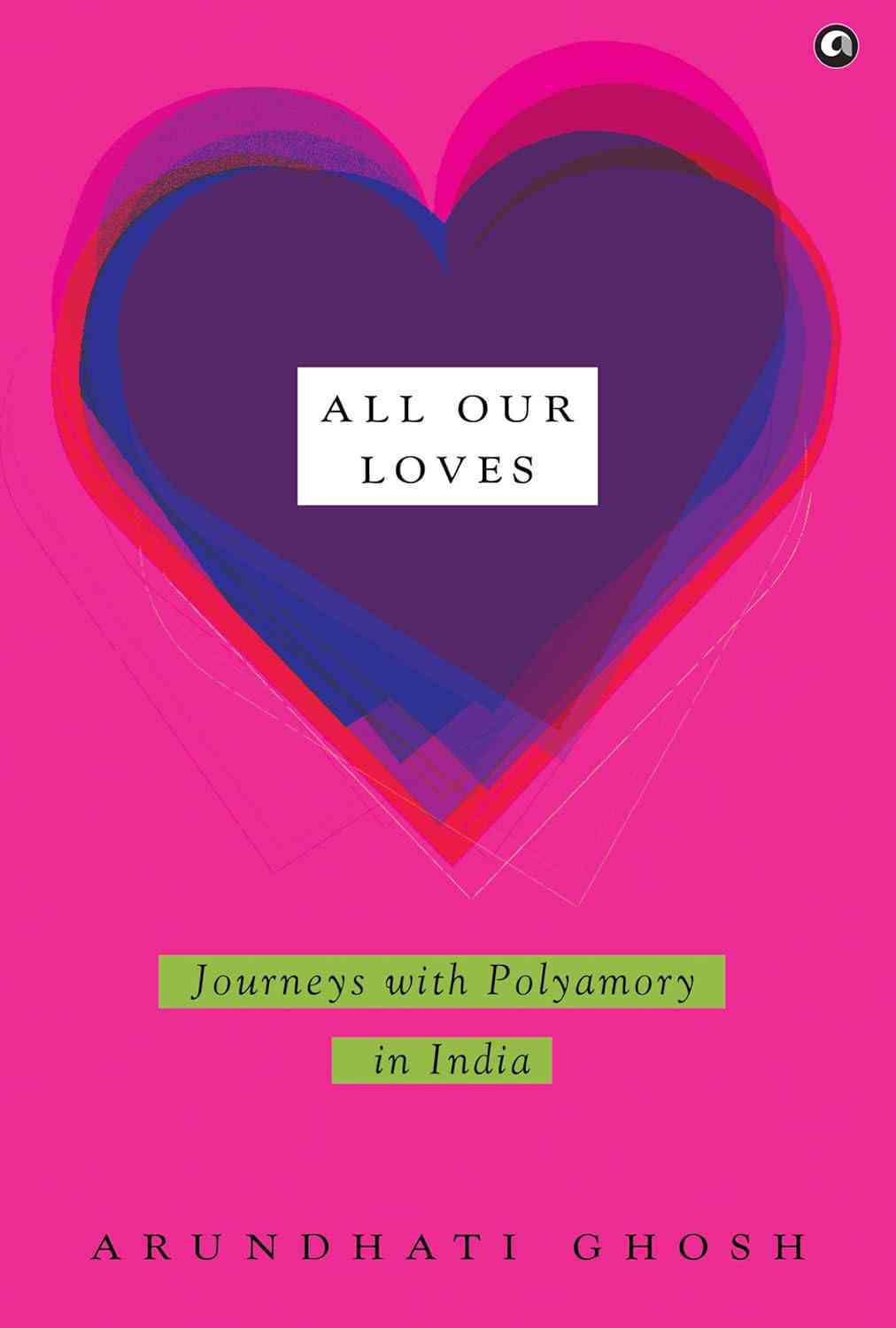




Reading Arundhati Ghosh’s All Our Loves: Journeys with Polyamory in India changed the way I speak about love. Ghosh – who also wrote Oshomoye Phire Esho Nodi Hoye, a Bangla poetry collection (LaStrada Prokashona, February 2023); and, edited, most recently, Meyeder Mayera, a Bangla essay collection edited with Sanhita Bandyopadhyay (Sonta Prokashona, January 2026) – has emerged as a prominent voice on polyamory, writing with a clarity and courage that encouraged me to have conversations I had long avoided. For the first time, I found myself talking openly to friends and family about love, relationships, desire, and choice.
This conversation with her felt like an extension of that same shift. As a woman, I know discussing polyamory invites judgment and raised eyebrows. But that is precisely why this conversation matters.
In your book, you write about love, desire and intimacy with striking honesty – almost rebellious. How did you claim that freedom of thought and self-trust?
Fortunately, I burnt the legacies of silence and obedience that women are handed down, much before they dug their toxic roots into me. It must have been the indiscriminate and incessant reading – the writers from across time and geography planting seeds of disquiet and inquiry in me. To claim one’s freedom, one needs to walk away from safety and comfort, which also means family and people dear to us. That can be scary. I am lucky to have had privileges that many other women don’t, enabling me to speak up and put myself out there. But we must realise that freedom is never claimed solo. There are histories of struggle and resistance of our feminist foremothers and queer elders, the giants whose shoulders we stand on. They have paved the way before us so we can further transgress, laugh louder. In the present too, we are part of collectives raising voices against various injustices and oppressions – journeys that inspire us led by sisters who co-conspire with us. That has been my strength.
Many people love more than once in a lifetime. When did you understand that your experience of love was not sequential but simultaneous?
While still in college, I realised that when it came to love, I was not like most people around me. I would fall in love with a new person while already in a wonderful romantic relationship with another. I responded to the beauty, courage and kindness in people I met and wanted to connect with them without too much thought about how long it would last or whether it would give me guarantees of lifelong togetherness. The present was alive with possibilities, and it mattered so much more than what futures promised.
But all popular films and songs about romantic relationships warned against this. They said falling in love with more than one person was, at best, a mistake and at worst, cheating – betrayal of trust. But the desire to love more than one person simultaneously felt natural and right for me and I was honest about it. It is true though that I have spent years struggling with the guilt and shame that come with being different, doubting what seems most authentic to the self, and not having the words to articulate personal truths.
Which early beliefs about love did you carry out of your teenage years, and which ones did adulthood force you to question?
There are many but let me discuss two here. The first idea I questioned was that love is finite, a zero-sum game. It assumes that if you truly love a person, you will give them your entire heart full of love which automatically means that you could no longer love anyone else! Unless this ends and your pot of love is returned to you, strangely undeterred, ready to be given to someone else. This I found most ridiculous because our capacity to love is boundless and in practice, we love many people in our lives simultaneously without thinking of love as a limited resource. This includes our parents, siblings, friends, etc. So why does this suddenly become questionable if the number of partners or lovers is more than one?
The second belief I questioned is the idea that among all our relationships, couples are considered the most important. But in real life, we don’t live with couplehood at the pinnacle of a pyramid. We live more in circles of intimacies with various people where the priority of relationships is determined by our phase of life, who needs care and attention at what time, and the contours of our co-dependencies. The glorification of couplehood skews the pitch of any honest conversation about love and relationships.
In a society designed to make women “behave”, how did you learn to “misbehave”?
Well, I must have been a “well-behaved girl” at some point – but then I just got bored. It’s awfully difficult to stay that way since there is so little to do when you are a well-behaved woman. Good behaviour in women mostly means adhering to the plethora of advice of “not to do” things that actually make life delightful. Speaking your mind, laughing out loud, staying out late, demanding what is rightfully yours, travelling solo to see the world – all these fall under utter bad behaviour in women. Women are not to want or need but make life convenient for others at great sacrifice of their own will and desires. For the greater good, always. The examples set for girls, even as I was growing up, were women who performed their daughterly, wifely, motherly duties ceaselessly, silently. And for that, sometimes, they even received a nod from those who benefited from the system. Basically, pleasure for women was a problem. So, I guess I did not have to learn to misbehave. I just stopped listening to advice and did what came to me naturally, joyfully.
Your book champions love without jealousy. What advice do you have for people navigating emotional turbulence in romantic relationships?
Not quite “love without jealousy” but to see jealousy as an emotion – like anger, sorrow, frustration – that needs understanding and work so that it does not fester and become a deal-breaker. With practice, over time, it is even possible that jealousy is overcome and one arrives at compersion – a feeling of happiness at your partner being joyful in the company of another.
Everyone’s context and struggle is different – so it is futile to advise on emotional turbulence. I can only speak from my own experience. I feel it is useful to lay out the contours of the problem – the trigger and how one is feeling – on paper or to a friend who will not rush to solve it but patiently listen. Sometimes I physically draw a map of it. First and foremost, the pressure cooker needs to let out steam. Also, never do anything about it while the storm is raging. Navigation falters in darkened skies. It has to settle either with time, help or both and then one can make decisions. That’s crucial – always seeking help if it does not subside, there must be no shame or guilt in doing so.
Diya Sengupta works in strategy and consulting. She is the founder and co-curator of Juhu Reads and the co-curator of Pint of View Mumbai.