







Heels
We Indians have rather a complicated relationship with feet and footwear. On again, off again. No shoes in the house, definitely no shoes on the bed (those Hollywood movies make us shudder!), no shoes in religious places, endlessly washing your feet or someone else’s feet, and so on.
It may be surprising to discover that, over the centuries, Indians had all sorts of extremely elaborate footwear, not just the basic chappals we might assume they made do with.
A distinctly Indian type of footwear was the paduka, made of wood – or, if you were rich, silver or ivory – with just a large knob between the big toe and the next. Sounds uncomfortable! In the Ramayana, Bharat took Rama’s padukas and placed them on the throne to symbolise that his elder brother was still the king and he just the regent.
Important Buddhist texts like the Vinay Pitaka describe the Buddha forbidding his monks from wearing an astonishing variety of shoes so that they could focus on a simple lifestyle. It also shows us that ancient India had the most creative footwear! Some shoes described in ancient texts are laced boots, cotton-padded boots, shoes pointed with ram horns or goat horns, shoes with tips like scorpion tails and shoes sewn with peacock feathers.
Warriors, on the other hand, wore sturdy closed boots. In fact, all ancient statues of the sun god Surya show him wearing knee-high boots, and Gupta coins often depict emperors wearing boots as well.
India’s vast animal kingdom was also used for luxury items, including footwear made from the skins of lions, tigers, panthers, antelope, otters (perhaps because they were waterproof), cats, squirrels, owls and more.
And lest this all sound too fanciful, we have some actual proof at last – at the archaeological site at Chandraketugarh, about 35 kilometres north-east of Kolkata, footwear with heels and floral designs were found dating back to around 200 BCE!
Kabootar
Pigeons, or kabootars in Hindi, seem to be everywhere you look, and many consider them a nuisance. But these ill-reputed birds have a long, illustrious history. Since ancient times, humans have kept pigeons for many different reasons. Initially, they were used for meat or religious sacrifices, but eventually, pigeon-racing became a popular sport across the world. Homing pigeons were also used to deliver messages, which proved important for ancient militaries. The Persians even established a formal pigeon post for relaying information across large distances as they were the first to form a vast empire.
The Mughals were devoted to pigeon-keeping, which they called ishqbaazi, literally translating to “love play”! There were many different varieties of pigeons. Some were kept for ornamental show, some for racing and others were trained to perform acrobatic tricks!
Akbar was extremely fond of pigeons – as he was of all animals – and kept more than 20,000 of these birds. Of these, 500 were selected as khassah (special). They were trained to do all sorts of manoeuvres mid-flight, from somersaults (bazi) to wheels (charkh). One khas pigeon could perform fifteen charkhs and seventy bazis in one session!
When Emperor Shah Jahan moved the Mughal capital lock, stock and barrel from Agra to the newly built Shahjahanabad – what we now call Old Delhi – pigeon-keeping exploded in popularity among the elite. Lore has it that the last Mughal emperor Bahadur Shah Zafar had pigeons trained to form a canopy over his head while he was out on his elephant! Gradually, the hobby of kabootarbazi spread beyond the elite to the common people.
In Old Delhi’s walled city, kabootarbazi is still a popular winter hobby, especially the annual Republic Day competition which draws crowds from faraway cities. Competitions can be fierce as master pigeon-keepers or ustads try to lure pigeons from other flocks. The birds are pampered with ghee, cream, raisins and almonds for strength and warmth, and are trained to respond to unique whistles, claps and sounds.
Interestingly, Odisha still has a flock of about 150 Belgian pigeons which belong to the Police Pigeon Service! They were used for the last eighty years to deliver urgent messages to remote parts of the state but are now kept mainly for ceremonial purposes.
Paan
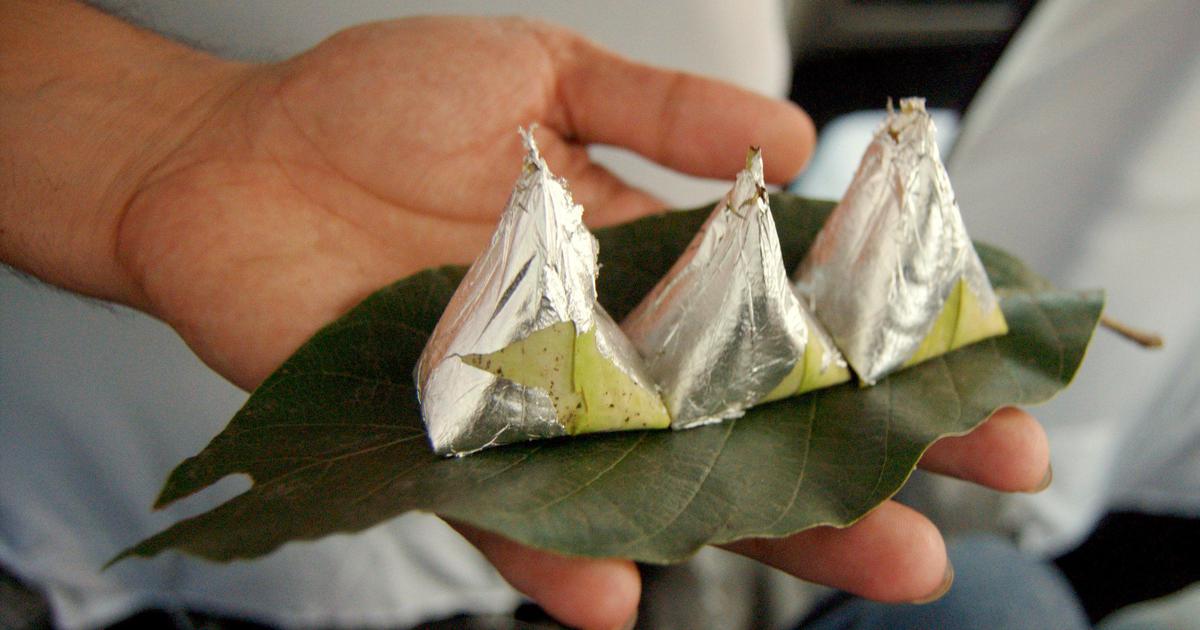
Who among us has not seen (and winced at) the red-stained walls on public buildings and boundary walls all over India, where incessant chewers of paan have left their mark? Paan has been an integral part of Indian culture since ancient times. The great classical physicians Sushruta and Charaka wrote that tambula – a betel leaf and areca nut preparation – should be chewed after meals as a mouth freshener, for dental problems, coughs and fevers! Paan, made with betel leaf, areca nut and lime paste, often included other ingredients like camphor, cardamom, cloves, sugar syrup and saffron. The super-wealthy even added ground pearls!
Intriguingly, both the betel leaf and areca nut originated in South-East Asia. A 5000-year-old skeleton of a young woman with betel nut traces on her teeth was found in the Philippines. Paan arrived in South India through trade and its popularity quickly spread. It was enjoyed by rich and poor alike as a stimulant, much like coffee or tea, which would only become popular in India thousands of years later. Women also used it to redden their lips, like natural lipstick.
Paan became a great hit with the elite of the Delhi Sultanate. Some, like poet Amir Khusro’s grandfather, apparently held parties with fifty servers circulating plates of paan! The Arabic visitor Ibn Battuta wrote, “The Indians have a high opinion of betel … a gift of betel is a far greater honour than a gift of gold and silver.” By Mughal times, elaborate paan rituals reached new heights. Even the extravagant allowance given to royal Mughal ladies was called paan-kharch (money to buy paan)!
Niccalao Manucci, an Italian traveller to Aurangzeb’s court in the 18th century, hilariously described his first encounter with this delicacy. He wrote that soon after he arrived, “I was much surprised to see that almost everybody was spitting something as red as blood. I imagined … that their teeth had become broken.” When offered some paan by his hostess, he wrote later, “My head swam to such an extent that I feared I was dying. It caused me to fall down, I lost my colour, and endured agonies … she assured me that everyone who ate it for the first time felt the same effects!”
Excerpted with permission from A to Z of Indian History, Archana Garodia Gupta and Shruti Garodia, Puffin India.
