





At an event a few months ago, I was introduced to a journalist as an award-winning author. He turned to question me, an almost imperceptible edge to his good-humoured tone, “Why do you think ChatGPT won’t be able to produce writing as good as any author now?”
I replied with equal good humour – and perhaps a more perceptible edge: “Ah, because ChatGPT can never replicate the place of passion and anguish that writing comes from.”
To write, not to produce
It’s certainly the question du jour on everyone’s lips. A spate of scandals in the last week alone have catapulted the usually stolid literary world into a dramatic confrontation – with publishers, authors and, most pressingly, its own identity – of proportions usually reserved for keeping up with reality TV stars.
The Granta-Commonwealth-Prize debacle, hashed and rehashed across think pieces and unthinking Twitter squabbles, needs no recapping. Shots were fired by James Daunt, CEO of Barnes and Noble, when he openly declared his willingness to sell books entirely produced by AI.
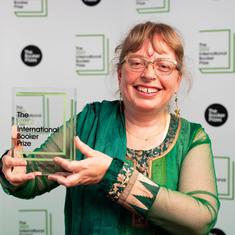
The admission from Nobel Prize-winning author Olga Tokarczuk that she asks “the machine”, “Darling, how could we develop this beautifully?”, hit harder still; if a Nobel Prize winner (!) needs AI to write, is there any hope for the rest of us? Does the secret to literary greatness lie in addressing your LLM as a lover? And most critical of all: et tu, Brute?
I come not to praise AI, but to bury it. The question of whether ChatGPT (or Claude or Chhotu or whatever the programs are called) can produce writing as good as a human author seems to me to be missing the point entirely – because the point of writing, after all, is to write. It is not to produce. It is distressing to find that this obsession with production has turned literature into a commodity, something to be produced in a factory, like a roll of Cellotape, and sold for commercial gain, instead of what we have always known it to be: art, creativity, therapy.
Sure, most (all) authors secretly (not so secretly) dream of being the next Elif Shafak, Vikram Seth or a Nobel Prize winner (cough cough), but most of us know, in our realistic moments, that these outcomes are rare. We’re not doing this for money or fame. We’re doing this because we simply can’t not do it, because we have the apocryphal flame of a story burning within us and we’re convinced we have to share it with the world, in the hope that the tangled threads of our human experience will connect with someone else out there.
Admittedly, even in the face of burning inspiration, writing is not easy. It’s often frustrating, challenging, and riddled with heartache and deep sighs in the dead of the night, and I imagine it might be tempting to trade the bleak and terrifying blank page for one that is comfortingly well-populated by a machine. But if you persevere long enough, there is beauty and catharsis beyond the terror, and an unsurpassable joy, a buoyant fulfilment, at having created something out of nothing, conquering the blank abyss, word by word – or bird by bird, to quote Anne Lamott.
Our words may be lauded or dismissed, they can uplift us or damn us, but they are ours, a small piece of eternity with which we can claim: we were here. We lived. And we made the most of it.
This is not to say, of course, that all human writing is sublime; indeed, I have just had to force myself to use the term “human writing” and I can attest to it that it feels more slime than sublime. When I first started submitting my teenage poetry, short fiction and essays to international literary magazines, my inbox was riddled with rejections, much to my dismay.
But once I was able to wipe my tears and stop gnashing my teeth, I tried again. I got myself some craft books; I studied the work of great masters like F Scott Fitzgerald and Rabindranath Tagore, and contemporary giants like Ian McEwan and Ahdaf Souief. I wrote more. And eventually, some of those rejections turned into acceptances.
I tasted blood, that high of publication that catalyses me still. But more importantly, I became a better writer. I learnt to compact my big, dizzying, disconnected thoughts into something intelligible and incisive, something that might impact a reader the way other writers’ words had impacted and moved me. When I revisit those initial pieces, I wince at my artlessness and lack of technique.
And I am grateful beyond measure for those rejections (and the ones that came later), because they saved me from the arrogance of the amateur, pushing me to work harder, study further, understand the world better – practices I intend to continue for the rest of my writing life. They taught me that anything worth doing is worth working at.
After all, rejection is only failure if you don’t learn from it – the most vital tenet of the artistic life – and the only real failure is the inability to grow – the most vital tenet of any life.
Also read
‘I ask the world to be kind to editors at this moment’: Literary magazines in the age of AI
Has an AI-authored story just won a literary prize? What does it mean for writing and books?
There’s also the matter, aside from these lofty ideals, of practicality: it is only within the writing process, in the midst of wrestling with structure, excavating the perfect adjective, mapping out the route from “Once upon a time” to “…and they lived happily ever after” (or, alternatively, “…and they all died”), that there is scope for creative lightning. As someone who is (regrettably) a serious plotter, I can attest that some of my best characters, plot twists and world-building layers have arrived organically and unexpectedly, knocking down my carefully-constructed storytelling ziggurats with little regard for time or convenience. No matter how much you plan, you cannot account for where the story might take you or for that flash of inspiration that comes out of nowhere and lights up your literary landscape. It’s disturbing to consider how much our stories will shrink if we simply feed ideas into AI – or worse, let AI feed ideas to us – and bypass the all-important steps of actually writing and re-writing them, wherein the real magic happens. Forget original stories; we’re destroying our chances to even tell unoriginal stories in original ways.
And what of voice?
And what of voice, that most essential and indefinable of literary elements, the one we pre-AI dinosaurs – er, writers – ere taught to revere above all else? The many pointers for identifying AI writing, ranging from buzzwords like “delve” to “not this, but that” clauses to em-dashes (ahem), all point to one inescapable fact: AI writing is devoid of voice, slop-ifying all communication into a set style that may appear polished and readable but is ultimately generic and soulless.
There is no one correct way to write; more often than not, it is the idiosyncrasies and breaking of the rules that make writing come alive: the unique turns of phrase; the rhythms and musicality of the language; the brevity of one writer vs the expansiveness of another.
One shudders to imagine what an LLM may have made of Gwendolyn Brooks’ lilting and hard-hitting “We Real Cool” or David Mitchell’s brilliantly inventive Cloud Atlas or even, indeed, Olga Tokarczuk’s own celebrated experimental work Flights. Linguistic innovation can be hit or miss, but it is crucial that we leave room for it to flourish, for the sake of readers as much as writers, and for the sake of a human race that seems to be increasingly intolerant of the variations that make up the richness and fullness of life.
Popular arguments for AI writing posit that writers have always made use of aids, in the form of mentors, editors, writing groups, craft books and more. Technology has constantly evolved, from notebooks and letter paper to typewriters to laptops and mobile phones. While these are irrefutable facts, it is also a fact that none of these aids was designed to actually churn out the writing for you. Their purpose was to make the process quicker and easier, to help you polish your voice, technique, plot and characterisation, but not to nullify the process altogether.
I wonder if AI fanatics would view with the same equivalence a chef, who has invested in a special oven, high-quality cheeses, perhaps a training programme in Naples, making a pizza, and someone placing an order for a margherita through Zomato. There’s still some labour involved, right – identifying the best restaurant, customising the toppings, cleaning the dishes? Right? Can I add “chef” to my bio yet?
I suppose the deeper truth is that the proliferation of AI in writing is merely emblematic of the deeper crises of our time. Along with the economic, ecological, and political collapse of society, it’s no wonder we’re facing a creative apocalypse as well. It’s unironic that these Orwellian times recall to mind Orwellian quotes about writing well and outsourcing critical thinking to a sinister machinery, where the simulacrum of a thing is invariably valued more than the substance of it.
I muse wistfully now on the “early days” when AI was touted as a technological revolution that was going to help us find a cure for cancer and solve complex scientific problems that we couldn’t manage on our own. When did creating art become one of those unmanageable problems? When did our focus shift from “we need to support artists more” to “we need to obviate the need for artists altogether”? And what is left of life for us, then, apart from the daily drudgery of making ends meet and the daily horror of hyper-awareness?
As a mere human writer and not a sophisticated LLM, I have no answers to these questions; only a fresh anxiety to add to the existing gamut, a fresh influx of outrage and helplessness, passion and anguish. Perhaps things haven’t changed that much after all. I tackle them as I always have: with my metaphorical pen and a blank page – and fortified ramparts for my em-dashes. It’ll take more than an apocalypse to make me give those up.
Aishwarya Jha’s debut novel, The Scent of Fallen Stars, is the winner of the 2024 Ram Nath Goenka Sahithya Samman for Fiction. Her upcoming novel, In the Moonlit Kingdom, will be published by Penguin Random House in September this year.
