





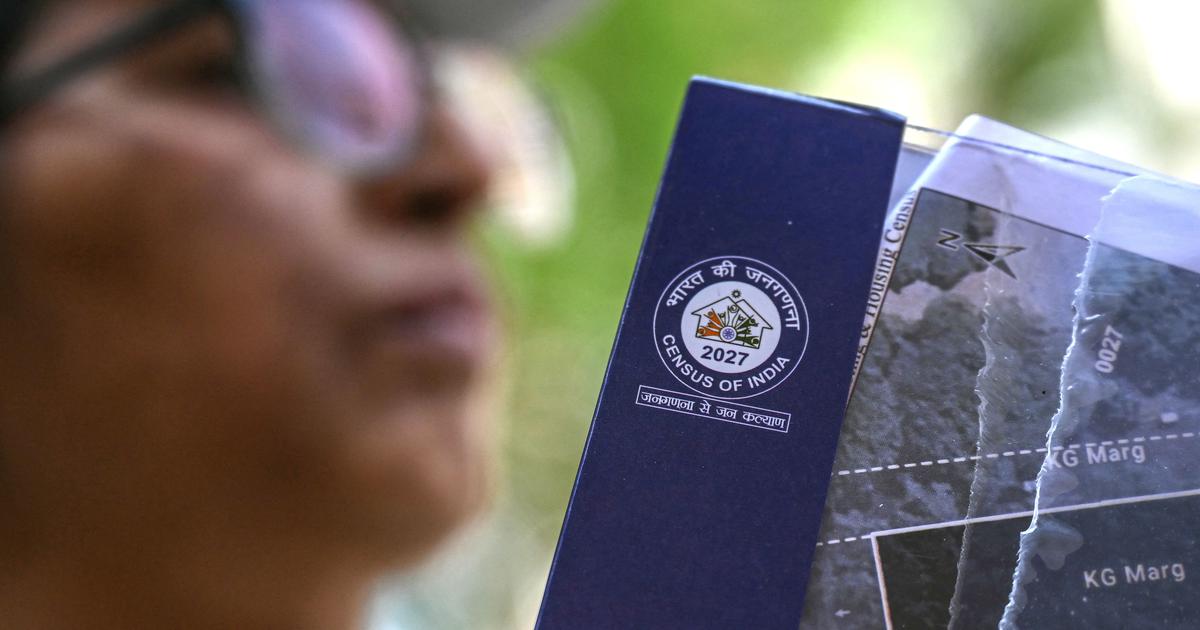
A trial for the second phase of the census now underway is testing an open column for counting caste. But by the government’s own admission, it is likely to produce data that reservation or welfare policy cannot actually use.
Since July 6, a “pre-test” for the second phase of Census 2027 has been underway across 16 states and Union Territories. In the first phase, data was collected on housing conditions and amenities. In the second phase, significantly, caste will be counted for the first time since 1931.
The form for the trial carries an “open column” for caste, officials told the media. Instead of a fixed list or boxes to tick, the form has a blank space for respondents to write down their caste.
The pre-test finishes on July 20. The government’s lessons from it will shape how caste is counted and governed for the next decade.
The open column sounds respectful, asking nothing of the state and everything of self-description. But the 2011 Socio-Economic and Caste Census used an identical method, which returned over 46 lakh distinct “caste names” such as Gupta, Agarwal and dozens of variants for what was, each time, the same caste.
The dataset was unusable for policy. Successive governments of different political persuasions chose not to publish it.
The current census pre-test is baffling because the government has already told the Supreme Court why open self-reporting fails. In a 2021 affidavit, it argued that because castes are divided into sub-castes under self-description, the resulting count cannot be relied upon to allot reservations of seats in educational institutions, government employment or electoral constituencies.
That is the government’s own assessment of the method now piloted as the front-runner for independent India’s first caste census.
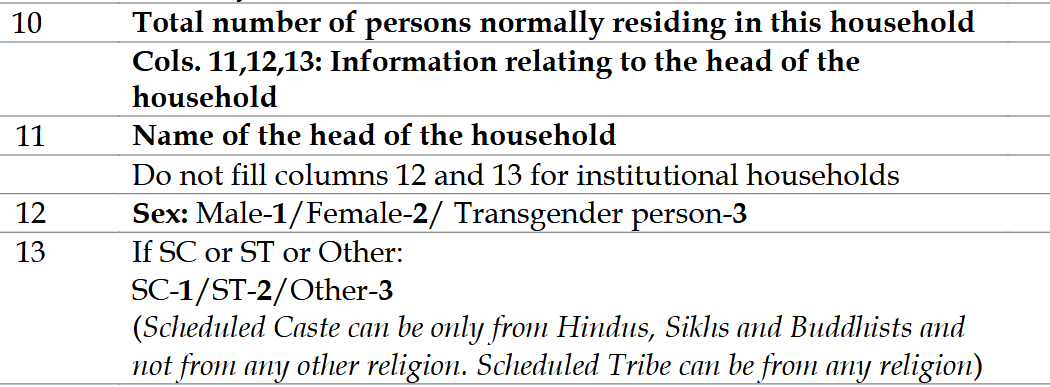
There is another inconsistency in the paperwork of the first phase. The form asked the sex of the head of household, offering male, female, and – unlike 2011, which used only a residual “other” – a specifically named transgender category.
The next row, asking about the head of household, offered only Scheduled Caste, Scheduled Tribe and Other. The Other Backward Classes and General category are absent. Instead, there is a single bucket “Other” for everyone the state does not consider worth separately naming.
Yet, Central government data lists roughly 2,650 Other Backward Classes, alongside 1,170 Scheduled Castes and 890 Scheduled Tribes. States also maintain their own OBC lists. This is proof that caste names can be identified and administered at scale, whatever the gaps in how thoroughly they have been coded.
Even so, the state has not extended this method to the names of Bania, Brahmin and other caste groups whose multiplying spellings sank the count of the 2011 Socio-Economic and Caste Census in the first place. Unlike that of Scheduled Castes, Scheduled Tribes and Other Backward Classes, there is no comparable list of caste names for the groups beyond these categories.
Listing caste names will never be exhaustive. But the state is obliged to try extending the list as far as the evidence allows before resorting to “open” for names that don’t tally.
The closed method means that the Other Backward Classes and the socially dominant groups (Bania, Brahmin, and other dominant castes) sit together in a single box. The open method guarantees a flood of self-reported variants that, by the government’s own admission, cannot be relied upon either.
Two opposite designs have one identical outcome: the OBC and the General category – the population a caste census was revived specifically to make visible – remain, by design, unseen.
This has implications beyond methodology. The policy of reservations for places in educational institutions and employment, welfare targeting and representation in electoral politics, all depend on caste data that can be acted upon.
A census that produces either an unusable flood of names or a residual bucket “Other” with no internal structure gives policymakers nothing new, spending the effort of the first caste census in a century without the evidentiary gain that was its entire justification.
Neither format on offer explores a third path: a coded list of caste names, built the way the list of Other Backward Classes already was, alongside an open field reserved for exceptions – the rare respondent whose caste does not tally with any existing entry.
In practice, enumerators moving locality by locality will encounter only a handful of recurring caste names at a time. The “open” field would be for the occasional residual case. Write-in responses that do not match an existing code would then run through expert coding before publication, rather than being left raw.
Phase-one enumerators visiting households already work on digital tablets, which can be used to offer a drop-down menu of existing entries as a category is typed, letting the enumerator select a match with a tap rather than write the name out by hand.
Every enumerator may not be carrying digital tablets, but where they do, offering such an option to specify caste identity is easy. Not doing so is a deliberate choice rather than oversight.
This option has been tested elsewhere. The United States codes race and ethnicity in its census in broadly the same spirit – broad categories at collection, write-in detail classified afterward. Even so, its coding rules have produced their own distortions and offer no model to import wholesale.
The step that India’s caste census keeps skipping is neither unusual nor unbuilt. It is simply the government’s willingness to do the coding work that makes either method – counting caste as open or closed – mean anything at all.
Sumit Baudh is the author of Law at the Intersection of Caste, Class and Sex (forthcoming, Routledge). Views are personal.
