









RBI keeps repo rate unchanged at 5.5% for second consecutive time
The central bank lowered its inflation forecast for the financial year 2025-’26 to 2.6% from 3.1%.
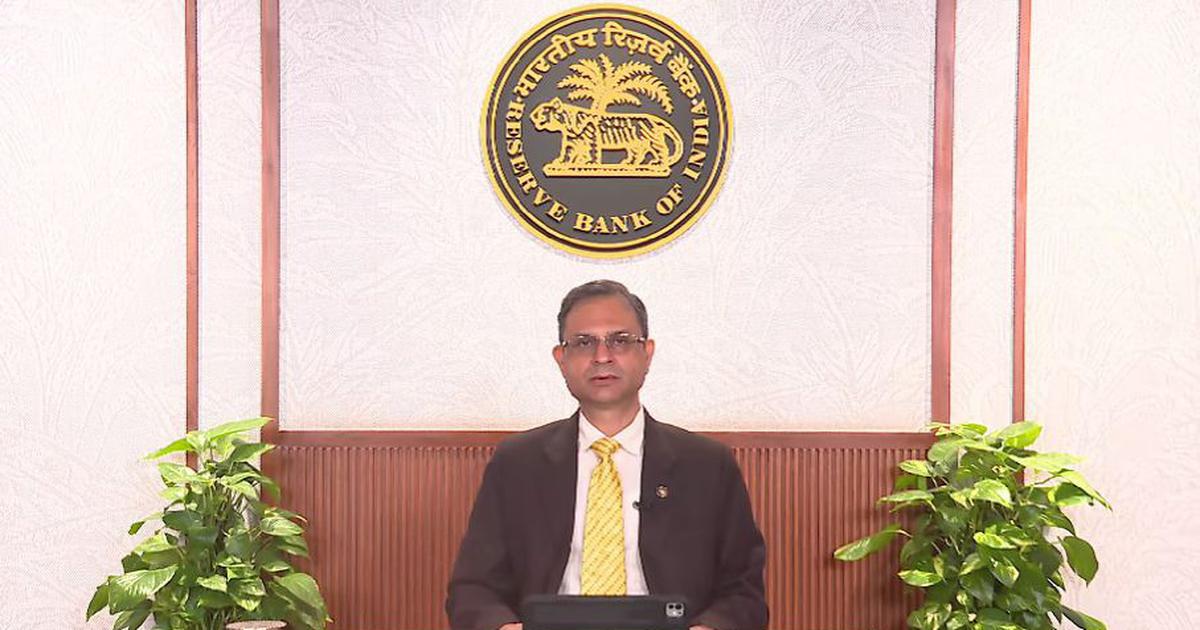
The Reserve Bank of India’s Monetary Policy Committee on Wednesday kept the repo rate unchanged at 5.5% for the second consecutive time, citing global tariff-related uncertainties.
The repo rate is the interest rate at which the central bank lends money to commercial banks. The Monetary Policy Committee reviews the rate every two months.
In June, the committee had cut the repo rate by 50 basis points, lowering it from 6% to 5.5%. The rate was reduced by 25 basis points each in April and February.
A basis point is one-hundredth of a percentage point. Basis points are used to describe the percentage change in the value of a financial instrument.
Central banks usually reduce repo rates to stimulate economic growth by making borrowing cheaper for individuals and businesses. This translates to lower equated monthly instalments for borrowers.
Reserve Bank of India Governor Sanjay Malhotra said on Wednesday that the committee had also decided to maintain its monetary policy stance as “neutral”.
“However, two members – Dr Nagesh Kumar and Professor Ram Singh – were of the view that the stance be changed from neutral to accommodative,” the central bank stated in a press release.
A neutral stance means that the Reserve Bank remained flexible in adjusting policy rates based on prevailing economic conditions. In contrast, a withdrawal of accommodation is a restrictive stance where the central bank aims to reduce the money supply in the economy by increasing interest rates to curb inflationary pressures.
The Donald Trump-led United States administration has imposed tariffs on dozens of countries, including India.
In August, Trump doubled the tariffs on goods imported from India to 50% for purchasing Russian oil. Trump has repeatedly alleged that India’s imports were fuelling Russia’s war in Ukraine.
Inflation forecast lowered to 2.6%
The committee on Wednesday also significantly lowered its inflation forecast for the financial year 2025-’26 to 2.6% from 3.1%, citing the cut in goods and services tax and better food prices.
The quarter-wise estimates indicate a persistent fall in prices, with inflation projected at 1.8% for the second and third quarter, before rising to 4.0% in the fourth quarter.
“Since the August policy meeting, significant developments on the domestic front amidst a fast-changing global economic landscape have altered the narrative on growth inflation dynamics in India,” Malhotra said on Wednesday. “Buoyed by a good monsoon, the Indian economy continues to exhibit strength by registering a higher growth in Q1.”
Growth projection increased to 6.8%
The real gross domestic product growth for the year has been projected to increase to 6.8%, up from the earlier estimate of 6.5%.
“Growth outlook remains resilient supported by domestic drivers, despite weak external demand,” the central bank said. “It is likely to get further support from a favourable monsoon, lower inflation, monetary easing and the salubrious impact of recent GST reforms.”
However, it highlighted that despite this, “growth continues to be below our aspirations”.
In August, NITI Aayog Chief Executive Officer BVR Subrahmanyam had said that India’s annual Gross Domestic Product growth needs to be 8% if the country wants to achieve the target of becoming a developed economy by 2047.
