








Flights disrupted amid dense smog in Delhi, northern India
The air quality in the national capital was in the ‘severe’ category on Monday morning.
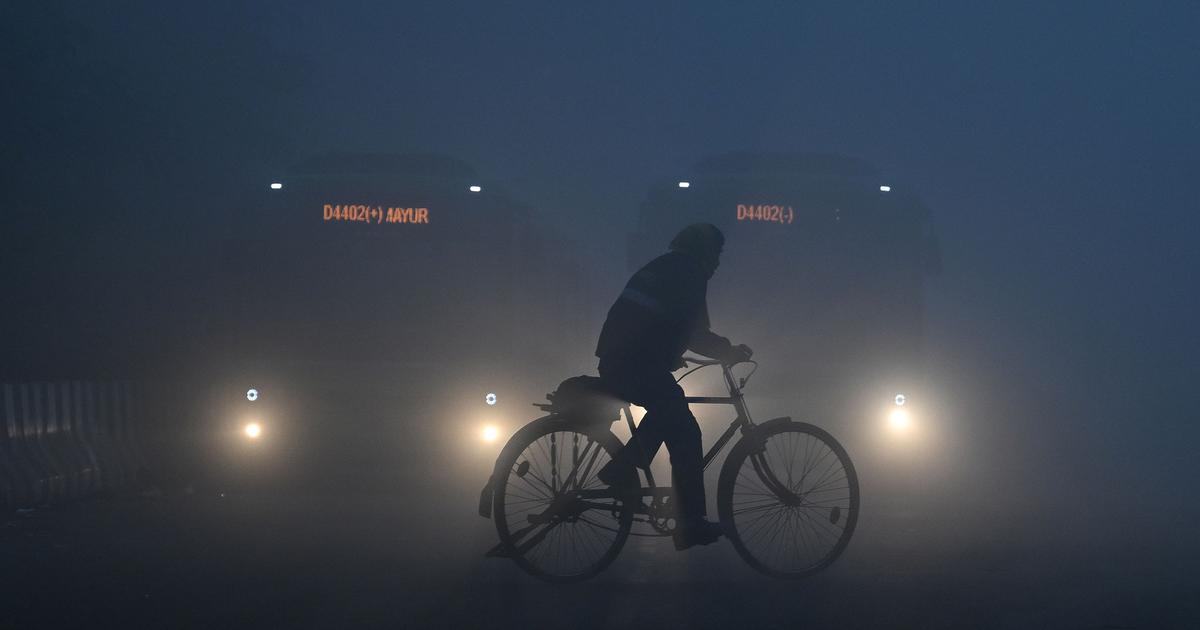
Flights were disrupted in the National Capital Region and northern India on Monday because of dense smog.
The air quality in Delhi was in the “severe” category with 22 of the city’s 37 active monitoring stations recording Air Quality Index readings above 400, according to data from the Sameer application at 8.05 am.
The national capital’s average AQI stood at 402, showed the application, which provides hourly updates from the Central Pollution Control Board.
Low visibility disrupts flights
At 9 am, the Delhi airport said that “dense fog” may cause delays and cancellations and urged passengers to check their flight status with their airline.
On Monday, an Air India Express flight from Goa to Delhi was diverted to Ahmedabad, ANI reported.
IndiGo said that foggy conditions were hampering operations in Delhi and several airports in northern India. “If reduced visibility conditions persist, flight departures and arrivals may be impacted as the day progresses,” it said.
The airline said that the dense fog in Jammu had also impacted flights operating to and from the city. “As conditions evolve, some services may experience delays, and a few may need to be cancelled depending on clearance and operational feasibility,” IndiGo said.
‘Severe’ AQI in NCR
On Monday, the cities adjoining the capital also reported hazardous air quality levels. While Noida recorded an AQI of 416 and Greater Noida 406, Ghaziabad was in the “very poor” category at 398 and Gurugram 326.
An index value between 301 and 400 indicates “very poor” air. Between 401 and 450 indicates “severe” air pollution.
An AQI in the “severe” category signifies hazardous pollution levels that can pose serious risks even to healthy individuals.
VIDEO | Delhi wakes up to a dense blanket of smog choking the National Capital.
— Press Trust of India (@PTI_News) December 29, 2025
Visuals from the AIIMS Flyover show traffic crawling through the haze, as air quality plunges into the 'very poor' and 'severe categories', shrouding the city in a murky winter grip.#DelhiSmog… pic.twitter.com/Z4HXmCWbvL
On Wednesday, the Commission for Air Quality Management revoked Stage 4 restrictions under the Graded Response Action Plan in the National Capital Region after the air quality improved.
Stage 4 restrictions had come into force on December 13 after the air quality slipped into the “severe plus” category.
GRAP is a set of incremental anti-pollution measures that are triggered to prevent further worsening of air quality once it reaches a certain threshold in the Delhi-NCR.
Air quality deteriorates sharply in the winter months in Delhi, which is often ranked the world’s most polluted capital. Stubble burning in Punjab and Haryana, vehicular pollution, along with the lighting of firecrackers during Diwali, falling temperatures, decreased wind speeds and emissions from industries and coal-fired plants contribute to the problem.
