







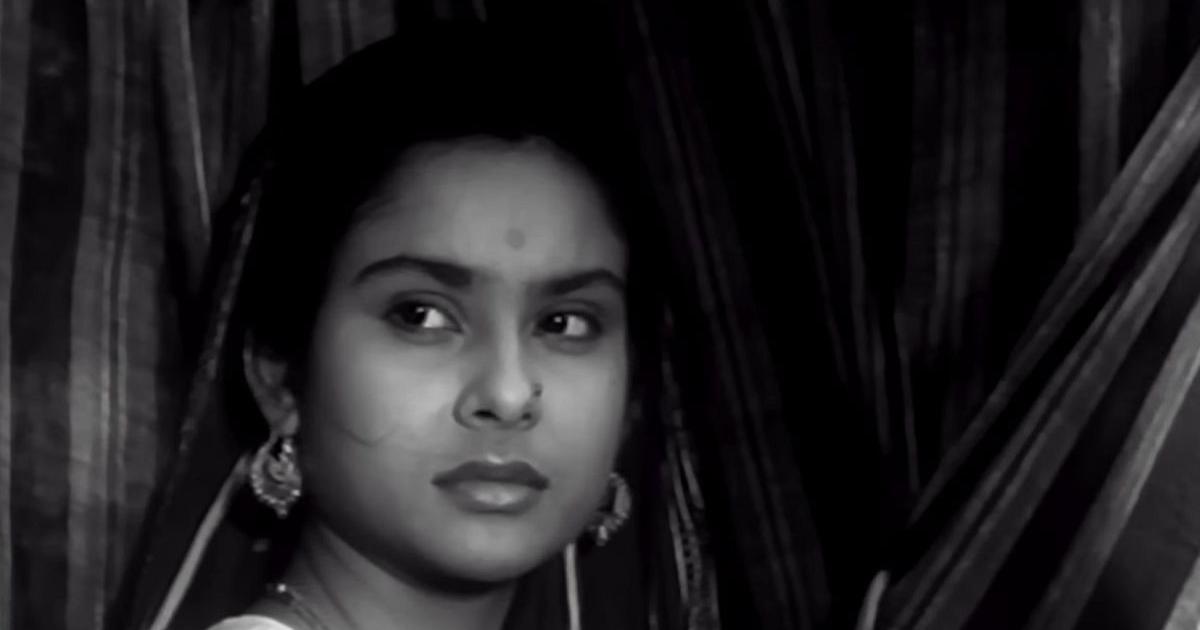
My first film with Premendra Mitra to be released was Kankantala Light Railway. This was followed by Shetu, in which Dhiraj Bhattacharya played a double role, and Chandraboti Debi was the heroine. I recall several other films I acted in, such as Ashabarna and Boloygrash, both directed by Pinaki Mukherjee. In Boloygrash, Shikharani Bag played the role of Suchitra Sen’s daughter, while I played the daughter’s friend.
And then, Baishe Srabon. The connection came about in a strange way.
Bijoy Chatterjee and Bholanath Roy were the distributor and producer of the film, respectively. They lived in Dhanbad, and had acted with me on stage when we performed the play Ulka there. I’d forgotten them, but they had remembered me. They were the ones who told Mrinal-babu about me. He in turn asked Anupkumar to get in touch, and he collected my address from Gita Dey. After this someone from the production team came to my house and asked me to meet Mrinal-babu. He used to live on Manoharpukur Road then. I went to his house, where he interviewed me.
‘Do you know how to mop the floor?’
‘Yes.’
‘To do the dishes?’
‘Yes.’
‘To put cow dung pats on the wall?’
Now I stumbled. I’d never done this. I was wondering what to say when Geeta Sen, Mrinal-babu’s wife, rescued me. ‘What a question! Everyone can do it!’ she said loudly. Not that there was any such scene in the film. I went back home after the interview. Mrinal-babu told me later that the young boy who was part of his domestic staff had said after I left, ‘That face makes you want to take care of her.’
One more important event in my life took place during the making of Baishe Srabon. My name was changed. I had been named Madhuri after my birth, and that was the name I had used all this while as an actress. But Bijoy Chatterjee asked me, ‘Would you mind if we altered your name a little? Madhabi instead of Madhuri? In that case we can present you as a newcomer.’
I thought for a moment – what was more important, my name or my family’s survival? Many have asked me whether I felt bad about it. What was more important than disappointment to me was the necessity of work, of survival. The household would run smoothly on the money they had promised me every month. This was the greatest gain for me. And so Madhuri was lost forever, I was Madhabi now.
Most of the shooting for Baishe Srabon was done outdoors. There wasn’t much work in the studio. When I asked Bijoy-babu about the location, he said, ‘Haven’t you read Rabindranath Tagore? Jibon is my name, Mankor my home.’ That’s the place. Sixty kilometres from Bardhaman.
It was an ancient village, with most of the buildings dilapidated, with time taking its usual toll. Arrangements had been made for us to stay in a two-storeyed house. The inner chambers were allotted to us. One room was occupied by Mrinal-babu, Paulda the cameraman, Paulda’s assistant Satyababu, and Bansi Chandragupta, the art director who needs no introduction.
Another room, with an adjoining veranda, was given to Himangini Debi – who played my mother-in-law – and me. She was the famous actress Nibhanani Debi’s elder sister. There was no separate bathroom to bathe in, we had to cover the veranda for the purpose. Himangini Debi went back to Calcutta after her scenes were done.
Worrying that I might be frightened to sleep by myself, Mrinal-babu would sleep on the floor beside my bed. This was how he took care of me. He used to call me Malati, in keeping with the character I was playing. Early every morning, he would wake me up, ‘Malati!’ I’d jump out of bed and get dressed at once. Sometimes Geeta-di would come too with their son. She would change the pillows and sheets on Mrinal-babu’s bed. But they wouldn’t talk when they fought, communicating through written notes instead.

Bansi Chandragupta had constructed the sets of Baishe Srabon. When it came to the hut with the mud walls, everything was flawless. The only blemish with Bansi-babu was in the way he pronounced the word ‘kulungi’ as ‘kulangi’.
We’d shoot all day, and then, after cleaning up in the evening, go for walks. Legend had it that the Maratha invaders had passed through Mankar, and some ruins remained of their camps. We would walk to those spots. Jnanesh-babu would sing, quite loudly, and some of us would join in. One day, when darkness had fallen and we were on our way back, Bansi-babu hissed with his unique sibilant, ‘Ssssnake! Ssssnake!’ We began to run in fear. When we had gone quite a long way, Mrinal-babu said, ‘Wait, let’s go and find out if it really was a snake.’ Jnanesh-babu wanted to check too.
What was I to do? I didn’t have the courage to remain there on my own, so I went along too, gripping Bansi-babu’s arm firmly. Jnanesh-babu pointed to a branch lying on the ground, whereupon Mrinal-babu began to say witty things in his characteristic way. But there was indeed an infestation of snakes in that area. And of insects. There were no electric lights in the house where we were staying, we always ate dinner by the light from lanterns.
Having our meals while evading insects was a horrifying experience. We used to call Indar Sen, who was Mrinal-babu’s assistant, Chandu. ‘How to eat with so many insects, Chandu?’ I said. ‘Eat them too, free protein.’
Excerpted with permission from Madhabi’s Garden – A Memoir, Madhabi Mukherjee, translated from the Bengali by Arunava Sinha, Bloomsbury India.
Also read:
Madhabi Mukherjee on ‘Charulata’, its enigmatic last scene, and the sea that returned an offering
