








Such an interesting evening, Maya thought. She remembered again the salons of her childhood, the late-night readings, how she listened to the men – and on one occasion a woman, a doctor in Kabul –talk about their life and experiences, and how she dreamt of visiting all the new worlds they described.
She was roused out of her reverie when the room came alive with new levels of animation, and different voices broke over each other in argument. They were talking of someone called Hurrychand Chintamon. Henry appeared particularly enthused, his face flushed, his eyes darker than before as he talked of the American Constitution, whose First Amendment allowed for freedom of expression.
“We should listen to what he has to say, shouldn’t we?”
Edith’s lips were set in the way Maya knew. “It’s a lot of nonsense, and quite scurrilous, Henry. The council is indeed planning a petition to stop him. He does advocate a lot of shocking, unmentionable things. Straight out…,” she broke off.
Maya tried not to catch Henry’s eye, whose face was now beetroot red. Everyone in the room was pretending not to know what the other meant, or to give away anything. Chintamon had once been keen on photography, with the occasional article in magazines like the Oriental Herald, but in recent months, he had earned considerable notoriety. He was accused of cheating Madame Blavatsky and others when he had travelled to the US as a member of the Theosophical Society. Then again, he had shocked everyone with his recent piece for The Courier. The paper had carried it on its last page, with the salacious title, Guru’s Praise of Ancient Secrets Divides Bombay Society.
It detailed how Chintamon’s lectures on practices and moves detailed in the Kamasutra could aid a person’s spiritual quest, and expose him to new realms of elevated experience.
Edith scoffed calling him a charlatan, and someone – Kothari? – reminded everyone that Chintamon’s first speech at the Freethinker’s Pavilion had been crowded. Everyone talked of choosing a side, and it was a good-natured argument, with voices raised excitedly, and guffaws of laughter followed when Henry promised to attend Chintamon’s next meeting but in disguise so that he would spare the ladies any scandal.
“He’s going to get a note from the Native Society, I am sure,” said Maya in an undertone and the last murmurs of conversation were drowned in the clatter of wheels as the carriages drove up the driveway to pick up the waiting guests.
“Henry,” she tapped him on the elbow, and he leaned back to hear what she had to say, “I intend to meet the police soon, about the missing cycle. Do you…?”
He frowned and was about to say something when Phipson called out to him. Maya shook her head and told him whatever it was, he could tell her later. There was always going to be a later, she added. They smiled on that light-hearted note, but the thought crossed Maya’s mind if the same Native Society somehow knew where her bicycle was, or the other bicycles too. If she ran into the constable Ganpatrao again, she would ask him some questions, tough ones that he couldn’t turn away from. A cycle couldn’t possibly be confiscated indefinitely. She had a fierce look on her face as she thought over this, quite alarming Henry who took a hasty step back as he said his goodbye.
She stayed up late, looking up at the night sky, knowing it was the same night sky that looked down on Reverend Barton. She breathed in the fragrance of the Rangoon creeper over the wall, listened to the buzzing of the night insects, the last call of the owls, and in the distance, she saw the golden sheen where the lighthouse cast its beam onto the sky and over the sea. She thought over the Reverend’s last line in that long-ago note. She wished she still had it. She could so easily imagine herself back in the Mission House in Firozpur, and the wave of remembrance – was this nostalgia – that filled her made her sad and teary. The Reverend understood her; she felt then. His gentle smile that gave nothing away, especially when the society ladies complained of her tomboyish ways, her missing classes to watch the theatre groups at work, and that first time she had written under an assumed name and sent a letter off to The Tribune.
She missed the nip of Lahore’s winters, as she breathed in the cool night breeze. She wondered if Henry felt the same way about his home town Chicago. It was the strangest feeling she had ever had, this missing someone, and not minding the distance between them, and yet feeling she understood some things, and maybe the Reverend, the man who had brought her up, did too. Something moved in the sky above her, a lightning flash over the sea maybe, a small black creature skulked in the bushes, harmless and shifty, and she felt that these things around her, the star, the fox, or the jackal in the bushes had always been there, that someone else standing at this same window, years, decades, maybe a century before her, had felt, and seen, and even listened to the same things. Someone like Carsten Niebuhr who had been in Bombay a century and more ago. Maybe he had been here, in this very old grey stone house with its distant view of the sea, and thought of someone he missed, or of home, like she was.
Or was it the unknown artist of the bird sketches who had lived in this house, in this back room, lost to himself? Or herself? No it was most likely a man. Someone who had travelled, as the artist had done, to Arabia – or knew someone who had – and who had spent days in this house, and used the paper so readily available then, right here in Bombay. Someone who could have been an assistant to Niebuhr and had faithfully copied and recorded all the impressions the Danish team had gathered; material that had come to Carsten Niebuhr after all his companions died, one by one. Maybe he had copies made, for Niebuhr, though he took every precaution, must have thought constantly of death, must have worried about his own chances of survival.
Hormuzji Dorabji, the landlord, the one man who might know something, was at this time on business in Dar-es-Salaam near Zanzibar. But he had never really lived in this house except in short bursts. And he had told Edith, when she first moved in, that parts of it, some rooms on the ground floor, and the first floor, as well as the short squat tower that was like an attic, had been there from the beginning, before other additions to the house and expansions like the garden, the courtyard outside, were made. It was, he had suggested, perhaps the home of an old pirate chief, or the head of a fishing colony, from over a hundred years ago, when Colaba was one of Bombay’s seven islands.
Separated from the main island of Bombay by a creek, this area of land could get dangerous when the monsoons drove in the tides. It had earned the nickname of the badlands for a thick, dense cover of forest that shrouded most of it from Bombay, especially the city’s well-guarded fort that watched everything coming in from the sea. The old squat tower over the house, the distinctly shaky steps that led up to it, offered a view of sorts of the sea, and of the boats coming in. There were rumours, Dorabji had told Edith who had passed this on in her droll amused voice to Maya, that the tower window was used to signal slave smugglers, pirates and even Portuguese soldiers who were constantly trying to sneak in and trouble the British.
Things were no longer so quiet after the completion of the new station at Colaba. From her position at the window, Maya could see the stone tower of the railway station that faced southwest, away from her. In the mornings, it presented a pleasing sight, with its red tiled roof, stone walls, and the sound of trains every few hours or so.
In the last few years, this small southern end of Bombay had seen a lot more people. The English merchants and sailors who liked their own yacht outings, the businessmen, the fishing merchants with their trawlers, the down-at-heel artists, and, as it was rumoured, even the shady smuggler or two who mingled easily with everyone, and cleverly evaded any detection. One day soon, she hoped to come across one. A smuggler with a patch over his eye, a knife in his belt, and a rusty rum song on his lips.
The taper on its stand was dwindling fast and she could see a giant shadow version on the wall. She leaned forward, peered through the thin rusty bars of the window, and gasped. She had seen a flash of white and wheels, silver in the moonlight, gliding past the trees. From her window, she had a clear view towards the end of the lane, though it was obstructed in places by the curtain of trees. But she had caught a glimpse of her cycle, a flash lasting no more than a few seconds. And just as Henry had insisted, she was sure too that this was her cycle. She thumped on her table, and she heard a gentle knock, almost in answer, or a soft echo. But she was not afraid of anything anymore. She was going to get her cycle back, no matter the dangers, the threats she received.
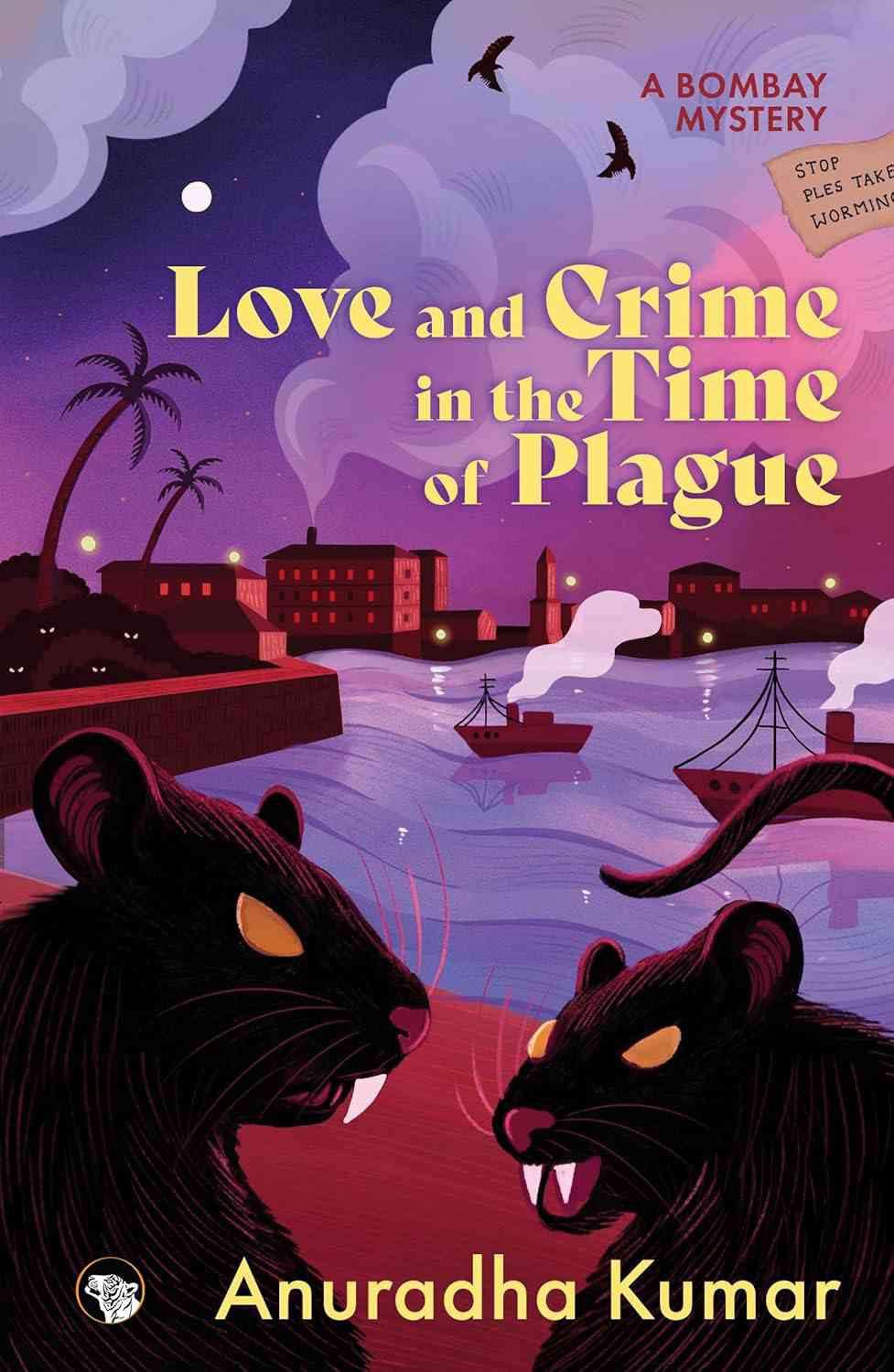
Excerpted with permission from Love and Crime in the Time of Plague: A Bombay Mystery, Anuradha Kumar, Speaking Tiger Books.
