





There was once a weaver who had two wives. The two wives had a daughter each. Of course, the two wives were constantly bickering and clashing with each other. The one who could put up a show of greater strength would win that battle. The weaver sat cursing his luck. “What a bad idea!” he thought. “No one should have two wives in one lifetime …”
At first, the weaver had only one wife, but the moment she gave birth to a daughter, he brought home a second wife, hoping for a son. The elder wife and her daughter, Shukhu the joyous one, were filled with malice. The new bride got an earful when she stepped into her new home. On top of that, within a year, she, too, gave birth to a daughter. Her daughter was named Dukhu, the woeful one. The elder wife and Shukhu could barely hold in their laughter. “Hah! How about that!”
The weaver soon died, lamenting the absence of a son. After his death, fights broke out once again over who would inherit the tiny house and his meagre savings. Finally, the dead weaver’s belongings were divided between the two wives, who then parted ways.
Despite her widowhood, Shukhu’s mother, who was fond of a leisurely life, enjoyed rich food and indulged in luxuries like shrimp curry and fish heads. Her behaviour shocked the village, which praised Dukhu’s mother for her modesty. They said, “Just go and see what a good widow Dukhu’s mother is! She weaves gamchha cloth and sells it and she survives only on vegetable broths and rice. She’s raised her girl so well. She’s happy with the little that she has. And look at Shukhu’s mother, off raising a little princess, isn’t she?”
Both wives now had to spin cotton themselves, laying it out to dry in the sun. Shukhu and Dukhu were tasked with watching over the cotton and thread. As they spent their days together, the animosity between the girls faded. They began talking secretly behind their mothers’ backs.
Dukhu said, “Sister, you are very outspoken. You quarrel too much.”
Shukhu said, “You, little sister, are too quiet for your good. You won’t protest even if someone slaps you seven times. You’d just sit there and cry!”
Dukhu said, “That’s true, I’m not brave like you. But it doesn’t need to become a woman to be so brave.”
Shukhu said, “You get scared too easily, sister. Living in fear is like living in death.”
One day, as the two girls watched over the cotton and thread, a gust of wind blew it away. Dukhu started crying in fear of what her mother would say. Shukhu said, “There’s no point in crying. Let’s follow the wind. It’s bound to return our cotton!”
At that moment, the two sisters noticed both mothers had come to the fence after finishing their baths. One of the mothers exclaimed, “What incredible luck! We’ve received a summons from the Old Mother. If we manage to please her, she won’t just return the cotton and thread we lost – she might even reward us with gold, diamonds, and perhaps, if she’s in a particularly good mood, find us a princely bridegroom. Hurry, hurry!”
Shukhu’s mother said, “Run faster than Dukhu, Shukhu.”
Dukhu’s mother said, “Run faster than Shukhu, Dukhu.”
Shukhu and Dukhu kept running after hearing their mothers. The mothers slowly faded behind.
As they went, they saw a cow tied on the side of the road. She said, “Where are you going? Please clean my shed before you go.”
Shukhu said, “Oh no! The cotton floats away.”
Dukhu said, “Yet, we should listen to what she says …”
Then, the two made a decision. Dukhu cleared the dung around the cow and Shukhu gave her hay to eat and water to drink. “Dear lady cow, adieu,” the two said. “Our cotton flies away. We will stop by you and clean your shed again on our way back.” The cow happily agreed and gave them a pail full of milk.
Shukhu and Dukhu resumed their journey. A little down the path, a banana plant called, “Where are you two going? Here I am, all tangled up in weeds and creepers. Clear them for me, please. Look how the bananas are drooping down. Pick them up.”
Dukhu was always willing to listen to others, but Shukhu insisted that the cotton would float away. Once again, they made a pact. They sheared away the weeds and creepers from the banana plant and said, “Let someone else pick the bananas, or we’ll do it ourselves, but on our way back. Our cotton is floating away!”
The banana plant was happy and gave them a bunch of bananas. Shukhu and Dukhu ate the bananas, drank the milk, and set off again.
A moss-covered tree a little far ahead called out too.
“Wait, wait! Could you two please clear the rubbish around my trunk? Gather all the leaves and other waste and burn them in a fire.”
Shukhu and Dukhu discussed the situation.
The poor tree must be feeling itchy with so much junk near its trunk. They decided that they would sweep away all the debris, and later in the day, they’d gather the leaves and light a fire. After they were done, the moss-covered tree happily gifted them a vase full of coins.
A little further down, they were stopped yet again by a horse. “Will you give me a few blades of grass on your way, please?” it asked. Dukhu and Shukhu had now started thinking the same way. They did not have a dispute this time. They each cut some grass and gave it to the horse. The horse gave them the tiny foal of a winged horse. The little horse flapped its wings and flew away.
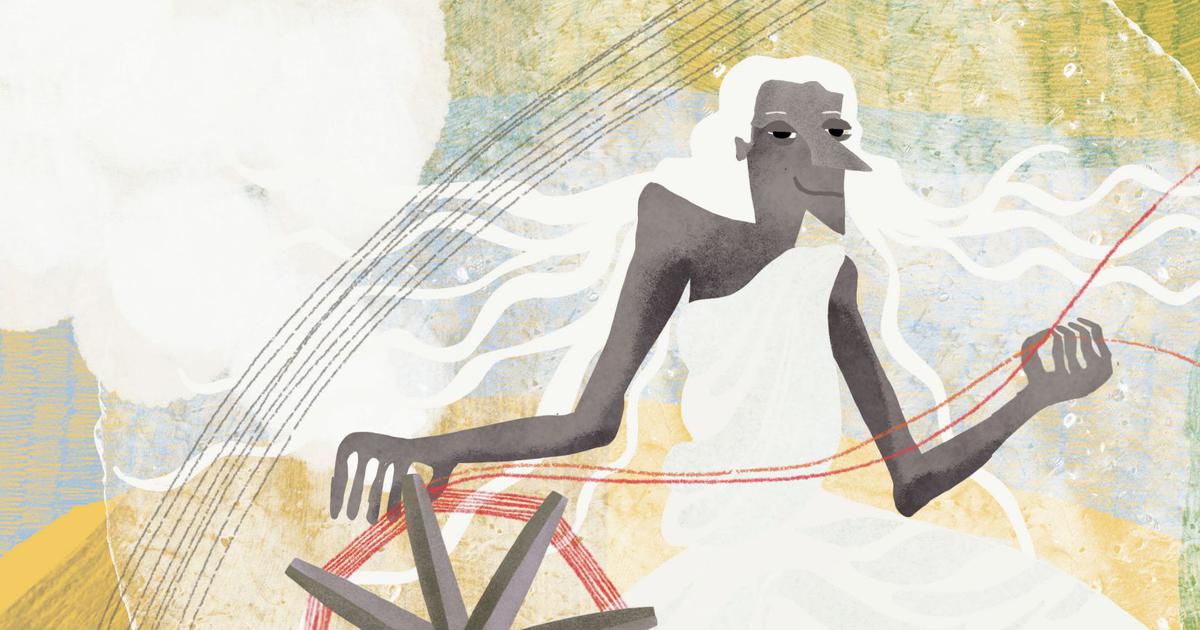
After some time, the sisters arrived in front of a spotless white house. An old lady sat at a spinning wheel in one corner of the courtyard. Threads were being woven together in a fraction of a second, and entire sarees were being made in the blink of an eye! Dukhu and Shukhu were the daughters of a weaver, yet they had never seen such quick and intricate work before. They stood gaping in amazement. A gentle breeze whispered in their ears that this woman was none other than the old lady on the moon – the one who sat there, spinning at her wheel all night and day!
“Is she not married?” Dukhu asked. “Does she have no one?”
Shukhu said, “Someone who can spin so skillfully and weave so beautifully is the queen of queens themselves! Did our mothers marry and find great happiness? Ever since our father died, their fate has been to weave towels all day long.”
The old lady smiled like the moonlight, brushing her milk-foam hair. Two little girls, sweet as grains of sugar, had come to her door looking for cotton and thread – one naive and gullible, one sharp as a tack. The old woman was greatly amused. She said, “Oh my moon-faced girls, come, come! There are towels in the next room. There is oil and soap, too. Clothes are kept there. Bathe yourselves and come. There is food in the other room. Eat well, and then I will give you your cotton and thread.”
Dukhu was true to her nature: She took a rag-like towel, used just a pinch of oil on her head, and as little soap as possible, wore the coarsest saree she could find, and ate a simple meal of fermented rice.
Shukhu, too, was true to her nature: She took generous helpings of oil and soap, wiped herself with the nicest towel she could find, wore the finest saree, and sat down for a five-course meal. “All these lovely things are available for free; why shouldn’t I enjoy them?” she thought.
The old lady was now well able to understand their characters. She laughed heartily. “Both of you need to learn a lesson,” she said. “Dukhu, why do you opt for the poorest options even when better things are available?”
Dukhu said, “Mother has taught me to be content with little. Girls are not supposed to be greedy, she says.”
The old woman said, “She’s wrong. And Shukhu, just because a lot is available, do you have to take all of it? Don’t you have any sense of proportion?”
Shukhu said, “Oh, but what if I never get the opportunity again?”
The old woman said, “You will get it for sure. If you deserve it, you will get it. Good work leads to good results, just as the spinning wheel spins to weave the thread!”
Then the two sisters said simultaneously, “You will teach us? Will you teach us? I want to cut thread like you! I want to weave sarees like you! I don’t want anything else.”
The old woman laughed and said, “Well, well! Did no one tell you what to ask for from me? Gold … jewels … husbands … did no one tell you?”
The two sisters said, “Make us the best of weavers. We will earn gold ourselves.”
The old woman of the moon said, “That’s right. The wealth that is found does not last, Shukhu. Wealth has to be earned. There is dignity in earning it. It lets one hold their head high, understand, Dukhu? One with her head high is a good girl, not a coward.”
Dukhu and Shukhu said, “Right, right!”
The old woman said, “All the girls who came before did not understand my words. Do you know how you understood them?”
Dukhu and Shukhu said, “How?”
The old woman said, “In friendship and love. A girl with a little bit of Shukhu and a little bit of Dukhu is a winner. You two are friends, aren’t you? That’s why you learned the lesson so easily.”
Dukhu and Shukhu hugged each other. Since then, Shukhu has learned to spin the wheel and Dukhu to weave the loom. They divided the vase’s gold in half and sent it to the two mothers on the back of the winged horse. Along with it, they sent a letter.
“We are doing well here.
Spinning, looms, and threads galore.
Chandburi’s life revolves around these.
Why should we need more?
Forget the quarrel, my dear mother,
Raise your head a little higher!
We’re learning knitting and learning life.
Learning to be a human, not a wife,
Different than before, we will be,
You’ll bless us so much, just wait and see!
This vase of coin is sent for you,
By your daughters,
Shukhu and Dukhu.”
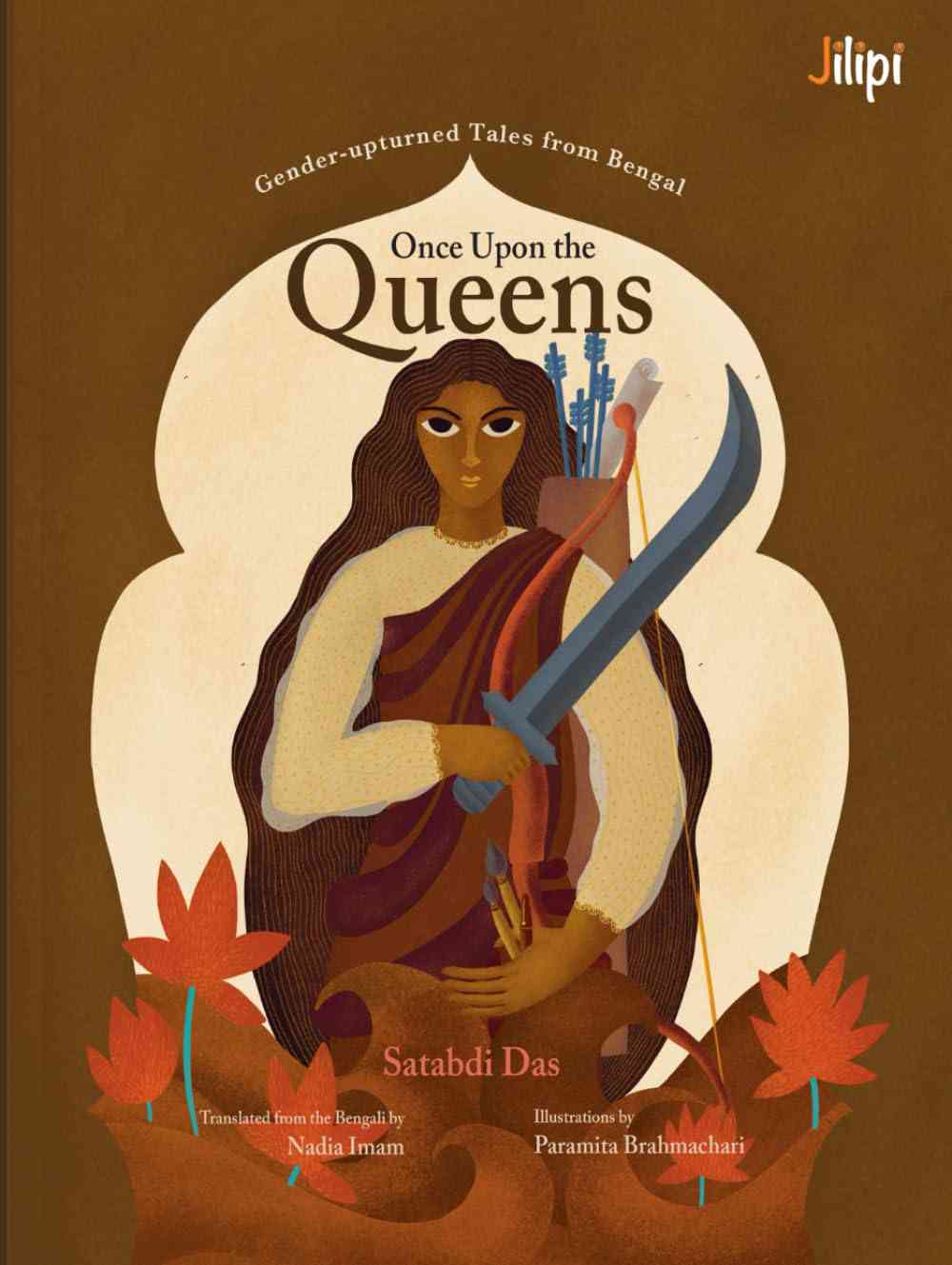
Excerpted with permission from ‘Shukhu and Dukhu’ in Once Upon the Queens: Gender Upturned Tales From Bengal, Satabdi Das, translated by Nadia Imam, illustrations by Paramita Brahmachari, Jilipi/The Antonym Collections.
