










No single learning strategy can be said to be the ultimate method of teaching. However, some strategies that adolescent students can use are: the SQ3R method, the Cornell method of making notes, and Mnemonics.
The SQ3R in its complete form is Survey, Question, Read, Recite and Review. Before starting any study, it is prudent to survey what one needs to read. The method is similar to having a rough map in mind before starting a venture. Question requires a rough estimate of questions related to the topic. The more questions you have about the topic the ready desire to seek answers to them. Read requires reading the text with understanding. In case illustrations, tables or any other visual adjuncts are given in the text then effort has to be made to go through them conscientiously. Children with LD, as mentioned earlier, tend to comprehend and remember better when visual aids are given. Recite requires repeating the read material periodically, especially the facts or text that are underlined as important. Going over the illustrated parts of the chapter several times would further reinforce learning.
Review requires going over to check what is really learnt. It is not to check what all remains to be done. It helps in mental revision and gives an idea to the teacher which are lesser remembered or comprehended portions. Such text may require clearer understanding and repetitions. Normally this should be done immediately after finishing a segment of the chalked-out material.
Cornell’s method of note taking focuses on the 5Rs – Record, Reduce, Recite, Reflect and Review. Record, is the usual taking down of notes while the teacher is teaching. Reduce, is to condense the facts so that they can be represented by a single word or cue. Recite, is repetition of what has been written down. Reflect, as the word suggests, requires reflecting on the subject so that it is mentally revised again and not forgotten due to disuse. Review, requires going through the notes before starting with the next section of text.
Mnemonics is an old method of giving a name to each alphabet, so that each letter is a cue to remembrance.
Attention Deficit and Hyperactive Disorder and AttentionDeficit Disorder are both associated with LD. As children with ADHD grow up, hyperactivity normally reduces but attention deficit remains which is termed as ADD. In ADHD and ADD the attention deficit is common which requires dealing with: a) distractibility; b) span sustainability; and c) ability to concentrate for the required task to be completed. But, in ADHD, the associated factor of hyperactivity has to be dealt with as well.
In case the child has been diagnosed with ADHD and the condition is moderate to severe, attention sustaining exercises are not very effectual. The first line of treatment would be psychopharmacological. Once hyperactivity is better controlled and the child can sit long enough to complete a task, then these activities are beneficial. The activities can be of the following types:
Colouring
Sorting tasks
Cutting and pasting
Collage
Cancellation exercises
Jigsaw puzzles
Computer games
Colouring and sorting exercises are designed for the younger age group, whereas the others are designed for the 8+ age group. There are two rationales on which these exercises are constructed, namely precision and interest. Precision work requires more attention than routine work. If a task is interesting and favoured by the child, there is far more chance of holding its interest and the task being completed. Hence the activities are created keeping both these aspects in mind.
Colouring tasks: This is a simple way to engage a child. One can use either an illustrated drawing book or one can draw a figure for the child to colour. Another convenient method is to draw a square covering three-quarters of the page and ask the child to colour it. The next day, on a fresh sheet, draw a line in the centre of the square and let it be coloured by two different colours. Third day increase the difficulty, by adding two lines thereby making three columns. Next day, put a cross inside the square making a quadrangle. In this way continue increasing the difficulty level. One needs to take care of time allotted to complete the task. Normally 10 minutes for older children and 15 minutes for younger children should suffice.
Sorting tasks: This is again a play method. All the toys are gathered. A concept is given according to which the child needs to sort the toys. For instance, if the concept is colour, and say red colour is given. The toys that are red in colour must be chosen by the child. This is a brief 2–5 minutes exercise, the time depending upon the age. Younger children are given more time. One can use playing cards, WWF cards, toys, blocks, coloured beads, miniature animals, plastic flowers, different sized coins, pictures of birds and animals. Any material can be used that holds the interest of the child. DO NOT use the same material repeatedly, because inattentive children tend to tire easily and become bored.
Cutting and pasting: First give a theme that interests the child, for example cricketers. Then help to select pictures of cricketers from old newspapers or magazines. Draw a square frame round the picture, to be cut along the line by the child. The pictures can be pasted in a scrapbook or chart paper. Besides attention, this task increases the dexterity of fingers.
Collage: These same pictures can also be used for making a collage.
Cancellation exercises: Old newspapers can be handy for this exercise. Mark a small paragraph, consisting of at least 10 lines. Give a vowel or a consonant to cancel. For example, if you have asked the child to cancel “m”, then all “m”s need to be cancelled in the selected paragraph. Please note the time taken for the child to complete the task. Then check for errors. There will be errors of omission (not cancelling the “m”), errors of commission (cancelling letters other than “m”). This exercise needs to be given every day, as it takes but a few minutes to complete. Change the letter every day.
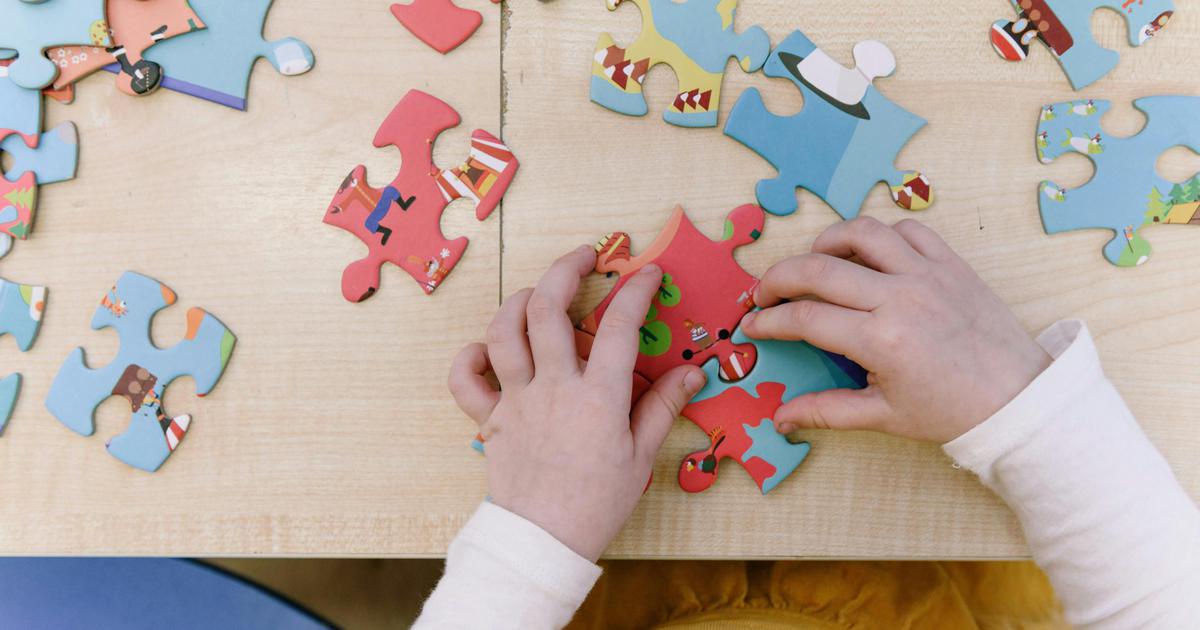
Jigsaw puzzles: Normally most children do have jigsaw puzzles. Joining the pieces correctly in a fixed time, helps to sustain attention. Since no school or home can have an unlimited supply of jigsaw puzzles, one method is to cut pictures from newspapers and magazines into various pieces. One can continue making new puzzles, and as complicated as possible, by increasing the number of pieces to join.
Computer memory games: There are innumerable memory games on computers. One game per day would help in both attention and memory functions. Time to complete the task and strict discipline to computer time must be maintained.
Excerpted with permission from Unlock Your Hidden Star: Guiding Children with Learning Disabilities, Vandana V Prakash, HarperCollins India.
