







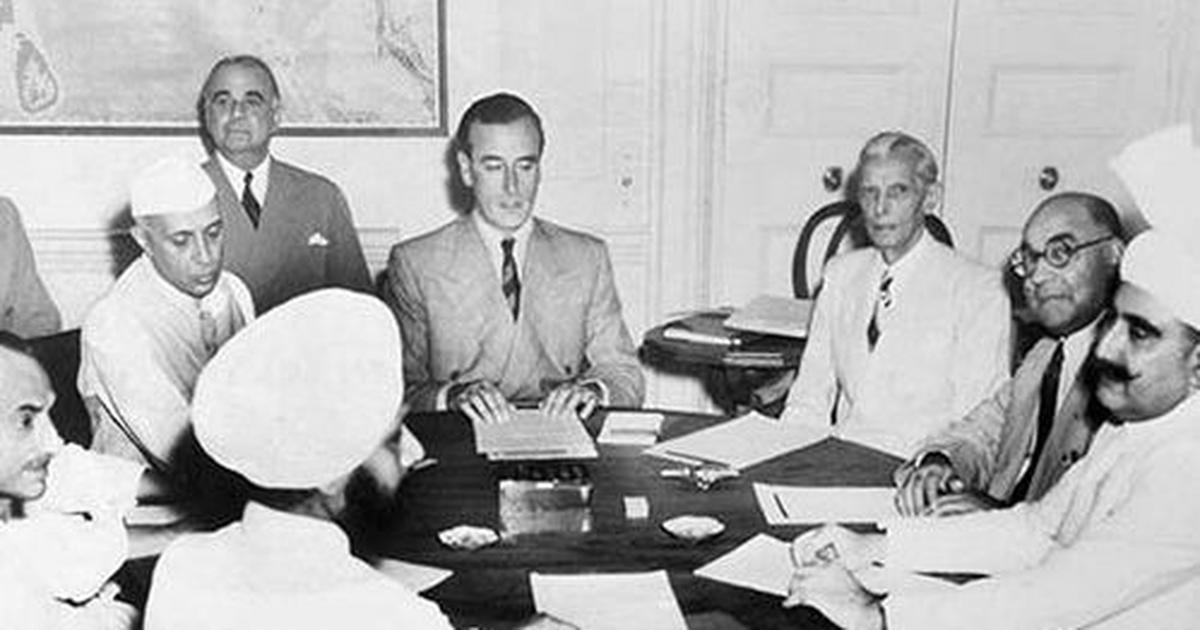
Would there be one India or two? Although press leaks and the lengthy negotiations had drained some suspense from the question, Indians from Calicut to Chittagong still gathered around their radio sets on the evening of June 3, 1947 to hear the verdict. At the offices of All-India Radio, employees crammed balconies and leaned out of windows as the viceregal motorcade rolled up outside. Nehru, Jinnah, and Baldev Singh followed Mountbatten into the building, harangued by a group of saffron-robed sadhus – Hindu ascetics – shouting anti-Pakistan slogans.? The viceroy had asked each of the Indian leaders to speak to the nation after him – to convince their followers to accept Partition and move forward.
Mountbatten had begun working on his own address within weeks of arriving in India, and he delivered it smoothly and with assurance. Baldev Singh signaled Sikh assent glumly but without quibbling; he still hoped that there would be a way to draw the border to keep the Sikh community intact.
Jinnah, by contrast, was disappointing. Like many others, Ismay found his address to be “egotistical and much below the level of events.” The Quaid noted that “the plan does not meet in some important respects our point of view.” He even refused to say whether the League would accept the scheme as a final settlement or only as a compromise that could later be adjusted.
Nehru’s short address was bittersweet but firm in its resolve to draw a line under the madness of the last year. There would at last be an independent India but one shorn of its northwestern and northeastern wings and tens of millions of its citizens:
It is with no joy in my heart that I commend these proposals to you, though I have no doubt in my mind that this is the right course… We stand on a watershed dividing the past from the future. Let us bury that past in so far as it is dead and forget all bitterness and recrimination.
Let there be moderation in speech and writing … There has been violence – shameful, degrading and revolting violence – in various parts of the country. This must end. We are determined to end it. We must make it clear that political ends are not to be achieved by methods of violence now or in the future.
Almost everywhere, the news had an initial calming effect. Over the next fortnight, provinces reported a palpable easing of tensions across most of the subcontinent. Rather than exploding into riots, cities like Bombay and Calcutta seemed to exhale in relief – their citizens glad finally to have clarity and a break from the ceaseless fear of preceding weeks. “A new feeling of hope and expectancy is] abroad,” Mountbatten wrote to the king on 5 June. For a moment, the viceroy could allow himself to believe that he had pulled off, as an excited Ismay put it, “a far bigger thing than the destruction of Hitler.”
One province, however, remained deeply unsettled: the Punjab. There, the Partition plan only delayed a reckoning. According to Mountbatten’s scheme, the 17 Muslim-majority districts in the western Punjab and 12 non-Muslim districts in the east were to vote separately on whether to join India or Pakistan; then, a Boundary Commission would determine exactly where the final border would run. While Tara Singh and other Sikh leaders seemed willing to await the commission’s verdict, they also vowed to resist any dividing line that did not ultimately extend India to the banks of the Chenab River in the west, leaving only a sliver of the province to Pakistan. “I am not a magician,” Mountbatten sighed when asked at a press conference how he planned to reconcile the Sikh and Muslim claims. “I believe that it is the Indians who have got to find out a solution. You cannot expect the British to solve all your problems.”
The militias that had been gathering in the Punjab for the past few weeks filled the resulting political vacuum. They met little resistance. “All governments, without exception, are stable only insofar as they can effectively reward and punish. In the Punjab, we began to lose this power in February 1947,” Governor Sir Evan Jenkins recalled many years later. “In June 1947, when it was made clear that we were to leave on 15th August of the same year, we became politically impotent.” Both Muslim and non-Muslim militants could count on sympathisers in the administration to pass them intelligence. Police and magistrates of the same religion reliably looked the other way. If arrested, fighters could be confident they would be freed after independence, if not before.
Local League, Congress, and Akali politicians were strongly suspected of encouraging, if not actually paying, the militants. Newspapers funded by Hindu tycoons spewed “insidious incitement to future violence,” according to the Punjab’s fortnightly report for the first half of June. Editorialists assured Sikhs of the Congress’s backing for their impossible demands. If the commission did not concede them, Lahore’s Tribune exhorted, the Punjab’s turbaned warriors could always fall back on a final appeal – the “appeal to cold steel.”
Day by day through the first half of June, the flickering war of shadows on the streets of Lahore and Amritsar began to burn brighter. There were no riots, no great, unruly mobs as there had been back in March. Instead, each night, those few foolish enough to venture outside their Hindu or Sikh or Muslim bastions simply ended up dead. Police would find limp corpses scattered about the next day, blood pooling around their bony limbs. After dark, arsonists skittered across rooftops in Lahore’s walled city, flinging kerosene-soaked balls of rags and shooting flaming arrows into Hindu homes or shops. (Although a minority in the city, Hindus owned more than three-quarters of the property; they provided the most tempting targets.)
Muslims conducted the vast majority of arson attacks. Jenkins had “no doubt whatever that the Muslim League approved, and in some degree directed, the burning,” he reported to Mountbatten.29 Firefighters wearing ancient tin helmets struggled to control the blazes in temperatures that rarely dropped below 100 degrees, even at night. Lahore had only two fire engines in all, and they proved next to useless in the spiderweb of tiny lanes that ran through the walled city. Hindus and Sikhs quickly lost faith in the authorities’ ability or willingness to protect them. They reinforced the metal gates and barricades blocking off their neighbourhoods and began stockpiling barrels of water to put out fires. Armed spotters took up positions on rooftops.
They also looked for ways to retaliate. By the middle of June, RSS bombmakers had finally started to master their craft. Beginning on June 10, crude bombs began exploding in crowds of Muslims – in a mosque, a cinema, a hospital. The devices were not particularly deadly, killing only fourteen people over ten days. But they injured over a hundred, and they terrified many more. With each outrage, the terrorists appeared to be getting more skilled. Just two bomb attacks on June 20 accounted for more than a third of the casualties.
The bombings enraged men like Billa Jatt – a Lahore Muslim goonda well-known to police for his brawling past. As his son recounted 60 years later to researcher Ishtiaq Ahmed, Jatt and his family had been driven out of the Hindu-dominated Shahalmi Gate neighbourhood during the March riots. The area had since become an RSS stronghold. According to rumour, Hindus and Sikhs were stockpiling guns, bombs, and ammunition behind their walls.
After the latest RSS bomb attack, a local Muslim magistrate came to Jatt with a plan to teach Shahalmi Gate’s Hindus a lesson. The goonda readily agreed to help. Just after midnight on June 21, a Saturday night, members of Jatt’s gang snuck past sentries posted at the Shahalmi Gate with two pippas, or drums, of a flammable solution used in shoemaking. They splashed the liquid across wooden shop fronts and homes, even on the barrels of water kept to fight fires. As the big clock at Lahore’s Government College struck 1 am, they lit torches. Wooden homes – dry from the monsoon-less summer – went up in a roar of flames. “Huge tongues of fire” were visible from miles away. Jatt’s son, who was watching next to his father, sneezed from the smell of chillies burning in local spice shops. Half a century later, the agonised screams of victims still chilled him.
A fire crew showed up, drawing water for their hoses from a nearby canal. But the Muslim magistrate who had masterminded the attack ordered the crew to turn their hoses around. “The result was that while it sounded as if the fire brigade was working full throttle, the water was flowing back into the canal,” Jatt’s son recalled. Over 250 homes burned to the ground over the next twelve hours. Ironically, the firefighters engaged in this charade while standing next to a small Hindu temple built years earlier by Nehru’s father, Motilal, whose wife had grown up in Lahore.
In Delhi, word of the fires reached Nehru just after he returned from a dispiriting visit to a refugee camp in Hardwar in the Himalayan foothills. Thousands of Punjabi Hindus and Sikhs displaced by the earlier riots in Rawalpindi had pressed in on him and Gandhi, “forming a solid wall of smelling, perspiring flesh which made one gasp for breath,” the Mahatma’s secretary recalled. Their misery weighed heavily on Nehru and blended in his mind with the piteous plight of Shahalmi Gate’s residents. Wild stories claimed that as Lahore’s Hindus rushed out of their burning homes, they were being gunned down by the police – who were predominantly Muslim – for breaking curfew.
Nehru held Jenkins’s administration responsible for failing to quell the League’s arson campaign, and he felt his own powerlessness keenly. Late on Sunday night, he penned a distraught, almost inconsolable note to Mountbatten. He had tried to stop himself, “but the thought of Lahore burning away obsessed me and I could not restrain myself,” Jawaharlal explained:
At this rate the city of Lahore will be just a heap of ashes in a few days’ time. The human aspect of this is appalling to contemplate. … I do not know if it can be said that what is happening in Lahore is beyond human control. It is certainly beyond the control of those who ought to control it. I do not know who is to blame and I do not want to blame anybody for it. But the fact remains that horror succeeds horror and we cannot put a stop to it. … Are we to be passive spectators while a great city ceases to exist and hundreds of thousands of its inhabitants are reduced to becoming homeless wanderers, or else to die in their narrow lanes?
Excerpted with permission from Midnight’s Furies: The Deadly Legacy of India’s Partition, Nisid Hajari, Penguin Random House.
